




How Orbán’s Media Project Brought Business to Világi and MKP Officials
Emese Ibos, Márk Finta (Napunk)
Illustration: ma7.sk 2026-10-05


Emese Ibos, Márk Finta (Napunk)
Illustration: ma7.sk 2026-10-05
While still in office, Hungarian Prime Minister Viktor Orbán and his government built up friendly media in neighboring countries. In Slovakia, million-euro subsidies from the Hungarian government’s Gábor Bethlen Fund gave rise to the Ma7 media group, which publishes in Hungarian. We looked into how its publisher — the Pro Media Foundation — spent the millions in subsidies it received from Orbán’s government. A low-profile company from a village near Galanta, run by former officials of the Party of the Hungarian Community (MKP) and also active in political campaigns, pocketed hundreds of thousands of euros. That’s what emerges from documents we obtained through a freedom of information request to the Hungarian fund, and analyzed along with the news site Napunk.
We arrived in one of the outlying parts of Horné Saliby, a village near Galanta in western Slovakia. On a quiet, tidy street, we checked house numbers. Nothing suggested that a company with revenues in the hundreds of thousands is based here. We found the right house at almost the very end of the street. Neither the doorbell nor the mailbox showed any name or company sign. Yet this is supposedly where H & K Plus is headquartered.
Even though the company’s registered business activities include advertising and marketing services, it doesn’t seem too concerned with promoting itself. We couldn’t find a website or contact details for it online. But that hasn’t stopped it from generating substantial revenue — largely thanks to money from Hungary and from the Party of the Hungarian Community. Between 2017 and 2026, the firm was one of the biggest suppliers to the Slovak-Hungarian media project Ma7, into which Viktor Orbán’s government poured more than €12 million from the Hungarian state treasury.
Based on the documents we have, a significant share of Ma7’s spending went toward the regular publication and distribution of a printed weekly. Distribution was handled by the same low-profile company run by former MKP officials. Experts we spoke with said these services may have been overpriced. What’s more, in recent years the company has also appeared in several election campaigns run by MKP and other Hungarian political groups in Slovakia, including their successor, the Alliance. Slovak law bans direct foreign financial support for political parties.
When we visited H & K Plus’s registered address in Horné Saliby in person, we found managing director Hajnalka Varga. She wasn’t inclined to talk much. The former organizational secretary of the Party of the Hungarian Community said she couldn’t tell us anything about the business relationship between Ma7’s publisher and her company, claiming she was bound by confidentiality.
A printing house in Oszkár Világi’s business portfolio also profited from the Ma7 project. Világi was photographed in Serbia this past summer in the company of former Hungarian Prime Minister Viktor Orbán after the prime minister’s electoral defeat. Not only is Világi a friend of Orbán’s, but, until recently, he was also the longtime director of Slovnaft, and he still holds senior positions at the Hungarian refiner MOL. Forbes magazine ranked him 20th on its 2025 list of Slovakia’s wealthiest people.
The Ma7 media group combines a Hungarian-language website with a printed weekly. It has faced questions since its founding. In the summer of 2017, József Menyhárt, then chairman of the Party of the Hungarian Community (MKP), announced that the party was working to build a Hungarian regional media network in Slovakia, and that the Hungarian government would provide the funding for it. A few days later, the Pro Media Foundation was established, and Budapest immediately granted it a subsidy of roughly €1.5 million (474.6 million forints). This made it one of the largest recipients of Hungarian state subsidies in Slovakia channeled through the Gábor Bethlen Fund (BGA). The fund is one of the vehicles the Hungarian government uses to send financial support to Hungarians abroad — an activity we reported on extensively several years ago in the international investigation “Hungarian Money, Orbán’s Control: Budapest secures influence with hundreds of millions of euros sent to Hungarians in neighboring countries.”
According to documents we obtained, the new Ma7 media house had, after just its first year, set for itself a goal of becoming the leader in the Slovak-Hungarian media market. In its most recent subsidy application, it claims to have achieved this — although publicly available data doesn’t back that up. According to figures from SimilarWeb, which tracks website traffic, for instance, Ma7 isn’t the leading Hungarian-language news site in Slovakia. The project’s sustainability is also questionable: the foundation’s revenue from its own products runs to only a few tens of thousands of euros a year, which wouldn’t even cover the cost of printing the Magyar7 weekly.
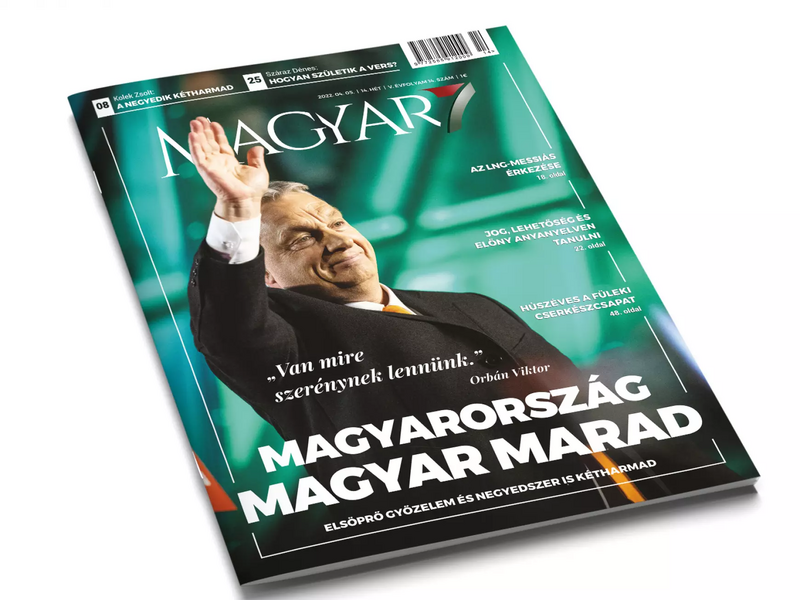
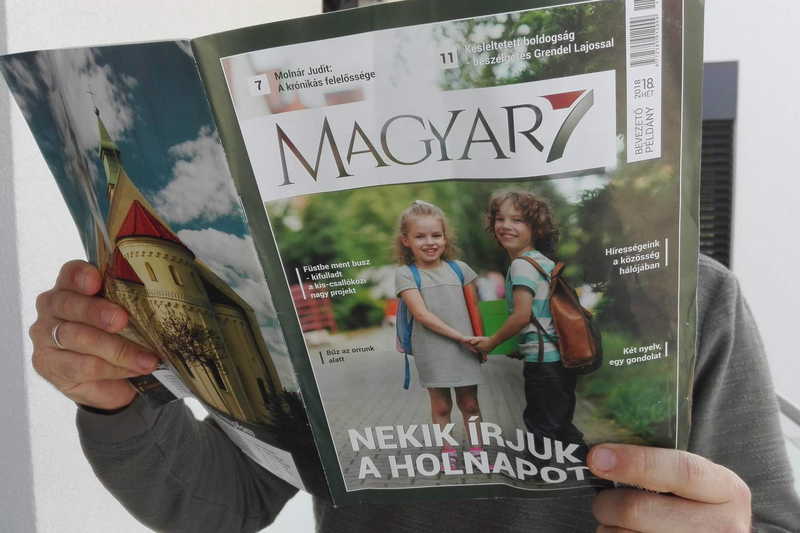
Front page of Ma7 magazine. Source: Ma7
What remains a fact, though, is that running Pro Media cost Hungarian taxpayers hundreds of millions of forints a year — money that was used to spread the messaging of the Fidesz party and Viktor Orbán’s former government. According to Beata Balogová, chief columnist at the daily SME, Ma7 “assisted Orbán’s propaganda machine in singling out universal enemies, even using identical terms and labels to those the former government centrally distributed to its media outlets.”
Although Ma7 isn’t part of the voluntary official media monitoring in Slovakia, Balogová points out that media influence can also be measured by how often other outlets cite its findings or reference its material. “My colleagues referenced Ma7 mainly when it published an interview with one of Orbán’s ministers — someone who wouldn’t talk to another outlet because they wouldn’t get the friendly, tailor-made questions there,” explains the former editor-in-chief of the opinion-shaping daily.
According to Gábor Polyák, a Hungarian expert on media law and policy, the Orbán government’s media funding served to shape a distorted public opinion, both at home and among Hungarian communities abroad. It amounted to a one-dimensional, very black-and-white picture. “For Hungarians living beyond the border, it was set up so that if Viktor Orbán is in power, Hungarians abroad will do well, and if he isn’t, things will be very bad for them,” he adds.
Even though the project has been running since 2018, the documentation we obtained under freedom of information law only included financial statements for 2018, 2019, 2021, and 2022. Transparent oversight is further complicated by the fact that a significant portion of the documents we received had been anonymized — including the names of suppliers and contractors. We managed to reconstruct many of them, but in this article we only publish those details that serve the public interest.
We requested written comment from the administrator of the Pro Media Foundation, representatives of H & K Plus, and the Hungarian ministry that oversees the BGA fund. None of them had responded to our questions by this article’s deadline.
Why Are we Writing About This?
Every year, Viktor Orbán’s government invested billions of forints in Hungarian communities in neighboring countries. Money from Hungarian taxpayers’ pockets flowed into Slovakia as well. For years, it wasn’t clear what criteria were used to award individual organizations subsidies worth millions of euros. This public money had the potential to significantly influence local communities and the Hungarian minorities’ political landscape abroad.
The lack of transparency in how grants were decided has been a major problem in recent years. When it isn’t clear what rules govern how money is allocated, who decides on its distribution, and who ultimately benefits, doubts inevitably arise over whether the funding was awarded fairly and in a way that serves the public interest. That’s exactly why it’s important to examine these financial flows, identify their recipients and political ties, and track what impact they may have had on the lives of Slovakia’s Hungarian minority.
The public has a right to know how the state oversees these projects, whether public funds are being spent responsibly, and whether adequate oversight mechanisms are in place. This question is even more important in the case of cross-border subsidies, since one country’s decisions and money can have a direct impact on communities and political life in another.
Last but not least, it’s worth noting that foreign financing of domestic political parties is banned by law in Slovakia. Questions had previously arisen over whether, in connection with Hungarian BGA subsidies, some of this money may have ended up funding MKP’s election campaigns.
The Company Run by MKP Officials Profited the Most
According to the documents we have, the biggest supplier to the Ma7 project since its founding has been a low-profile company from Horné Saliby, near Galanta. Its job was nationwide distribution of the Magyar7 weekly, newspaper sales, rental of advertising space, and marketing campaigns. One of the company’s directors confirmed to us that that partnership continues to this day
H & K Plus has no public-facing output at all, yet it has generated revenue in the hundreds of thousands of euros since it was founded — which was right around the time the Magyar7 website and weekly launched in 2018.
Behind the company are Hajnalka Varga and Katalin Kajos, both former officials of the Party of the Hungarian Community. Varga was the organizational secretary at MKP’s headquarters; her name last appeared on the party’s website around 2020. Kajos, at the same time, was the party’s regional secretary for the Galanta district. So both women were, at one point, active within the party while simultaneously serving as suppliers to the Ma7 project. Katalin Kajos’s email address has also appeared in recent years on the financial statements of the Pro Media Foundation, which oversees the Ma7 project.
Even though the company generated close to €400,000 in annual revenue in some years, its profit in its best years was only around €15,000. Our analysis shows that H & K Plus drew a substantial share of its income from the Pro Media Foundation.
According to detailed financial statements we have obtained, in 2021 alone Pro Media Foundation paid the company more than €217,000 — over 95 percent of its revenue for that year.
Beyond that, Hajnalka Varga and Katalin Kajos also appeared in the Ma7 project as private individuals, performing administrative services for the Pro Media Foundation. We asked the foundation’s administrator whether these were in fact the same people who run H & K Plus, but received no response. Varga herself couldn’t say whether Pro Media had paid her personally, saying she didn’t remember. “I can’t tell you — I’d have to check,” she said.
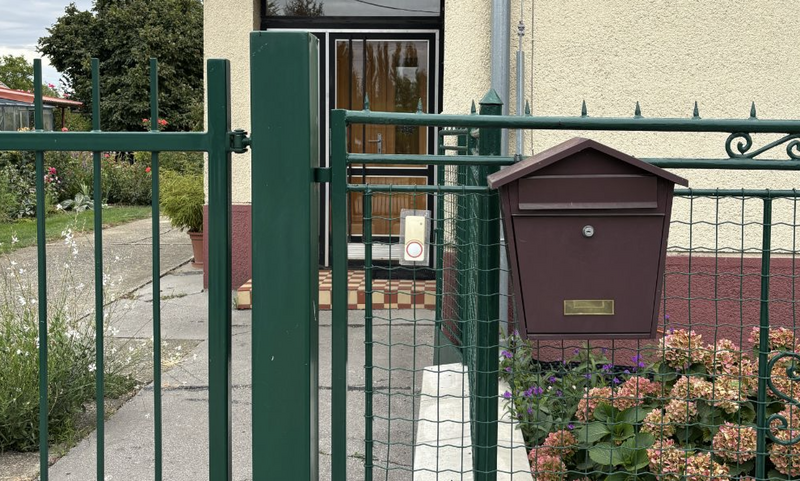
Nothing here suggests that a company with revenue in the hundreds of thousands is based in this house. We couldn’t even find the company’s name on the mailbox. Source: ICJK
The company’s other owner, Kajos, admitted in a phone interview that the firm has no website and that it gets work through personal contacts. She described the company’s work as brokering services. We also sent her written questions about the company’s activities and its cooperation with Ma7. She had not responded by our deadline.
Campaign Work for Hungarian Parties
Besides the Pro Media Foundation, H & K Plus has in the past also taken on work from the Party of the Hungarian Community, which now operates under the name Hungarian Alliance. H & K Plus also provided services for Krisztián Forró’s presidential campaign. Four years ago, during the local elections, the company was paid more than €50,000. In the most recent parliamentary elections, it received nearly €167,000. Around that time, Napunk also flagged a problematic telephone campaign run by the Alliance party, which may likewise have been the work of the Horné Saliby company.
In the campaign already underway for this year’s local elections, the Horné Saliby company has again turned up on the Alliance’s transparent account. In Slovakia, during an election campaign, political parties must manage their campaign-related expenditure via a transparent bank account, which means that every transaction and its details must be publicly visible. A large share of the party’s spending so far has gone to H & K Plus — more than €56,000 in total.
According to election monitoring data from Transparency International Slovensko, H & K Plus has now earned more than €415,000 from MKP-related campaigns. We wanted to know whether the Alliance party sees this kind of arrangement with former party officials as problematic. According to the party, selecting the company for the current campaign involved requesting three price quotes. “The fact that the owners of a business previously held positions within the party does not in itself constitute a conflict of interest,” said Klára Magdeme, spokesperson for the Hungarian Alliance. She added that these individuals do not take part in the party’s decision making processes that could influence the selection of their own company or the signing of a contract.
Printed at Világi’s Printing Houses
Printing the Magyar7 weekly as part of the Ma7 project — funded by subsidies from Orbán’s government — required substantial money over the years that the project has existed. Printing and distribution costs accounted for line items in the hundreds of thousands within the annual budget. According to documents obtained from the Gábor Bethlen Fund, the foundation used the services of the joint-stock company ADC Media — a printing business from the portfolio of Oszkár Világi’s family — from 2018 to 2023. Világi himself was listed in official records as the company’s ultimate beneficial owner. In recent years, Imrich Tomasek has also appeared at the company; he’s one of the directors of Torreol, a firm belonging to Slovak business magnate Ján Sabol, whose ownership structure recently came to include MOL chief Zsolt Hernádi as well.
The Magyar7 weekly is printed in a run of 8,000 copies. According to the project’s own documentation, it’s “primarily based on a subscription model,” though it’s also sold in stores. The documentation also claimed that after just the first year, the number of subscribers stood at between 3,000 and 3,500. Pro Media cited the identical figure in its annual report — though this figure cannot be verified against any independent source.
What is a fact, however, is that after several years of “stagnation” at a declared 4,500 to 5,000 subscribers, that number dropped sharply in 2025 to somewhere between 1,300 and 1,500. Despite this, in its most recent funding application, Pro Media still claimed that “most of the 8,000 printed copies are distributed to subscribers.” According to the documents we reviewed, printing the weekly cost between €144,000 and €228,000 a year.
Since printing and distribution costs — alongside staff salaries — represent Ma7’s biggest expense items, we looked closely at this area. We held informal conversations with several people who have spent years working as advertising and marketing professionals, or who currently work in print distribution. We asked people who have worked or currently work in the distribution or publishing of publications comparable to Magyar7 in terms of print run size and distribution scope.
Several factors affect printing costs — size, number of pages, and whether pages are bound or glued, as well as the world market price of paper, among other things.
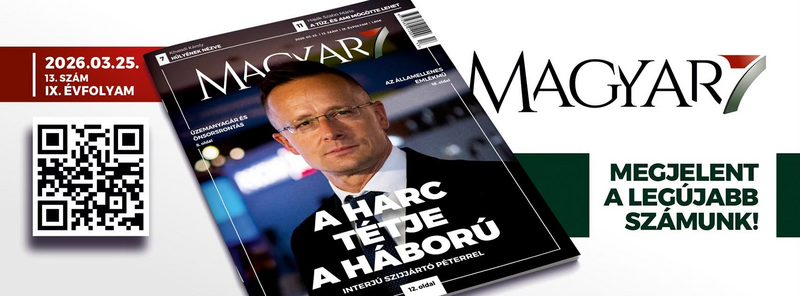
Former Hungarian Foreign Minister Péter Szijjártó on the cover of Magyar7. Source: Facebook/ma7
Our sources also pointed out that the market functioned very differently before 2020, and that the COVID-19 pandemic drove up prices. Prices on world markets typically fluctuated much more sharply during that period, which led to a steep rise in printing costs. At the same time, COVID-19 significantly affected the purchase of printed newspapers: starting in 2021, many services shifted online, and more and more people switched to online subscriptions.
According to our sources, four to five printing houses operating in western Slovakia would be capable of regularly printing the Magyar7 weekly. Suitable printers are located in Komárno and in Bratislava. Based on a current price quote reflecting the parameters described above, printing 8,000 copies would cost around €3,760.
Overpriced Distribution?
While preparing this article, we reached out to several experts in advertising, marketing, and print distribution. The experts we spoke with considered the printing costs listed in Pro Media’s financial statements to be realistic. The invoiced distribution costs, however, are another matter — the experts consider these disproportionately high, and say they may reflect markups several times over. According to our sources with experience in this industry, the costs invoiced for distributing the Magyar7 weekly are unreasonably high and may point to significant overpricing.
Katalin Kajos, co-owner of H & K Plus, confirmed in a phone interview that Magyar7 magazine is indeed distributed by the Slovak postal service. According to Slovenská pošta’s publicly available price list, delivery costs are affected by the number of copies and the weight of the publication. Final prices, however, are also set according to individual customer needs and quotes.
H & K Plus issued its first invoice in May 2018, for nearly €15,000. Another invoice with the same date followed, for €27,000, for newspaper distribution. At the end of the month, the company invoiced another €16,500 for the same purpose. In May 2018 alone, then, Pro Media transferred more than €58,000 to H & K Plus.
Surprisingly high amounts were billed for distributing the weekly in its first year, even though, at that point, there was not yet any talk of several thousands of subscribers. The documents we requested from the Gábor Bethlen Fund don’t make clear how H & K Plus went about acquiring subscribers.
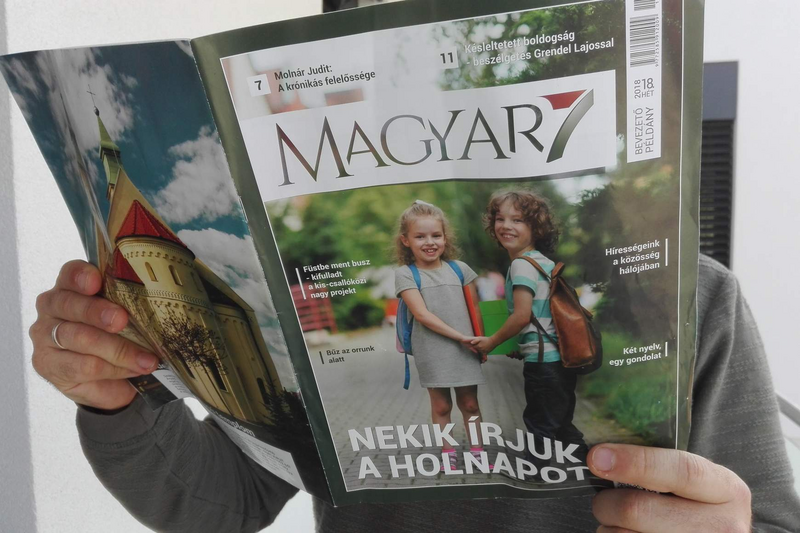
The first issue of the Magyar7 weekly. Source: ma7.sk
Under the commission agreement that Pro Media signed with H & K Plus, the company is responsible for selling Magyar7, finding subscribers and carrying out activities aimed at acquiring them, concluding sales contracts, and ensuring and delivering the goods. For each copy distributed, the company was to receive 55 cents.
Since sales of Magyar7 magazine are not officially measured, there’s no way to verify how many copies have actually been sold over the years. As a result, it’s genuinely impossible to estimate what level of sales and subscriber acquisition actually lies behind the sums paid out to H & K Plus.
It’s possible that some issues were distributed without an addressee’s name in municipalities with a predominantly Hungarian population. Many companies offer this kind of service today, including the post office, and it’s always cheaper than delivery addressed to a specific name. Under the current price list, this service would fall under the category of unaddressed distribution of flyers and advertising materials. Here too, the price depends on the weight of the material and the number of copies, but at an average price of 20 cents, monthly distribution could cost €6,400 — roughly €76,000 a year.
According to the foundation’s final report for 2018, the Magyar7 weekly had 3,000 to 3,500 subscribers. Under the post office’s current price list, distributing the paper four times a month to 3,500 subscribers would cost €4,620.
Despite this, in 2019 Pro Media paid as much as €18,480 in some months for distributing Magyar7, and in another instance, as much as €26,796 for distributing four issues.
While reviewing the documents we obtained from the Gábor Bethlen Fund, we also noticed that in 2019 Pro Media Foundation paid H & K Plus for a billboard campaign in three separate line items — €2,496, €9,016, and €9,240 — totaling nearly €21,000.
According to copies of invoices we obtained, in October H & K Plus billed just over €9,000 for printing and renting 22 billboards, as well as renting 2 “bigboards” and 11 citylights. A month later, though, the cost of printing and renting 52 billboards, 2 bigboards, and 5 citylights came to only €9,240.
A Loudspeaker for Orbán’s Government, with Ties to MKP
We also managed to obtain the very first subsidy application that Orbán’s government received for running the Hungarian-language Ma7 media group. In it, the Pro Media Foundation’s administrator laid out its goals across three pages and directly requested funding of 474.6 million forints. It went on to receive subsidies worth millions every year after that — until 2026, the year Viktor Orbán lost the election to Péter Magyar’s Tisza party.
According to a study by Transparency International, “by Slovak standards, these are exceptional levels of financial subsidy.” The analysis also warns that such subsidies distort conditions in the Slovak media market.
Gábor Polyák, the Hungarian media expert, also notes that financial support for media outlets is a form of corruption that is extremely difficult to track. “How much money is needed to run a media outlet, how much a journalist or a manager costs, what consulting contracts and deals are hiding in the background — that’s a very simple and easily defensible path to corruption,” the researcher warns. He adds that it also served as a tool of corruption through which Fidesz could finance a pro-Fidesz elite abroad.
The need to establish the Ma7 media group in 2018 was justified on the grounds that it would contribute to pluralism among Hungarian media in Slovakia and would be able to present national-conservative values — reaching Slovakia’s Hungarian community through a wide range of content, across multiple platforms, in a modern format.
The very fact that József Menyhárt, then chairman of the Party of the Hungarian Community, announced in 2017 that the funding needed to launch the project would be coming from the Hungarian government raised questions about the group’s political independence. “The goal was certainly not to create a party-affiliated media outlet, but rather a modern, broad-based new media body that would present a national-conservative value system and be accessible to everyone,” Menyhárt told us.
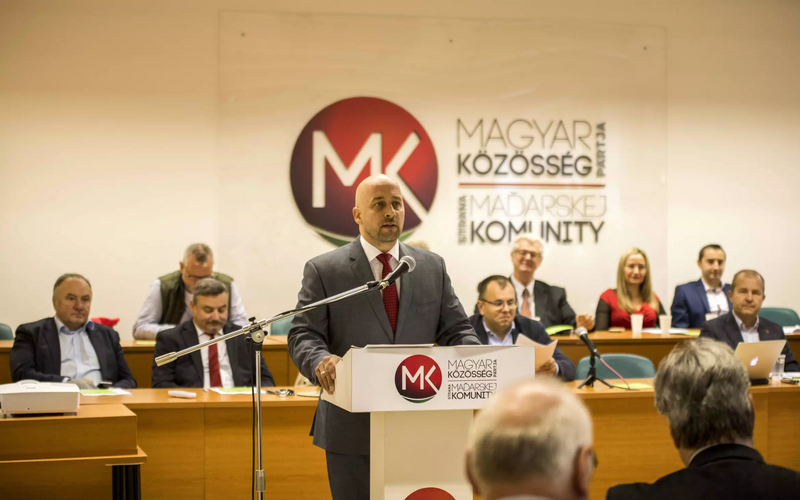
József Menyhárt, former MKP chairman (center). Source: Facebook
He did acknowledge, though, that the party played some role in getting the funding to the foundation. “At the time, they consulted me, as a strategic partner, on certain questions of national policy. When the need arose for the Hungarian minority in southern Slovakia to have this kind of voice in the media space, and when this idea was presented to me, I backed it. To this day, I’m convinced it was the right path,” he says.
Weak Oversight
Through a Hungarian freedom of information request, we tried to obtain the complete documentation of the Pro Media project from the Gábor Bethlen Fund, covering the period from 2017 to the present. The documents included account statements as well as final reports on the operation of a media outlet that significantly amplified Viktor Orbán’s government’s voice in southern Slovakia. A substantial portion of the data, however, had been anonymized, including the names of suppliers and contractors — which prevents effective oversight of these projects. It’s also unclear why the Gábor Bethlen Fund took this approach.
Another problem is that the final financial statements we received only covered 2018, 2019, 2021, and 2022. According to the BGA fund, the final reports for 2020, 2023, 2024, and 2025 were never approved. As a result, we only have an accurate picture of how Pro Media operated in its early years.
It wasn’t clear from the fund’s response why these final reports — covering how millions of forints in Hungarian taxpayer money were spent — were never approved. We also wanted to know what conditions an applicant had to meet to receive further funding, even in cases where its project financial statements were not approved.
We put these questions directly to the Gábor Bethlen Fund, but it turned out that the fund’s administrator isn’t authorized to answer questions from journalists. We therefore turned to the Hungarian Ministry for Social Relations and Culture, which oversees the fund. We did not receive a response by this article’s deadline.
The new government, led by Péter Magyar, is paying particular attention to the subsidies that flowed through BGA, and a review of past subsidies is now underway. As we previously noted as part of our Hungarian Money project, the transparency of grant decisions during Viktor Orbán’s government was, to put it mildly, questionable. There was no single, easily searchable public database providing clear information about projects funded with Hungarian taxpayers’ money. And while there were public calls for small grants that anyone could apply for, the criteria used to decide on large sums were never disclosed.
This investigation was originally published in Slovak on ICJK.sk.
Subscribe to Goulash, our original VSquare newsletter that delivers the best investigative journalism from Central Europe straight to your inbox!

Karin Kőváry Sólymos is a Slovak journalist at the Investigative Center of Ján Kuciak. Previously, she was an editor and presenter at the Hungarian channel of the Slovak public service media. During her university years, she was an analyst for the only fact-checking portal in Slovakia. She was a recipient of the Novinarska Cena 2022.