




“The Kremlin is Very Worried” – Interview with Estonian Foreign Intelligence’s Top Analyst
Illustration: Shutterstock 2026-01-20


Illustration: Shutterstock 2026-01-20
For the past five years, Andres Vosman was responsible for analyzing intelligence on Russia at Estonia’s Foreign Intelligence Service (EFIS), until his appointment as ambassador to Israel in August. He gave his first comprehensive interview to Estonian investigative journalist Holger Roonemaa. The interview took place just days before the US raid in Venezuela.
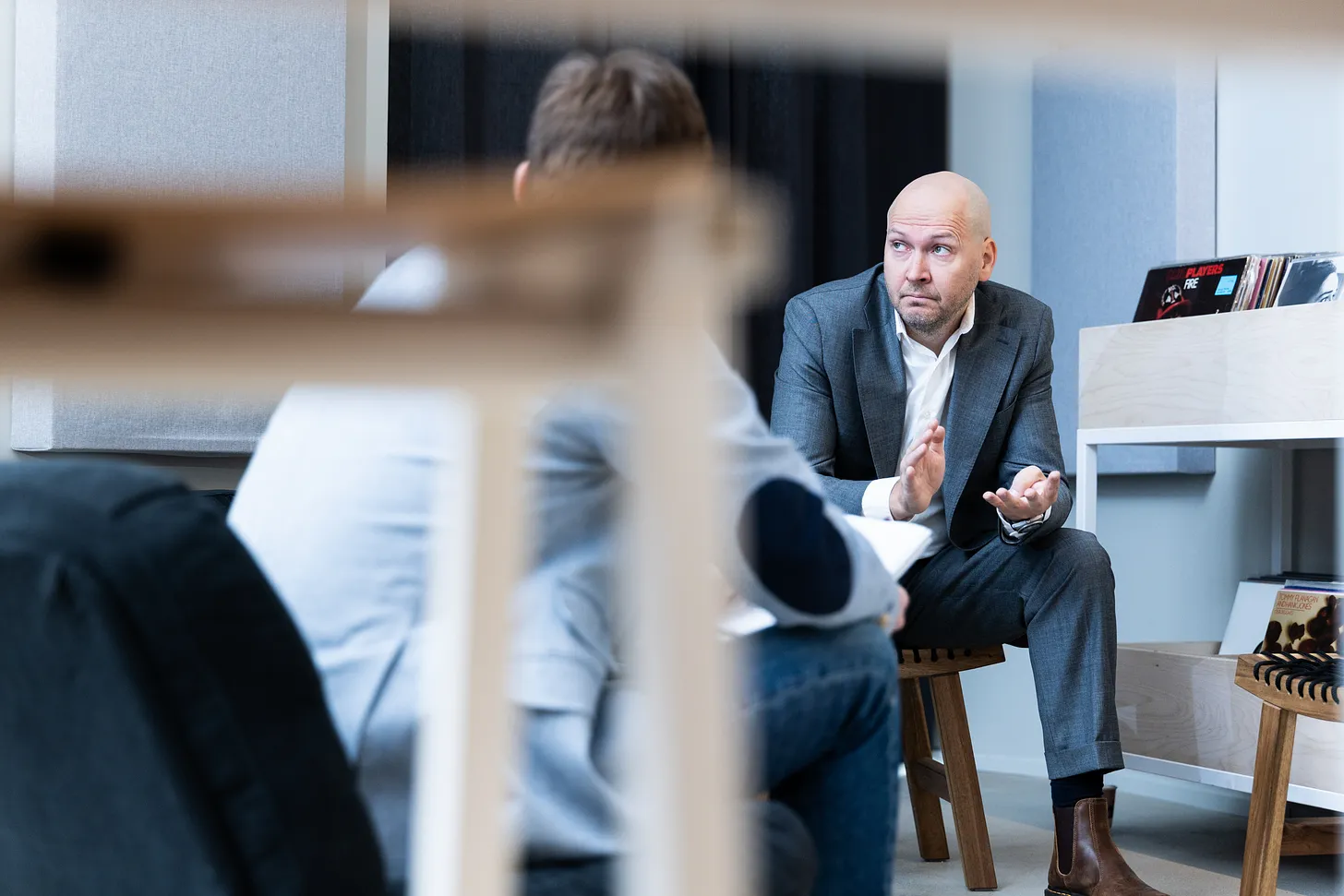
Andres Vosman. Photo: Priit Simson / Delfi Meedia
Let’s start with a trivia question. Faith, hope, love, peace, anxiety, or victory? Which of these words best characterizes the emotional world of Russian society?
One can probably find matches for all keywords, but I think the word ‘anxiety’ characterizes it most generally. Russian people are increasingly asking where is this much and long promised victory. They probably see difficulties related to their subsistence and many are worried about the future. But there are many words characterizing Russian society that were not in your list: indifference, switching off, brainwashing.
I am glad that I am interviewing the right person. Readers of the bookstore “Читай-город” (Chitai-gorod) overwhelmingly chose “anxiety” as the Russian word of the year. How can anxiety express itself in such a closed and repressive society?
For the majority, it expresses itself in dealing with other things. They don’t think big or socially. It certainly expresses itself in self-censorship. In many ways, Russia has long been back in the Soviet era. The only question is whether it is the year 1937 or 1984, meaning whether it will get even worse or if the bottom has been reached and perestroika will come.
I do not predict perestroika in the near future today. At the same time, all pivotal events in Russia have occurred with a short fuse. Working in intelligence and making forecasts has made me very cautious, and especially regarding Russia, I wouldn’t make long forecasts, but no ray of optimism shines there. Brains have left, people are full of violence. They are willing to turn a blind eye to whatever evil.
The hope is that if at one moment Russian people have to choose between the television and the refrigerator, the refrigerator will win. If there is nothing left in the refrigerator, people might suddenly come to the streets and that is the end of this regime. I certainly hope for Putin’s end. Whoever comes after him, a time of confusion will follow. Russia’s attention will certainly be on internal problems for some time, and this is not pleasant for any dictatorship. There will certainly not be any natural selection where someone simply takes over Putin’s place.
How does the Kremlin itself understand this and how much does Putin’s gang monitor what is happening in society?
The Kremlin monitors societal processes and moods very keenly. It micromanages what happens in Russia at the most local level. The Kremlin receives real-time overviews of what is happening in local municipalities, settlements. Every dictatorship is worried about losing control and therefore uses surveillance methods.
We know that the Kremlin is very worried about how to mitigate potential tensions with likely radicalized or disappointed men returning from the war. The Kremlin and FSB monitor these developments very keenly, including all sorts of religious movements, for example neo-paganism. Russia cannot control such things like it controls the Orthodox Church. Russia lacks the capacity to deal with such fundamental problems. Hundreds of thousands of men will come demanding prostheses, demanding hero status, maybe sweet positions. A separate topic is the proliferation of weapons after the war.
With mental disorders…
All that alcoholism, PTSD – Russia simply is not ready to deal with this. We see what the level of Russian healthcare is. Thus I forecast that the end of the war will be difficult for Russia.
So the end of the war and the possible gradual lifting of sanctions would not mean a certain liberation for Russia?
It might create short-term euphoria for a moment. Maybe the economy even goes up a few percent. But this of course depends on the details, to what extent sanctions go off and on what conditions the war ends. In the long run, Russia faces fundamental problems, primarily related to the economy.
You mentioned impoverishment. Such a word is not really used about the conditions prevailing in Russia so far. Rather, the conventional wisdom says that sanctions have not had a visible impact on the ordinary person’s life. True, over the last half year there have been more danger signs hanging over the Russian economy, but not impoverishment.
The ordinary person’s income is largely at the same level as it was around the year 2010. This means 15 years of stagnation. But let’s look at the future. What are Russia’s perspectives? Essentially, it is increasingly an economy under China’s control, a raw material warehouse. They have oil, gas, rare earth metals and other metals, but Russia cannot produce anything [meaningful] itself or create new quality. If we leave the war industry aside, then how to cope in the competition of international economy, where keywords are AI, smart technologies, international interaction on scientific level? In this big game, Russia has moved backward a lot in recent years. I don’t see that anything would get better for Russia. Oil price forecasts are rather downward. Their liquid reserves are essentially out.
Which of those same nominees for Russia’s word of the year characterizes Estonian society the most?
I think anxiety as well. It is persistent. It is inherent to us, we are a small nation and live next to a serial killer neighbor. Maybe it is also a force motivating us to act. But on the other hand, it is also a factor eating our confidence and exhausting us.
How often do your friends ask you when will the war start?
Very often. It happens a lot and I am depressed that there is so much of this anxiety. I am also anxious about Ukraine and at times depressed by the news, but regarding our own security we could be significantly more confident. This doesn’t mean that everything is fine and the end of history has arrived. Putin’s Russia needs constant monitoring, we must constantly validate our assumptions. But the “is Narva next” questions are indeed frustrating.
What do you tell your friends who ask when the war starts?
A conventional war against Estonia is not very likely in the near future for various reasons. But we must prepare for it, because we live next to a sick and by nature aggressive state.
What makes you think so?
First, everything I know about Russia’s thinking, Russia’s vision of the world, Russia’s intent, and war against the Baltics does not figure there. I do not know that there is currently or has been in recent years an intent to militarily attack the Baltics. We are in NATO. NATO, last I checked, is still operating. Russia takes Article 5 seriously.
We see every day how Russia actually very consciously calibrates how far it goes with certain things. For example, if we take the ongoing sabotage campaign. Certain things are sort of okay for Russia, but certain things are not.
What for example is not okay regarding sabotage?
Terror attacks with large civilian casualties. For example against passenger planes, which sort of was on the table. When Western intelligence found out about this and escalated it to the political level, this thing was put on hold [in the Kremlin], because it was understood that this is playing with fire.
Here is also a paradox. General top-down orders are characteristic of the Russian system and then some officials with lower than average IQ carry out these orders and sometimes improvise in hopes of doing favors for the Czar. Due to which mistakes can happen and this is dangerous. With Russia one must always be on guard.
The biggest danger for us is a miscalculation in Moscow. As is known, they also miscalculated in Ukraine, although Putin has wanted Ukraine back from day one. Estonia does not belong to the so-called Russian world (Russki mir). We are not part of this core Russia for Putin or his inner circle like Ukraine or Belarus are. Russia currently lacks the intention to occupy part of the Baltics, but this may change in time. So I always emphasize the temporal definition, because it is also the task of intelligence to check and validate these assumptions every day.
The second reason is our NATO membership and thirdly the Ukraine war, which is a limiting factor for Russia. Russia has completely tied itself militarily to the Ukraine direction. Even when the war ends, a considerable part of the Russian army will likely remain tied to Ukraine. So any military attack involving many risks against NATO, for example in the Baltics, would likely force Russia to free up very large resources from elsewhere. It is not like the Pskov 76th Air Assault division will get an order and it’s done. There are very many things that can go wrong.
At the same time, throughout the last year we have read and heard countless claims to the contrary from Europe, Ukraine, and even the U.S. Chancellor Merz talks about how Putin’s goal is to restore the Soviet Union. Budanov says that Putin will not stop with Ukraine and so on. Again, different experts have started putting a year number on when Russia will attack or be ready to attack the Baltics.
Often what Western intelligence says about Russia’s capability relies on the assumption that the war with Ukraine will end and Russia achieves its goals there. Russia has so far not achieved any of its major goals in Ukraine. So these are hypothetical scenarios, but primarily in terms of forecasting capability. Often no distinction is made between intent and capability.
Indeed there have been different statements in the media, but it is not my business to comment on them. I know that Estonian intelligence assessments of the Russian threat do not differ from the assessments of our most capable intelligence partners.
Regarding the statements of Ukrainian intelligence leaders about the Baltics not only this year, but also earlier, these are largely caused by the desire to create an attitude of certain urgency or acuteness in the West, which would make them deal with Russia more forcefully. So we are a bit like collateral damage.
The statements of Western politicians and intelligence services are often related to addressing domestic audiences. For example in the case of Germany, with the desire to create some resonance in society for example to increase defense spending. The Baltics is a convenient example to use. The media is also to blame, which amplifies and sometimes takes things out of context to create a shinier headline.
On the last day of 2025, another ship carrying Russian cargo cut the undersea cables between Estonia and Finland. Estonian security agencies have held the position that all these incidents have not been organized by Russian intelligence. Why do you assess so?
One should ask the security agencies, but I will say this much, that it is likely in Russia’s interests to keep the Baltic Sea as problem-free and navigable as possible, since their export, as well as connections with Kaliningrad, depend on the stability of the Baltic Sea.
Every such incident brings new calls for restrictive actions regarding the shadow and other fleets, NATO missions, sanctions. Looking strategically, Moscow doesn’t need this mess. At the same time, bardakk (disorder/mess) also characterizes Russia, due to which one cannot always rule out a situation where one hand doesn’t know what the other is doing.
My strong assessment is that predominantly the Baltic Sea incidents of recent years have been caused by a coincidence of circumstances – significantly larger shipping traffic in the Russian direction, vessels in poor condition and crews with low professionalism, more underwater infrastructure than before, greater public attention. Broken anchor devices cut underwater cables in stormy conditions earlier as well, but these incidents weren’t talked about. At the same time, the longer the West collectively allows the shadow fleet to rally on the Baltic Sea, the more likely it is only a question of time when the next thing happens.
There has recently been a lot of talk about Europe and NATO needing to start paying Russia back regarding sabotage and take counter-activities to Russian territory. Most recently, for example, the head of the NATO Military Committee Giuseppe Dragone presented such a line of thought. Is this a realistic plan?
This is talking about something that should be obvious. Why talk about it at all. If Russia is in a so-called hybrid war against us, then it seems reasonable to stand against it. One part of standing against it is also offensive activity.
Maybe these statements are also part of this same search for confidence that the US reproaches us for?
Agreed. After all, a large part of Europe continues to live in the hope that these problems will just disappear. I subscribe to America’s reprimanding attitude towards Europe, especially regarding defense spending.
Why don’t we have this confidence in Estonia?
This stems from our smallness and history, but is clearly also linked to international developments on the other side of the ocean, which has made people more anxious. Being now in Israel, which is one of the most self-confident societies of all, I think that without it, it is hard to survive. You have to believe in yourself, in your friends, and be ready to act.
But Europe is not small neither geographically nor in terms of population. 450 million people live in the EU. The economy is many times larger than Russia’s. What explains the lack of confidence in Estonian society cannot explain the same in Europe.
From our view the situation is not perfect. Europe often does not speak with one voice. This cacophony is written into EU’s architecture. Unfortunately there are also member states who work against it. But let’s rewind ourselves back to February 2022. Would anyone have predicted that now four years later we are working out the 20th sanctions package, tightening the screw all the time? Yes, in our assessment things take too long and are at times full of exceptions and gaps, but in the big picture relative unanimity and readiness to support Ukraine prevail.
In the Russian word of the year competition, договорнячок (dogovornyachok) was also put to a vote. Put into an endearing-sarcastic form, that term roughly translates as a secret agreement, a reference to negotiations going on through US mediation. Why is Russian society so sarcastic regarding these negotiations?
Sarcasm is inherent to Russian society in general. It comes from the Soviet time, that one cannot believe everything the mass media says. I think that currently the attitude is simply widespread that one cannot actually negotiate with the West, one cannot trust the West. Therefore they are skeptical regarding all sorts of agreements. The West is conversely just as skeptical [towards Russia].
How would you analyze the current negotiations?
It is hard for me to comment because I don’t know the latest status, but it seems a kind of round game is going on. We have already been in this place before, where through the words of the US president it was said that a breakthrough is expected any moment. We have also heard before that Putin wants peace. In actions we do not see this in any way. I am skeptical regarding any significant breakthrough in the coming months. At the same time the situation for Ukraine could also be much worse, so the glass is simultaneously half full and half empty.
The Wall Street Journal published recently how it was Putin who lured Steve Witkoff to be the US chief negotiator and that this chain went through Saudi Arabia. Why did the Kremlin need specifically a man like Witkoff to negotiate and not for example Secretary of State Marco Rubio?
Witkoff declares that he is a master of deal making and open to deals. Russia certainly uses different levers very cunningly in negotiations and one of the biggest levers is all sorts of flatteries, promises for deals and other benefits accompanying it. I very much hope that Western negotiators see through this. Russia has certainly consciously looked for such dealmakers.
On the other hand Russia itself has now replaced the pseudo-historian Vladimir Medinsky with Kirill Dmitriev, who similarly lacks any diplomatic background, but in other regards is perhaps more credible.
Dmitriev has a US background, he has lived in the US. Dmitriev himself has also been very interested in being in this role. I think Putin uses him as long as needed and at one moment, when his contribution is no longer useful, he will be pushed aside. Dmitriev is another pawn, he is certainly not any decider in the Russian system. His coming into this game has created competition in other Russian players as well. It is inherent to Putin to use different levers and wait who brings a better result, and at the same time keep all options open.
Q: Witkoff is a dealmaker and ready for deals, but it seems to me that the US and Russia are pursuing very different things in negotiations. Trump, Witkoff, Jared Kushner want a deal, be it financial or business, and Putin exploits this. Putin himself, however, proceeds from an ideological strategy and one of establishing “historical truth”.
I think you are right. For a large part of today’s US administration, Russia’s war in Ukraine is an unpleasant distraction that should be packed up quickly to deal with main topics, be they South America or China topics.
Does Putin also want to make a deal?
Putin wants a deal on his own terms. For him control over Ukraine seems to be an existential question of his legacy in Russian history. Ukraine is a topic that has passionately captivated Putin for over 20 years. Putin is not any historian, but already since the late 1990s he seems to believe that Russia cannot restore its greatness without controlling Ukraine and Belarus. These three countries form the so-called core Russia for him. When Putin talks about Russia’s greatness and growth, about Russia’s borders, then he primarily means these three.
This war is not about Donbas or the Crimea land connection. For Putin this war is still about control over Kyiv. Kyiv does not necessarily have to be conquered for this, but a pro-Russian government must be installed. Currently this does not seem doable from any angle. Ukraine has shed too much blood for this.
Especially if as a result of whatever negotiations Ukraine should give up Donbas or some part of unconquered territory?
Maybe it would mean a pause in the war, but not the end of it. It is a separate question on what conditions this pause would arise for Russia, what happens to sanctions, what happens to demobilized soldiers. As much as the Western intelligence community knows, Putin has not given up on his goals. He has likely corrected his timeframes, but there are no references that he has given up on his final goal. The good news is that the final goal does not look significantly closer to Russia than it was four years ago.
How long will Russia last and how long will Ukraine last, assuming a peace treaty will not be agreed on?
Very hard to say. If new forceful sanctions were to hit Russia, Russia’s resilience would be more fragile. If some economic cataclysm were to happen in the world that brings oil prices down, Russia’s resilience will be more fragile. Or a natural catastrophe that directs attention and resources elsewhere. There are more and more of these possibilities.
In Ukraine’s case there are fewer of these possibilities, since Ukraine has been in a very difficult state for a sufficiently long time. Ukraine’s problem is primarily a shortage of personnel, but I do not see signs that Ukraine would be ready to give up. Because they know what the alternative is. They have no choice. As long as at least European support remains, and it seems to me that a very large part of Europe is still and strongly behind Ukraine, then I think Ukraine will hold out. This does not mean that it is easy for them or that they will not lose more territory.
Besides the question of conceding territory, the other important chapter of the negotiations is about security guarantees to Ukraine. What basis is there to even believe and assume the validity of such agreements in case the guarantee will need to be activated?
Doubt regarding the validity of agreements and promises has likely grown, but whether this mistrust has now taken over completely, I am not sure. Among other things, I think, for example, that Russia continues to consider NATO Article 5 valid and does not wish to test it at the moment. As for Ukraine’s security guarantees, the key question is whether the guarantors are ready to go to war with Russia for Ukraine’s security. This is a black-and-white question. If the answer is yes, then the guarantees are credible.
My question targets Europe at least as much as the US. You said that today there is great support for Ukraine. But if we look a few years ahead, which elections are coming up in various European countries and which parties might come to power, then I do not have confidence that any guarantee or agreement regarding Russia would hold.
Regarding Article 5, it does not seem to me that President Trump would want to go down in history as the president during whose time Article 5, and consequently NATO, lost its credibility, its functionality, and is thrown into the trash bin of history. Trump does not seem to me to be a politician who would want to be a loser. He wants to be a winner. I think Russia sees him that way too. Considering also the moods in the Congress, the moods of the American society and its political establishment, which are generally, to put it mildly, critical of Russia, I do not see why an American president would somehow want to go down in history [as the destroyer of NATO]. The situation is of course dynamic and maybe in a year there will be some other winds blowing.
A month ago, the US confirmed a new National Security Strategy. It contains statements about Europe’s civilizational erasure, lack of self-confidence in relations with Russia, and so on. How tragically should we take the NSS?
Lack of self-confidence is of course a correct diagnosis. I am not the ambassador to the US and it is not my place to give assessments, but it simply seems to me that during Trump’s time, any strategy document does not possess the value it would have at some other time. It is not characteristic of Trump to act within the framework of strategies written up by officials. This document was likely written in a relatively short time by a handful of people. Also, the entire communication of this document was different than before, which makes one ask how programmatic or strategic it actually is. It is full of slogans characteristic of the MAGA movement. My personal opinion is that we should not pay very much attention to this strategy.
The other document, adopted a bit later, is the National Defense Authorization Act (NDAA), which does not come from the White House, but from the Congress. The NDAA seems to me to be much more optimistic, precisely in the part concerning Europe, Estonia and the Baltic states.
Yes, the Baltics are the benchmark of good allies from Washington’s view. Estonia generally has a good image in Washington. We say what we do and we do what we say. We don’t go around whining, but also offer solutions ourselves. All this ties in with the new winds in Washington. The fact that American financial aid for Baltic defense investments was cemented is certainly an important milestone.
Compared to before, the funding earmarked for the Baltic Security Initiative is even growing.
I would recommend taking note of this fact to many of those who are extremely worried about America’s stance in Europe. I am not one of those who would be declaring the end of NATO. Yes, NATO is probably neither the most urgent nor the most popular topic for Washington policy makers at the moment, but in a few years we may again be in a situation where NATO will again be very topical in Washington as well, for example due to China. It is not known to me that there would be an intention in Moscow to test NATO in connection with America’s new administration or alleged weakness. On the contrary, I think that the unpredictability characteristic of Trump and the readiness to use military force in various places in the world has made Russia somewhat more concerned.
This version of the interview was published on The Baltic Flank newsletter. The first version, in Estonian, was published in Eesti Ekspress.
Subscribe to Goulash, our original VSquare newsletter that delivers the best investigative journalism from Central Europe straight to your inbox!

Head of the investigative desk at Delfi Estonia, Holger Roonemaa has extensively investigated topics related to national security, including Russia’s espionage, interference, and influence operations in Estonia and the wider region. He is a member of the International Consortium on Investigative Journalists (ICIJ). Estonia’s national media association named him the journalist of the year in 2020 and 2021.