




“…And Most Importantly, Friend”: Jeffrey Epstein’s Encounters with Miroslav Lajčák
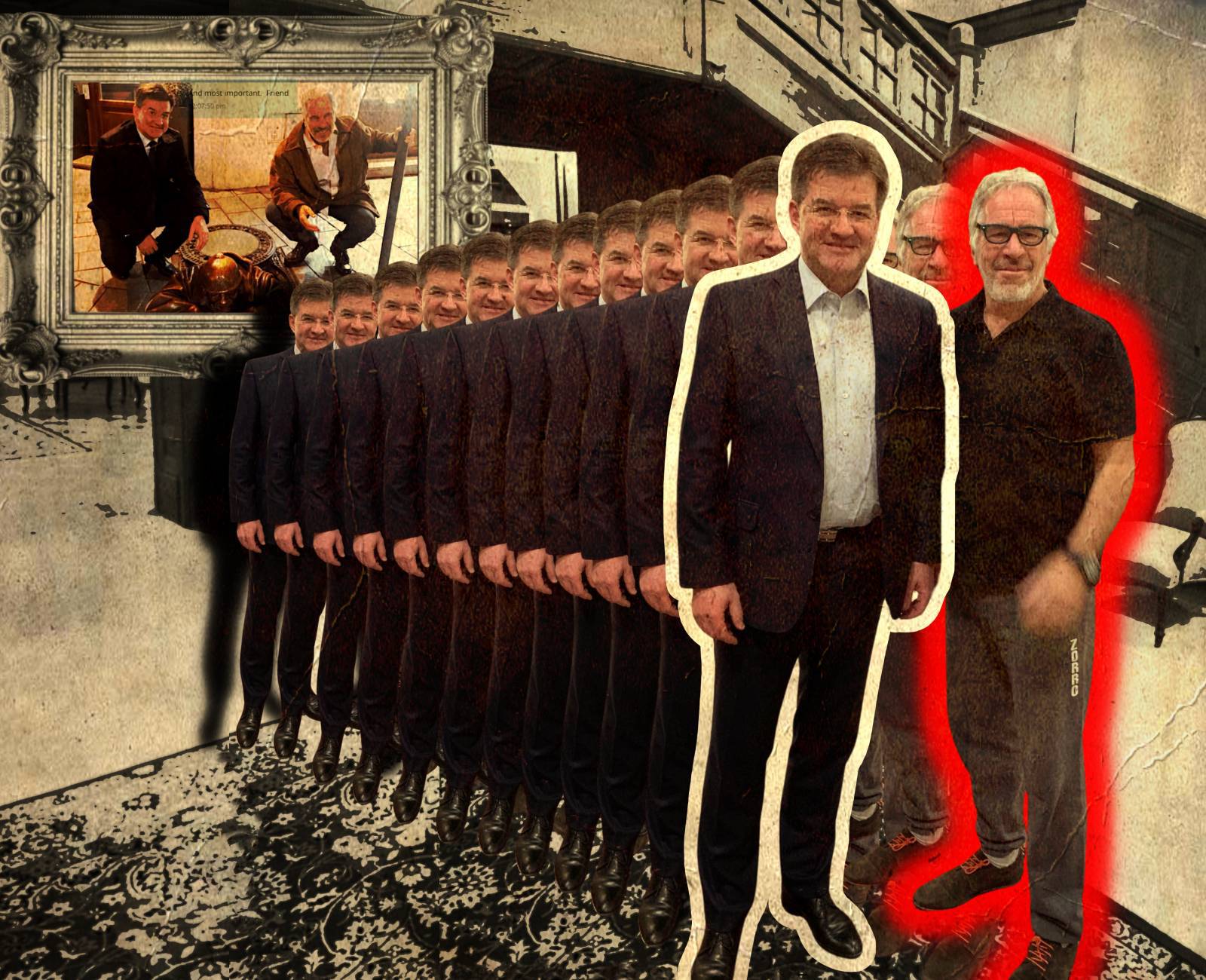
Illustration: ICJK (DOJ/Epstein Files, House Oversight Committee, Vintage PNGs by Vecteezy) 2026-02-17


Illustration: ICJK (DOJ/Epstein Files, House Oversight Committee, Vintage PNGs by Vecteezy) 2026-02-17
Shortly after Miroslav Lajčák became President of the UN General Assembly, Jeffrey Epstein entered his proximity. Based on emails and text messages from documents known as the Epstein Files, recently published by the US Department of Justice, it appears that there was intense and long-term contact between the high-ranking Slovak diplomat and the American financier. The Investigative Center of Ján Kuciak (ICJK) has identified at least 25 personal meetings in the United States and Europe, and this may not be the final number. Several of the meetings appear to have taken place in convicted sex offender Epstein’s private residences, where he also met with other influential figures in world politics.
“The current Minister of Foreign Affairs of the Slovak Republic. The current Chairman of the OSCE. The former President of the United Nations… and most importantly. A friend,” replied American financier and sexual predator Jeffrey Epstein in 2019, a few weeks before his arrest, when asked by Donald Trump’s former chief ideological strategist Steve Bannon what official position Slovak diplomat Miroslav Lajčák held.
The documents in the Epstein Files show that Epstein’s personal contact with Lajčák began shortly after the Slovak foreign minister became president of the UN General Assembly. According to the documents, they first met in September 2017 in New York, when Lajčák was still serving as minister.
Lajčák claims that they were introduced by a “very good friend,” a highly respected foreign diplomat. Communication published by the US Department of Justice suggests that this could have been Norwegian ex-diplomat Terje Rød Larsen, long-time head of the International Peace Institute, who had a demonstrably close personal and financial relationship with Epstein. Today, his connection with Epstein is being investigated by Norwegian authorities.
Emails and text messages indicate that from the very first contacts, Epstein was interested in regular personal meetings with Lajčák. In just a few months, they met repeatedly, most often at Epstein’s New York residence on Fifth Avenue, a house that the media later dubbed the “house of horror.” After Epstein was charged with sexually abusing minors, authorities found photographs of child abuse there.
A restoration of communications from more than six million published documents points to at least 25 meetings between Lajčák and Epstein. Most of them took place in New York, but some also took place in Europe, in Paris, Vienna, and Bratislava.
These were not exclusively one-on-one meetings. Documents and organizational reports indicate the participation of several other individuals, including former White House chief strategist Steve Bannon.
Available documents show that Epstein initiated most of the meetings, arranging logistics and offering Lajčák accommodation at his Palm Beach residence. The nickname “Miro,” as the sex offender called him, also appeared in an email with the subject line “Numbers in case of problems,” which Epstein sent to his lawyer.
Communication captured in the Epstein Files suggests that Lajčák last met with the sexual predator in mid-June 2019 in Paris, just three weeks before the American billionaire’s arrest. Epstein committed suicide in prison in August 2019.
We wanted to talk to Lajčák about his meetings with the convicted sex offender, but our attempts to contact him by phone went unanswered. The former minister and, until recently, advisor to Prime Minister Robert Fico did not even respond to our text messages. Lajčák sits on the supervisory board of Slovnaft, a Slovak refinery which is part of Hungary’s MOL Group, but the company did not respond to our questions either.
Following the recent publication of three and a half million documents in the Epstein Files, which revealed the extent of his communication with Epstein, the former foreign minister resigned from his position as advisor to Prime Minister Robert Fico. “When I read it today, I feel like a fool,” Lajčák said on Slovak Radio. “But that doesn’t absolve me of responsibility. I showed poor judgment and a lack of caution. Those messages are nothing more than stupid male egos in action. Self-important male banter,” he said, downplaying his contact with Epstein.
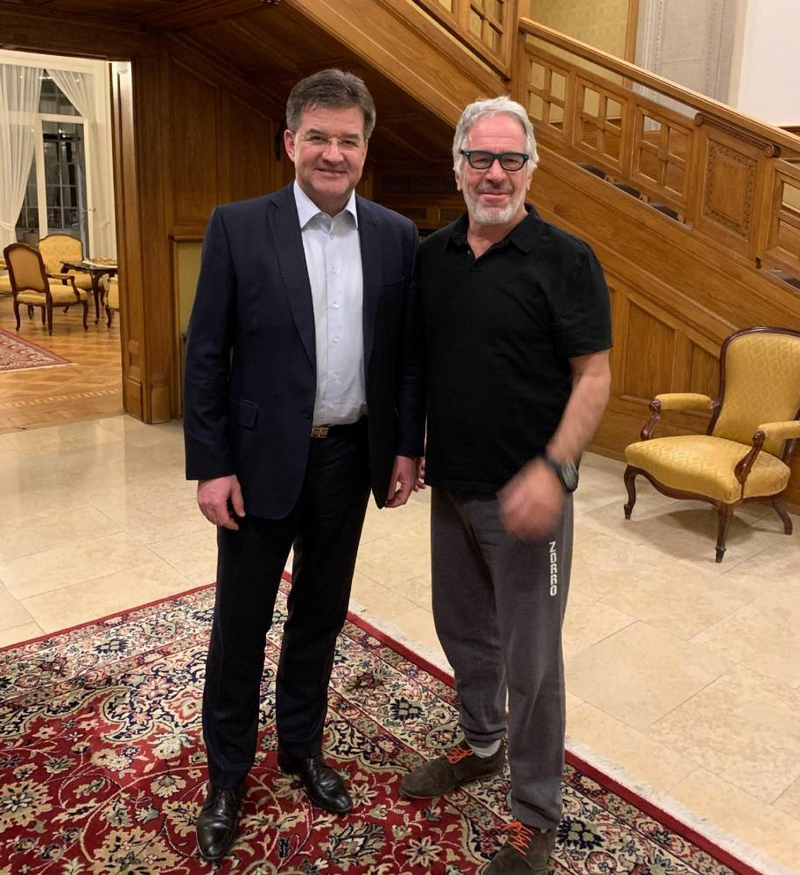
Miroslav Lajčák and Jeffrey Epstein at the Slovak Embassy residence in Vienna. Source: House Oversight Committee
Last year, Lajčák claimed to TASR that he only communicated with Epstein socially as part of his diplomatic duties. He also said that the role of a diplomat is to establish contacts with as wide a range of partners as possible.
However, former diplomat and foreign minister Rastislav Káčer points out that Lajčák met with Epstein “not as a diplomat, but as a foreign minister and constitutional official,” which, is not getting enough attention. “Yes, a diplomat can consciously meet with controversial people, but it should not be a secret meeting; it must be transparent within the system,” explains the former minister.
The Beginning of a Beautiful Friendship?
In addition to leading the Foreign Ministry, Lajčák also served as President of the 72nd session of the UN General Assembly. He took office on September 12, 2017, and remained in that position until the fall of 2018. According to documents, his first meeting with Jeffrey Epstein took place in September 2017.
Source: Epstein Files
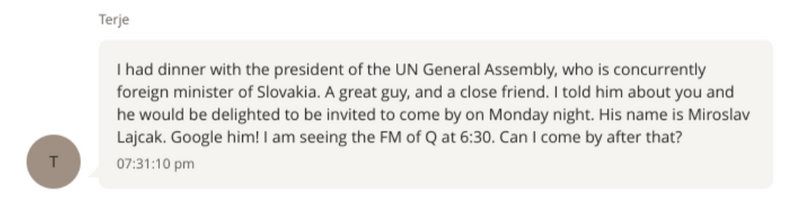
“I had dinner with the President of the UN General Assembly, who is also the Minister of Foreign Affairs of the Slovak Republic. He is a great man and a close friend of mine. I told him about you and he would very much like to accept the invitation for Monday evening. His name is Miroslav Lajčák,” wrote a user under the nickname Terje (likely Terje Rød Larsen, former president of the International Peace Institute, ed.) to Epstein on September 16, 2017. Two days later, Lajčák and the former Norwegian diplomat were to visit the convicted sexual predator at around 9 p.m. It was only four days after Lajčák took office at the UN.
The documents also revealed Rød Larsen’s close relationship with Epstein. The Norwegian resigned as president of the International Peace Institute when it emerged that he had taken out a personal loan of $130,000 from Epstein in 2013.
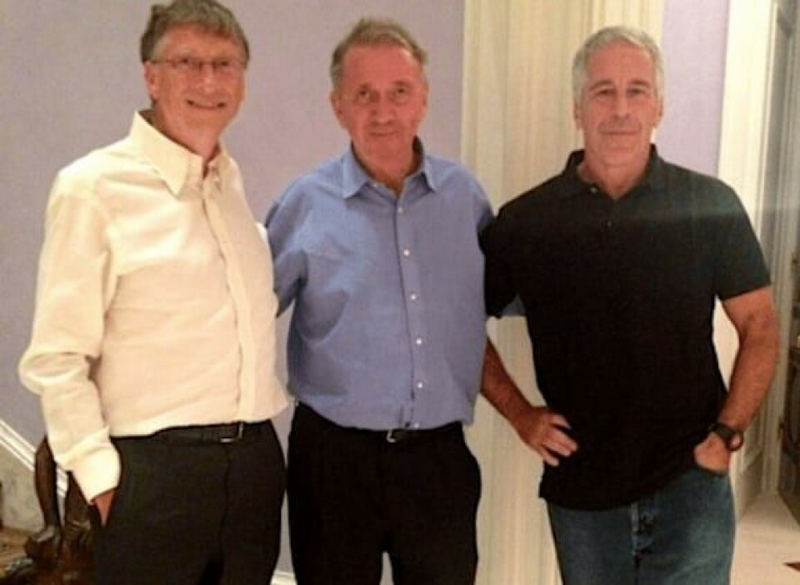
Terje Rød Larsen (center) with Bill Gates and Jeffrey Epstein. Source: Epstein Files
In the communications, we found references to more than two dozen meetings between Miroslav Lajčák and Jeffrey Epstein. At least 16 of these meetings took place at the American financier’s New York home on Fifth Avenue near Central Park.
The French neoclassical townhouse is located in one of the most modern neighborhoods of the Upper East Side. It has seven floors and 40 rooms and is one of the largest private homes in Manhattan. The New York tabloid media called it “the house of horror” after Epstein was charged with abusing underage girls and photos of child abuse were found in the house’s safe during an FBI raid.
Lajčák was also supposed to visit Epstein at his residence at the end of September 2017. “If you have time this week, I invite you to breakfast or lunch (…)” the American invited him via direct message. “With pleasure! Lunch on Friday would suit me best. Miro,” Lajčák replied two minutes later.
They were to meet four times that same year, including once on New Year’s Eve in Palm Beach, Florida. Epstein owned a luxury residence there right on the coast. He offered the former minister a 1,300-square-meter house. “You can stay there anytime. You won’t suffer,” the financier wrote.
Some meetings were organized through Epstein and Lajčák’s assistants. Others were arranged through direct messages. They exchanged friendly messages from the very beginning, including photos and greetings from different corners of the world. Lajčák’s assistant also knew that they were communicating with each other. In their messages, they also wrote about “girls.”
The former minister’s claim that it was Epstein who “initiated the meetings” is confirmed by email messages between his assistant and the sexual predator’s assistant.
In response to the published details of his relationship with the American financier, Lajčák stated that he could not have known that he was a “dodgy character.” “I had no way of knowing,” the former minister said on Peter Bielik’s show.
Rastislav Káčer points out that such an argument does not hold water. “As a member of the government, like any other constitutional official, the minister can ask the intelligence services to conduct additional checks on individuals,” Káčer argues, adding that “the foreign minister, as president of the UN General Assembly, has about a million ways to verify the identity or rank of someone he meets.”
Meeting Even Several Times a Month
Lajčák and Epstein met most intensively during Lajčák’s time in New York, when they had several meetings a month. Their communication indicates that this was most often in the evening, just the two of them, though sometimes in the company of other people. Organizational reports also mention former Norwegian diplomat Terje Rød-Larsen, American billionaire Tom Pritzker, and influential Wall Street lawyer Brad Karp.
At the end of 2017, Lajčák and Epstein also met in Palm Beach. Although it is not clear from their message exchange, the location of their meeting may have been Epstein’s property again. Lajčák was to be picked up at the hotel by Epstein’s driver, Renato. Palm Beach was fateful for Epstein: in 2005, the police began investigating him after the family of a 14-year-old girl reported that she had been sexually abused at his residence. In 2008, a Florida court convicted Epstein of child prostitution and solicitation of prostitution. He admitted his guilt.
In the summer of 2018, 10 years after Epstein made that admission, it was agreed that Lajčák would visit the convicted pedophile at his Paris apartment, just a seven-minute walk from the iconic Arc de Triomphe. They were also supposed to meet at the same property a year later. It was there that a photograph of Peter Mandelson, former British ambassador to the US, was supposedly photographed in his underwear.
Lajčák and Epstein remained in contact even after the end of his term at the UN in September 2018. “How was Russia?” the American asked the former minister in early October. “Russia was great, 3.5 hours with Lavrov, ending with a cigar (…) And an honorary doctorate at my MGIMO,” was the reply. At that time, Lajčák visited the Moscow State Institute of International Relations, and not only as Slovak foreign minister: MGIMO is his alma mater.
Lajčák’s second meeting with Epstein in Paris in 2019 would be their last. Three weeks later, the American pedophile was arrested on federal charges of trafficking minors for sexual purposes in Florida and New York. In August 2019, he hanged himself in his cell.
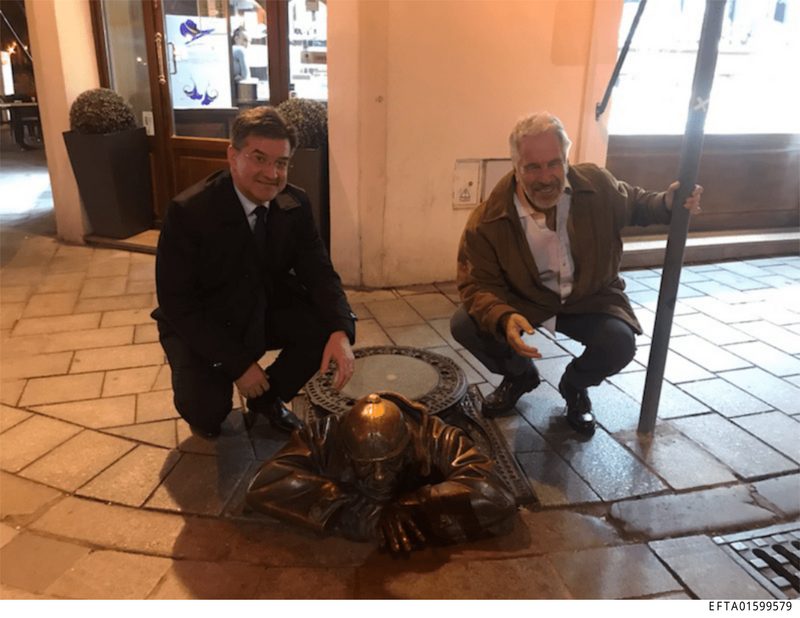
Paris was not the only European location where Miroslav Lajčák and Jeffrey Epstein met. According to information that has already been made public, they also met in Vienna and Bratislava. It is from these two cities that their joint photographs originate, which were part of the documents published as part of the Epstein Files. On November 7, 2018, Epstein was supposed to fly Lajčák from Bratislava to Poprad in his plane. Individuals from Ukraine, Belarus, and France were also supposed to be on board.
Source: Epstein Files
They also planned to have dinner together in Brussels on January 28, 2019. However, according to the documents, Epstein canceled his trip from Paris to the Belgian capital. The next day, Lajčák spoke at NATO headquarters in Brussels about the priorities of the Slovak presidency of the OSCE, the international organization of which he was acting head that year (in addition to being foreign minister).
The published documents did not only reveal the intensity of Miroslav Lajčák’s relationship with Epstein. They also showed that the high-ranking Slovak diplomat was in contact with Steve Bannon. In 2017, Bannon fell out of favor with US President Donald Trump, so he tried to promote his new “project,” which aimed to strengthen and unify the European far right.
He called it “The Movement,” and Lajčák recommended his former boss, Robert Fico, as one of its faces. “He would like to play Steve’s game. He’s good,” Lajčák wrote to Epstein in 2018. The documents suggest that Lajčák and Bannon communicated not only indirectly but also directly. They are said to have met in person at least three times—for breakfast, lunch, and dinner. Fico has denied meeting with Bannon.
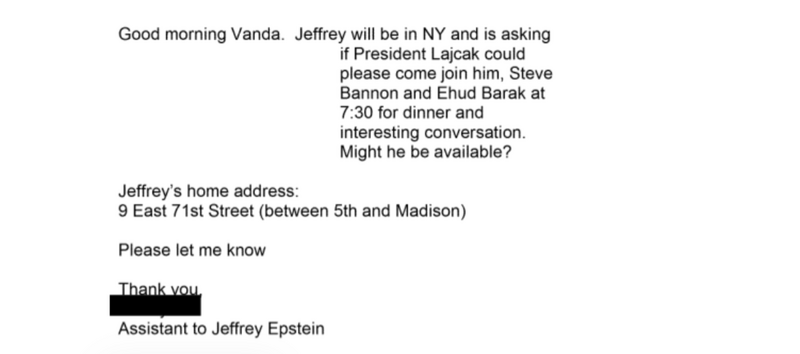
Invitation for Lajčák to dinner with Bannon, former Israeli Prime Minister Barak at Epstein’s. Source: Epstein Files
According to data from the JMail project, which processed bulk data from the Epstein Files into a more readable form, Lajčák was often mentioned in conversations between Epstein and Bannon. The nickname “Miro” appears 50 times. However, this may not be the final number. Lajčák did not respond to our questions about meetings with the American far-right ideologue.
This investigation was originally published in Slovak on ICJK.sk.
Subscribe to Goulash, our original VSquare newsletter that delivers the best investigative journalism from Central Europe straight to your inbox!

Karin Kőváry Sólymos is a Slovak journalist at the Investigative Center of Ján Kuciak. Previously, she was an editor and presenter at the Hungarian channel of the Slovak public service media. During her university years, she was an analyst for the only fact-checking portal in Slovakia. She was a recipient of the Novinarska Cena 2022.