





Babiš, Orbán, and Agrofert’s Lucrative Business in Hungary
Illustration: Shutterstock/VSquare 2026-07-17


Illustration: Shutterstock/VSquare 2026-07-17
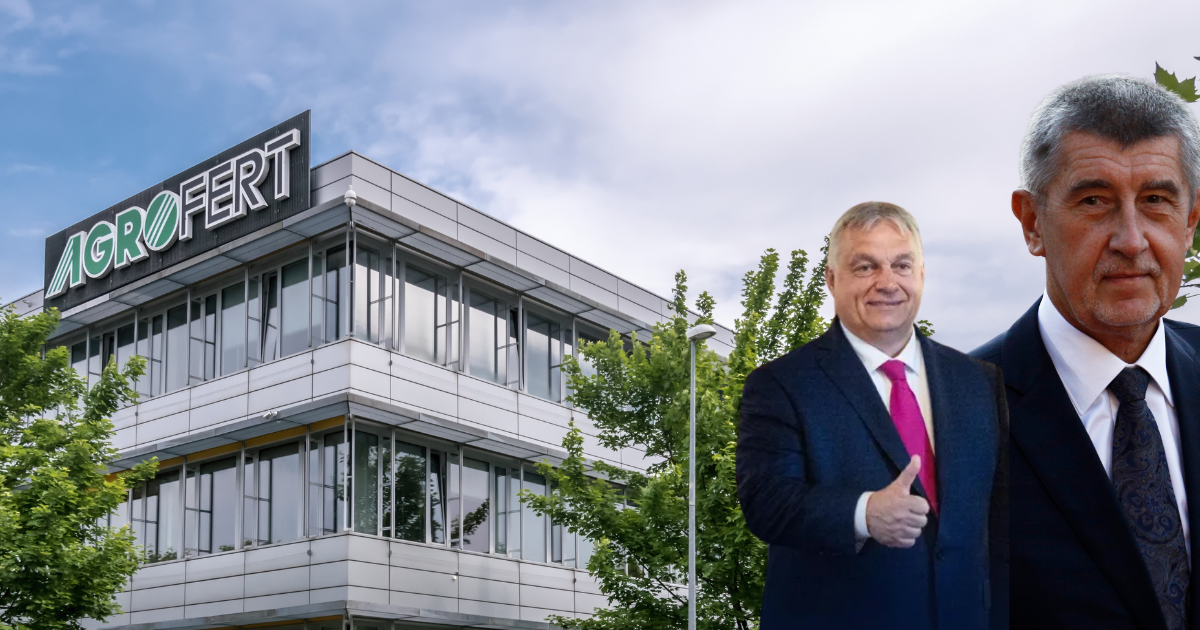
As Czech Prime Minister Andrej Babiš and former Hungarian Prime Minister Viktor Orbán’s friendship deepened, the business operations of Babiš’s Agrofert holding company in Hungary and Romania also grew. Agrofert secured loans worth billions from a bank co-owned by the Hungarian state as well as by Orbán’s childhood friend, and acquired a stake in a company linked to individuals close to the Hungarian government at the time.
Under Viktor Orbán’s government, the following rule applied in Hungary: anyone who wanted to run a successful business in the country had to get along well with Orbán and his Fidesz party. Czech Prime Minister Andrej Babiš followed this rule.
The editorial team at investigace.cz discovered that Agrofert benefited from Hungarian state subsidies and loans from banks linked to Orbán’s friends; three years ago, Agrofert also acquired a stake in a company whose ownership structure included two former ministers from Orbán’s government.
Andrej Babiš and Agrofert Ownership
Andrej Babiš founded Agrofert in 1993. Under the 2017 Conflict of Interest Act, he had to transfer Agrofert to trust funds—specifically, AB Private Trust I and AB Private Trust II. However, he retained influence over both funds, as demonstrated by an audit conducted by the European Commission. He was also registered as the ultimate beneficial owner in the Czech Register of Beneficial Owners (ESM). This did not change until October 2025, when Babiš, amid the unresolved conflict-of-interest issue, announced the establishment of another trust, whose trustee (and, according to the ESM, beneficial owner) is attorney Wilfried Reinhard Elbs.
However, because of the conflict of interest still not being fully resolved, as reported by Seznam Zprávy, the EU has currently suspended the payment of subsidies to Agrofert and its subsidiaries. The European Commission is still assessing whether or not Babiš is in a conflict of interest.
The Path to Hungary
Agrofert entered the Hungarian market in 2009 when it acquired Devecseri Agrokémiai Kft., a company specializing in the logistics and distribution of agricultural crops. Over time, Agrofert began to thrive in Hungary and later in Romania as well. It now has several subsidiaries in these countries. These include a bakery, agricultural equipment sales centers, and a sunflower oil production plant.
In Hungary, the company received subsidies for these ventures. As described by the Hlídací pes website, in 2019, Agrofert received a subsidy of approximately €5 million (CZK 130 million) directly from the Hungarian government, intended for job creation.
Another subsidy, this time funded by the European Union in the amount of approx. €11.37 million (CZK 285 million), was awarded for a production line for toast bread manufacturing.
Seven years after expanding into Hungary, in 2016, the first subsidiary was established in Romania. It specializes in the trade of agrochemicals.
And it was in Romania that the business of the current Czech Prime Minister, Andrej Babiš, became directly linked to people in Viktor Orbán’s inner circle: In 2023, Agrofert acquired a stake in the Romanian company East Grain, which it now co-owns with the Romanian group East Consulting. That group, in turn, is controlled by the Hungarian group Hodler Capital, founded by Miklós Kerezsi. Kerezsi is also a member of the board of directors of the Jövő Nemzedék Földje Alapítvány foundation, which manages Hungarian state-owned agricultural assets under the coordination of János Lázár, the former Minister of Construction and Transport — and one of the most influential figures in Orbán’s government.
The Hodler Capital Group, which along with Agrofert, co-owns East Grain, controls, among other things, funds that were managed by former ministers in Orbán’s government: former Minister of Energy Csaba Lantos and former Minister of Culture and Innovation János Csák. A Transparency International report describes these funds as a mechanism through which public money served private interests.
A few months before the announcement of the East Grain acquisition, Babiš’s longtime closest associate —Tünde Bartha — joined the Hungarian branch of Agrofert. After Babiš lost the presidential election, Bartha took up the position of business development manager. She oversaw Agrofert’s expansion in Eastern Europe and the Balkans.
Billions from Orbán’s Childhood Friend
The editorial team at investigace.cz reviewed Agrofert’s annual reports and discovered that Agrofert had obtained loans from the Budapest-based MKB Bank. In 2023, MKB Bank merged with two other Hungarian banks. They now operate jointly under the name MBH Bank.
The Hungarian state owns 15 percent of MBH Bank’s shares, and another major shareholder is Orbán’s childhood friend Lőrinc Mészáros, who also held a stake in MKB Bank. Thanks to Orbán, Mészáros has become one of the wealthiest Hungarians. The Hungarian investigative website Átlátszó revealed that his companies secured a large number of government contracts, most of which were funded by the European Union.
And according to journalists at hvg.hu, Viktor Orbán used this very bank to provide loans to his allies. However, the loans were often not intended to finance their businesses, but rather their political parties. The Spanish far-right party Vox received a loan of 9.2 million euros from this bank for its 2023 election campaign. And its predecessor, MKB Bank, provided 10 million euros to Marine Le Pen’s National Rally.
MKB Bank also provided loans to Agrofert. The bank’s name first appeared in Agrofert’s annual report in 2021, with a loan amount of €8.7 million (CZK 222.7 million). In 2022, the amount was €25.6 million (CZK 629.7 million).
And in 2023, the bank lent Agrofert €71 million (CZK 1.7 billion), which is the largest loan Agrofert has ever received from MKB Bank.
The Chinese Gateway
Between 2018 and 2025, funds also flowed into Agrofert from the Chinese Bank of China. This bank is majority-owned by Central Huijin Investment, a state-controlled investment firm, and also has a branch in the Czech Republic — which was established by the Hungarian branch.
Hungary and Relations with China
Hungary has long maintained exceptionally close ties with China — so much so that the country is often referred to as China’s gateway to Europe. Chinese companies are building significant manufacturing facilities here, such as the automobile plant by BYD planned in Szeged. The policy of rapprochement with the East was pioneered by Orbán. However, following the landslide election victory of the opposition Tisza Party and Péter Magyar’s assumption of the office of Prime Minister in May 2026, Hungarian foreign policy appears to be undergoing something of a course correction with an aim of balancing dependence on China and strengthening ties with the EU.
Agrofert received loans worth hundreds of millions of crowns from the Hungarian branch of the Bank of China. In 2022, for example, the loan worth was €35.8 million (CZK 880.1 million). Agrofert has not yet published the value of the loans for 2025.
The editorial team gave Agrofert the opportunity to comment on these findings, but its spokesperson did not respond to inquiries by the time this article was published.
This article was originally published in Czech on Investigace.cz.
Subscribe to Goulash, our original VSquare newsletter that delivers the best investigative journalism from Central Europe straight to your inbox!