




Diplomat in the Shadows: Belarus’s Honorary Consul in Czechia Trades with Russia Despite Sanctions
Sonya Maksimiv (Trap Agressor, StateWatch)
Illustration: Embassy of the Republic of Belarus in the Czech Republic 2026-01-06


Sonya Maksimiv (Trap Agressor, StateWatch)
Illustration: Embassy of the Republic of Belarus in the Czech Republic 2026-01-06
He is invisible — and, at the same time, a successful businessman who has managed to evade the sanctions imposed on Russia. Denis Karpovich is Belarus’s honorary consul in Czechia, and authorities know practically nothing about his activities. A businessman who holds Czech, Belarusian, and Russian citizenship, Karpovich exports parts that could be used in military production to Russia through his company in South Korea. Yet he lives in Prague. Karpovich’s diplomatic role and business activities were examined by the editorial team of investigace.cz in cooperation with the Ukrainian analytical center StateWatch.
Because relations between Belarus and Czechia are poor, Belarus does not have an ambassador. Only two Belarusians are listed on the current Czech diplomatic register. The first is the chargé d’affaires (head of mission), Stefaniya Zmitrakovič. The deputy head of mission, Belarusian Mikalaj Dukšta, was labelled in September 2025 by the Czech Security Information Service as an agent of Belarus’s State Security Committee (KGB) and had to leave the country.
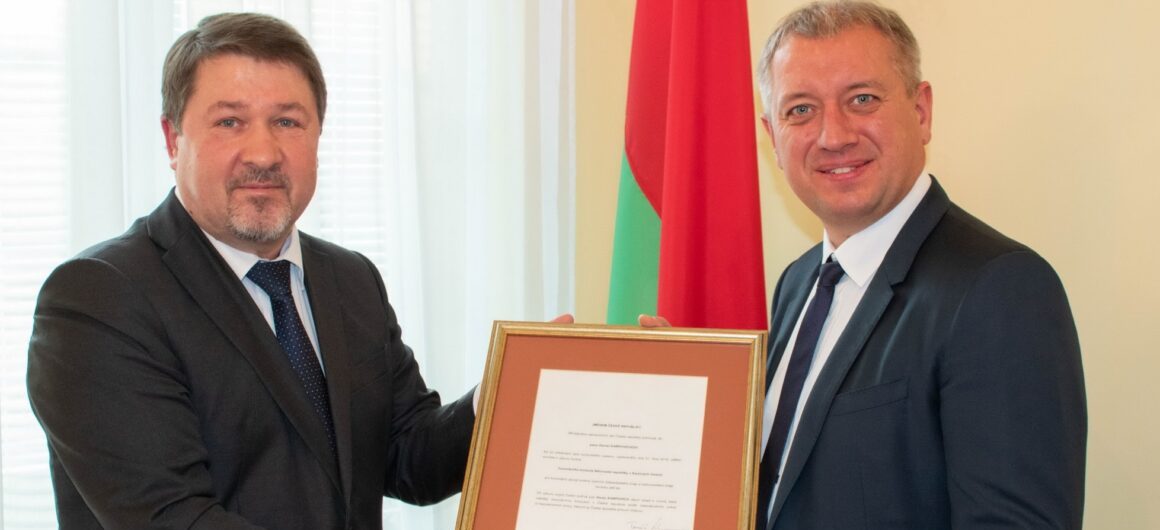
The second person, listed since 2020, is honorary consul Denis Karpovich, who is also chairman of the Czech–Belarusian Chamber of Commerce and Industry. His appointment was approved by the Czech Ministry of Foreign Affairs for nine years, i.e., until 2029.
The role of honorary consuls is primarily to support trade relations between countries. But Karpovich’s agenda appears far more ambitious.
“An honorary consul is tasked with a range of duties in the political, trade and economic, scientific and technical, and consular spheres. He will also participate in cultural cooperation and work with the expatriate community,” reads the announcement of Karpovich’s appointment, which was published at the time on the Belarusian embassy’s website.
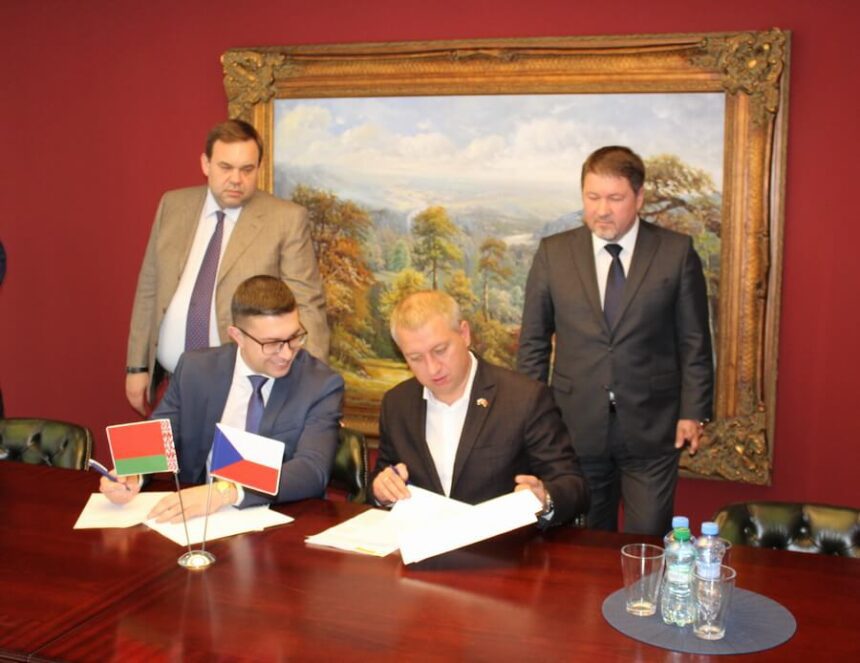
Visit of a delegation from the National Center of Legal Information of the Republic of Belarus to the Czech Republic in 2017. Left to right: Belarusian Foreign Minister Jevgenij Šestakov, Director of the National Center of Legal Information of the Republic of Belarus Jevgenij Kovalenko, Denis Karpovich, Ambassador of Belarus to Czechia Valerij Kurdjukov. Source: Embassy of the Republic of Belarus in the Czech Republic
A Consulate That Doesn’t Exist
Karpovich’s consulate is said to be based in the so-called “Russian village”: the Gejzírpark complex in Karlovy Vary, owned by the company Gejzír real. Until 2024, its owner was Sergei Katyrin, head of the Chamber of Commerce and Industry of the Russian Federation. The current owner is a company from Kazakhstan. The consulate’s working phone number is out of service.
Karlovy Vary City Hall has no information about the activities of the Belarusian consulate, which is meant to operate in the Karlovy Vary and Central Bohemian regions, nor about the consul himself. “In the last 10 years we have never had any contact with him,” the city’s spokesperson says.
According to spokesperson Zuzana Žídková, the Central Bohemian Region cut all contact with Belarus back in 2021 — after Belarusian President Aleksandr Lukashenko forced a plane carrying opposition activist Raman Pratasevich to land and had him arrested.
No one at the Czech Ministry of Industry and Trade or at CzechTrade (the state agency supporting trade) knows anything about the consul’s current activities either. “According to our information, the last contact with Mr. Karpovich took place in 2020. Subsequently, the Ministry of Industry and Trade ended, in response to the forceful suppression of protests in Belarus, its contact with the trade section of the Belarusian embassy in the Czech Republic,” said ministry spokesperson David Hluštík.
Denis Karpovich is also unknown within the Belarusian community in Czechia itself. The one exception — the one time when Karpovich engaged publicly — was during the Belarusian parliamentary and presidential elections in 2019 and 2020. At that time, the consul sat on election commissions — first as deputy chair, and the following year as chair of the commission at the embassy in Prague. In 2020 in Prague, Lukashenko received 22 votes, while opposition candidate Sviatlana Tsikhanouskaya received 447 votes. The honorary consul did not comment on the election results. He also did not comment on the violent crackdown on Belarusian protests after the rigged elections. Previously, he had not commented on the annexation of Crimea either. As his wife, stylist and blogger Anastázie Karpovičová, wrote on social media, she and her husband are “outside politics.”
Investigative journalist Aleksei Karpeka from the Belarusian exile newsroom Buro Media says that is an illusion. “It’s impossible for an opponent of the regime to become an honorary consul. There’s no formal ban, but they would never allow anyone who criticizes Lukashenko into such a position,” says Karpeka, who has examined the ties between honorary consuls and Belarus’s president.
In this context, a major red flag stands out: Karpovich’s phone number is registered to his passport at the Russian Embassy in the Czech Republic. Before that, the same number was assigned to three departments of Belarus’s Ministry of Internal Affairs — in other words, it was a government line. This suggests that Karpovich may have had ties to state structures in both Belarus and the Russian Federation.
And this only makes sense in light of a new regulation. In November 2025, Belarus’s Ministry of Foreign Affairs issued rules stating that candidates for honorary consul must now be vetted and approved by the KGB and by Lukashenko’s administration personally.
According to Slovak diplomat and former foreign minister Rastislav Káčer, in some developing countries, the title of honorary consul can even be “bought.” “Formally, an honorary consul has almost no benefits, but in practice the police often view them as a diplomat. Most people don’t distinguish at all between an honorary consul and an actual diplomatic representative,” he explains. Journalist Karpeka shares the same view: “Legally speaking, a consular function offers no advantages in business or other fields. In reality, however, it represents a status that brings certain perks and can open doors to high-ranking officials,” he adds.
Contact with Czech officials, however, does not appear to interest Denis Karpovich. This is also confirmed by the experience of the investigace.cz newsroom: the consul refused an interview request and did not answer the questions the editors sent him.
A Very Real Businessman
Karpovich’s diplomatic appointment was preceded by a business career in Czechia. In 2011, he founded his flagship Prague company, K&K trade group, s.r.o., which supplies accessories to automotive companies. Despite a drop in revenues after 2019, the company recorded a net profit of 35 million Czech crowns last year and was employing five people.
According to the company’s website, K&K trade group supplies roughly 250 million automotive components per year and currently has representation in three countries: Czechia, Uzbekistan, and South Korea. While the website now states the company supplies more than 20 countries across Europe, America, and Asia, back in 2017, it also specified CIS countries (the Commonwealth of Independent States, grouping some post-Soviet republics) as recipients.
Today, Karpovich co-owns K&K trade group with his business partner, Belarusian Aliaandr Klopau, through Global European Solutions. Through this same company, based in Prague’s Karlín district, he also still owns a Russian eponymous branch that is overlooked on the main company website. K&K Rus says it supplies components to the automakers Kamaz and AvtoVAZ — both of which are now on the EU sanctions list because they produce armored vehicles for the Russian army.
Up until the start of the war in 2022, components were shipped from Czechia to Russia via a Czech company that is now owned by Karpovich’s mother-in-law. According to a customs database, the last direct shipment left on 28 February 2022 — four days after the start of Russia’s full-scale invasion.
A Route Through Korea
Working with StateWatch, investigace.cz found that shipments of components to Russia are still continuing — but now via Turkey, China, or the South Korean branch K&K Korea, which is also headed by Karpovich.
From records in several commercial databases available to our newsroom, we found that between 2022 and 2025 Karpovich’s K&K Rus imported goods worth more than USD 1.6 million in total. Although deliveries came — besides Czechia — from non-European countries, the products supplied originated in Europe: Germany, Switzerland, Poland, and other countries. Of this, goods worth USD 432,000 were delivered directly by Karpovich’s Korean branch.
The electronic components imported by Karpovich’s Russian company fall under EU sanctions regulations as dual-use goods — components usable both in civilian production and for military purposes. For this reason, their sale to Russian companies is prohibited.
Among the imported brands is the German company Wago, which manufactures, among other things, electrical components for the automotive industry and also has branches in Czechia. The company did not respond to our questions about imports of components into Russia.
Russian or Belarusian?
Karpovich has been doing business on the Russian market for a long time. According to investigace.cz findings, in addition to Belarusian and Czech citizenship he also holds Russian citizenship, which he obtained in 2005. He began working in the electrical-components trade in 2009, when he served in Russia as general director of Elko Group, headquartered in Moscow with a trade office in Minsk. The company sold industrial electrical equipment and automotive parts including connectors, which it supplied to, among others, Kamaz and AvtoVAZ. The company ceased to exist in 2018.
Several months after Russia’s invasion of Crimea in 2014 and the introduction of the first sanctions against Russia, Karpovich set up a company in the Seychelles. That company then registered another entity in the United Kingdom, whose director was Karpovich’s partner from the Czech–Belarusian Chamber of Commerce and Industry, while the owner was a company belonging to another of Karpovich’s partners.
It was this UK company that controlled the Czech K&K trade group from 2017 until it was dissolved in 2019. The newsroom was unable to determine the specific purpose the offshore structure served.
According to Belarusian investigative journalist Karpeka, honorary consul status may have helped Karpovich build a successful logistics setup aimed at circumventing European sanctions. “Consular status of course provides no exemption from sanctions. In practice, however, it makes it easier to build ‘grey’ schemes and at the same time provides a certain degree of political protection — at least until the story becomes public,” he says.
At present, there are more than twenty Belarusian honorary consuls operating in Europe. At least some of them, according to findings by the Belarusian Investigative Center, are involved in illegal activities such as “circumventing sanctions, smuggling goods, illegal construction, arms trading, and selling medicines at inflated prices.” This is one reason some European countries have decided to reassess the presence of honorary consuls in their territory. Although approving — or, conversely, terminating — honorary consul appointments falls under the Czech Ministry of Foreign Affairs, the press spokesperson referred us to the Belarusian Ministry of Foreign Affairs.
The Czech version of this article was published on Investigace cz.
Subscribe to Goulash, our original VSquare newsletter that delivers the best investigative journalism from Central Europe straight to your inbox!