




Orbán’s Dirty Raid: Inside Hungary’s Hijacking of Ukraine’s Bank Convoy
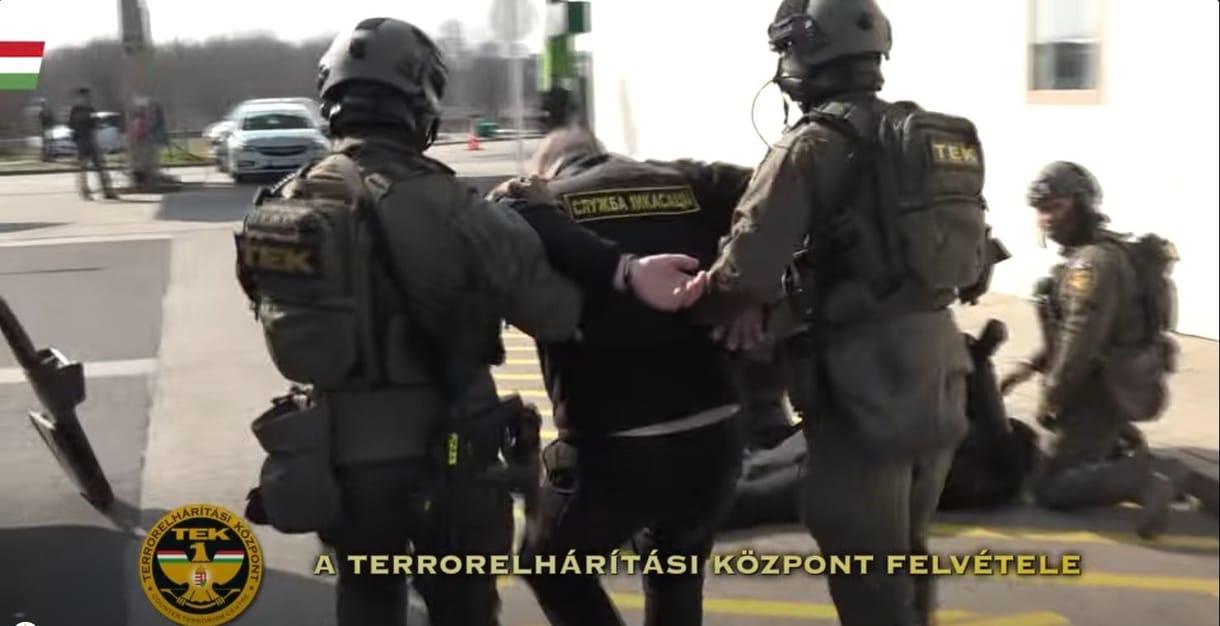
Photo: Counter-Terrorism Center (TEK) 2026-03-20


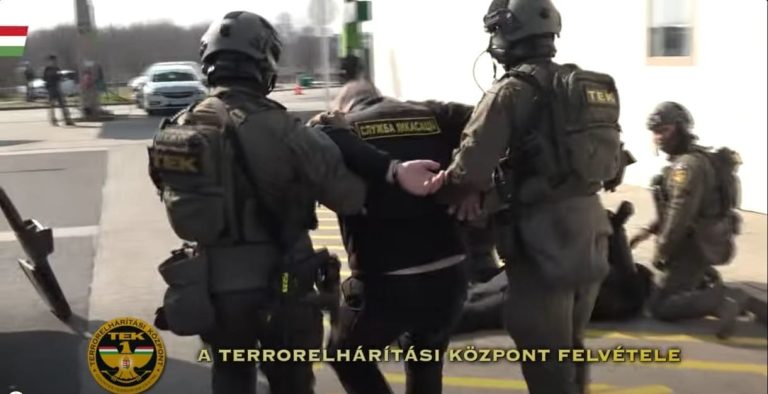
Photo: Counter-Terrorism Center (TEK) 2026-03-20
Hungary’s Counter-Terrorism Center raided a Ukrainian state bank’s convoy not to enforce the law, but to manufacture a diplomatic crisis that could be weaponized in Viktor Orbán’s re-election campaign, sources familiar with the operation revealed to VSquare.
Hungary’s domestic counter-terrorism agency raided two armored trucks belonging to Ukraine’s state-owned Oschadbank a few weeks ago in an operation driven by political motives rather than legitimate law enforcement concerns, according to four sources familiar with the details of the operation.
The March 5 raid, carried out by Hungary’s Counter-Terrorism Center (TEK), targeted the vehicles as they passed through the country on a routine cash transport run from Vienna to Ukraine. Seven bank employees were detained and approximately $82 million in cash and gold was seized. Hungarian government-aligned media outlets subsequently alleged the cargo was illegal and linked it to what they described as a “war mafia” involved in Western financing of Ukraine’s military.
According to sources, however, the operation was designed to manufacture a confrontation with Ukraine that could be exploited ahead of Hungary’s April 12 parliamentary elections. Vilifying Kyiv and Western support for it has been a central feature of the ruling Fidesz party’s campaign messaging.
The Operation
The operation was spearheaded by Örs Farkas, the state secretary overseeing Hungary’s civilian intelligence services and a senior aide to Antal Rogán — Prime Minister Viktor Orbán’s powerful minister who controls both the intelligence apparatus and the government’s communications machine. The stated legal pretext was a counterintelligence investigation focused on a former Ukrainian Security Service (SBU) officer who headed Oschadbank’s security team protecting the bank convoy.
Hungarian intelligence operatives had been monitoring the bank’s regular courier runs between Austria and Ukraine since at least early January 2026, sources familiar with the operation told VSquare. Part of that surveillance was conducted on foreign soil: Hungarian operatives identified the hotel used by Ukrainian security staff in Vienna and mapped their routes through Austria.
The original plan — referred to by sources as “Plan A” — was to catch the convoy carrying illegal weapons, which would have provided the basis for a terrorism or arms trafficking narrative on which Orbán’s propaganda machine could further escalate its anti-Ukrainian messaging. TEK’s well-armed counter-terrorism squad was assigned the operation for that reason. State Secretary Farkas personally oversaw the raid from TEK’s command post, with representatives of the civilian intelligence agencies also present.
Farkas’s central role has also been independently reported by the Hungarian weekly HVG, which likewise identified him as the architect and operational commander of the raid. Farkas himself appeared to confirm his involvement in a parliamentary debate on March 10, revealing that national security agencies were working on the money transport case independently of NAV’s separate anti-money laundering investigation.
The Improvised Aftermath
The operation did not unfold as intended. According to a source with knowledge of NAV’s role in the operation, the Ukrainian bank cargo vans were stopped and subjected to a NAV inspection at the Hegyeshalom border crossing on the Hungarian-Austrian border on the morning of March 5. Officers found all documents and permits in order and let the vehicles pass. The convoy continued into Hungary, where TEK was waiting. They raided the two-truck convoy and its seven-man team as they stopped for a rest on the M0 highway near Alacska.
Following the raid, the Ukrainians’ documentation, the money transfers, and the broader logistics of the transport were found to be entirely legal, again. It also turned out that the drivers and guards were not carrying weapons. According to multiple sources, it became clear there was no legal basis for the raid, nor for the subsequent detention, interrogation without legal counsel, or expulsion of the Ukrainian personnel.
A contingency — described by sources as “Plan B” — was then hastily triggered: Hungary’s tax authority, NAV, was directed to open an anti-money laundering investigation to provide legal cover for the operation. The move reportedly caused significant internal friction within NAV, as the authority’s own anti-money laundering unit had not been consulted before the investigation was announced.

Cash and gold seized by Hungarian authorities. Photo: TEK
According to HVG’s report, should the illegality of the operation later be established, those who participated in the raid and those who ordered it could face several years in prison. HVG also reported that the NAV colonel who directly signed on to the operation — and bears legal responsibility — is currently on sick leave. VSquare has reached out to this NAV officer through multiple channels but received no reply.
The improvised character of the operation against the Ukrainian bank convoy is further illustrated by a logistical failure. Sources familiar with the operation told VSquare that TEK, having seized the Ukrainian vehicles and their contents, only realized mid-operation that it lacked the transport capacity to haul them away. The agency was forced to request military vehicles to complete the removal — meaning Hungary’s Ministry of Defense was only informed of the operation after it was already underway. Hungary’s military intelligence was never briefed on the operation at all, sources added.
A Mysterious Injection
The seven guards were held for more than 24 hours — much of it blindfolded and handcuffed, and without a Ukrainian interpreter, only a Russian-speaking one — before being deported to Ukraine and banned from the Schengen zone. Their impounded cargo, consisting of gold bars and tens of millions of dollars and euros in cash, remains in Hungarian custody.
However, The Guardian has also revealed a previously unknown detail of the operation. According to the paper, TEK forcibly injected one of the seven detained Ukrainian Oschadbank guards with an unknown substance during their interrogation. The man — the same former SBU employee whose affiliation was used by Hungarian intelligence agencies to open a counterintelligence probe — is diabetic, and it was he who had the injection administered “despite his objections,” his Hungarian lawyer Lóránt Horváth confirmed to The Guardian.
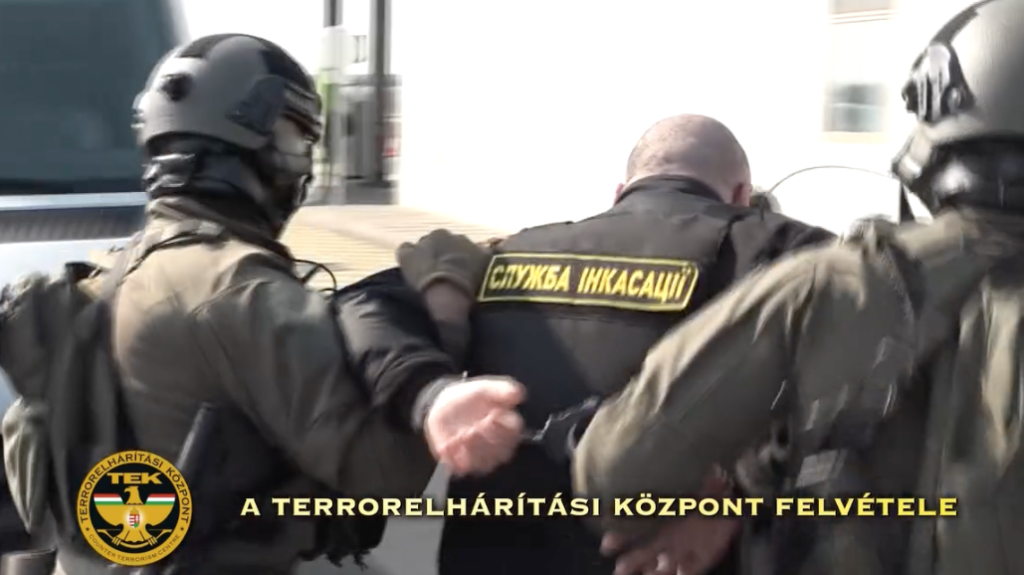
Photo: TEK
Ukrainian security sources told the paper they believed the substance was a relaxant intended to make the subject talkative during questioning, with one source describing the method as “Russian-style” and reminiscent of KGB-era truth serums. Traces of a “drug of this class” were later discovered during blood tests, another source told The Guardian.
Rather than achieving that effect, the drug reportedly triggered a hypertensive crisis, causing the man to lose consciousness; he was taken to hospital only after he passed out. Oschadbank confirmed that one detainee “needs a special diet and regular medication” and that “medical care was provided only after he lost consciousness.”
A Campaign Asset
Despite its logistical failures, questionable legal background and the triggering of multiple intra-agency tensions, those who directed the Hungarian operation against the Ukrainian bank convoy have since interpreted its outcome as a political success, sources familiar with details of the operation told VSquare.
In their telling, news of the Oschadbank raid reached Ukrainian President Volodymyr Zelensky within hours, and it was Zelensky who, at a press conference later that same day, made remarks widely read as a personal threat against Orbán — saying he would provide the address of the person blocking EU financial aid to Ukraine to his soldiers. Whether Zelensky’s comments were a direct response to news of the raid could not be independently confirmed. But sources said Orbán’s inner circle interpreted the episode as validation that their provocation had succeeded in eliciting a reaction that could be used as campaign material.
Zelensky’s remarks handed Orbán — who at the time was trailing his main rival Péter Magyar by 15-20 points in polls — exactly the campaign lifeline his team had been hoping for: within days, Fidesz rebuilt its entire election messaging around the Ukrainian president’s threat as well as alleged threats against Orbán by various Ukrainian commentators. Some of these threats were actually fabricated and manipulated through AI and deepfake video techniques.
The story of the Ukrainian bank convoy was also utilized to accuse the main opposition Tisza party, with thinly veiled allegations that the “illegal” cash and gold cargo is somehow financing Orbán’s political rivals.
The Hungarian Prime Minister’s Cabinet Office, which has oversight of the civilian intelligence services, and NAV did not respond to requests for comment. The legal representative of Ukraine’s Oschadbank has filed a complaint with Hungarian prosecutors alleging abuse of office and an act of terrorism.
This news piece is based on the story originally published in VSquare’s Goulash newsletter.
Subscribe to “Goulash”, our newsletter with original scoops and the best investigative journalism from Central Europe, written by Szabolcs Panyi. Get it in your inbox every second Thursday!

VSquare’s Budapest-based lead investigative editor in charge of Central European investigations, Szabolcs Panyi is also a Hungarian investigative journalist at Direkt36. He covers national security, foreign policy, and Russian and Chinese influence. He was a European Press Prize finalist in 2018 and 2021.