




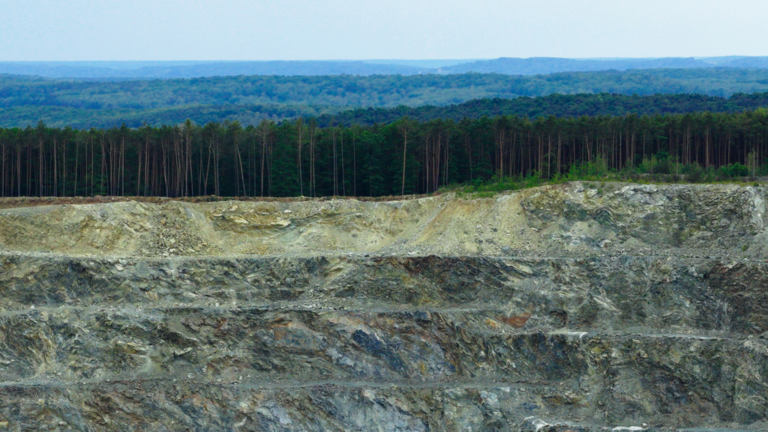
Hungary’s Asbestos Scandal: Austrian Quarries Exploited an EU Loophole
Video and photos: Pápai Gergő 2026-06-11


A situation similar to the one in western Hungary and Burgenland could easily have occurred — and could easily reoccur — in other countries. Asbestos-bearing rock is found across many parts of Europe, and EU policymakers have yet to act on a regulatory gap that has been known for years.
“It never crossed my mind, even in my dreams, that this scandal would break out right here on our doorstep,” says Dr. Tamás Weiszburg, geologist and associate professor at ELTE University. “There are no asbestos-bearing rocks in Hungary — with the Treaty of Trianon, every such area ended up beyond our borders.” Kitted out in a hazmat suit and respirator, magnifying glass and hammer in hand, the professor is leading a field exercise for his students in Szombathely on streets that have been surfaced with asbestos-laden crushed rock. The pupils search for samples in a newly built residential quarter dotted with nondescript single-family homes, bare yards ringed by cheap metal fences, and SUVs parked at the curb. Poppies bloom on heaps of construction debris; there are no trees in sight. Only residents may drive into these streets, and even they are limited to a crawl — yet despite the previous days’ rain, the road still kicks up dust behind them.
Trade in products containing deliberately added asbestos has long been banned in the European Union. The familiar corrugated asbestos-cement roofing of decades past is one example. Mining for the purpose of extracting asbestos is likewise prohibited.
But mining is not prohibited when the operator is after the host rock rather than the asbestos itself.
“What people find hard to grasp is that asbestos is not a separate substance — it is the rock,” Dr. Weiszburg explains. “Asbestos is a morphological form in which certain rocks occur; the same mineral can contain both asbestos and non-asbestos portions.”
Asbestos consists of fibers so vanishingly thin that their true dimensions cannot be made out even under a magnifying glass: what appears to be a single fiber is in fact a bundle of thousands. Asbestos is not inherently toxic. It is dangerous “only” because external forces cause those fibers to splinter into still finer fibrils, which then enter the air as fine particulate dust that can be drawn into the lungs. There they do not break down. Instead, they cause inflammation that can, over the long term, lead to cancer.
“Mining asbestos is prohibited in the European Union, so if rock is being mined for the purpose of extracting asbestos from it, that is not permitted,” Dr. Weiszburg says. “Had these Burgenland quarries applied for asbestos-mining permits, they would not have received them. But they weren’t mining asbestos — they were mining crushed stone, and unfortunately nothing prohibits that.” According to the geologist, opening or operating a quarry does not require the kind of geological surveys that would necessarily reveal the presence of asbestos on the site. “That said, had I been the owner of the quarry, I would have stopped extracting asbestos-bearing stone immediately, on purely moral grounds.”
Alongside the mining question, the other key issue is whether such rock may legally be placed on the market. According to Weiszburg, many are trying to apply the rules governing products with added asbestos to naturally occurring rock as well. For the former, the ban is unambiguous. “But under the law, crushed stone is not a product — it is a substance — and a different set of rules applies. And current European rules do not, by default and as a binding matter, prohibit trade in asbestos-bearing rock,” the geologist says.
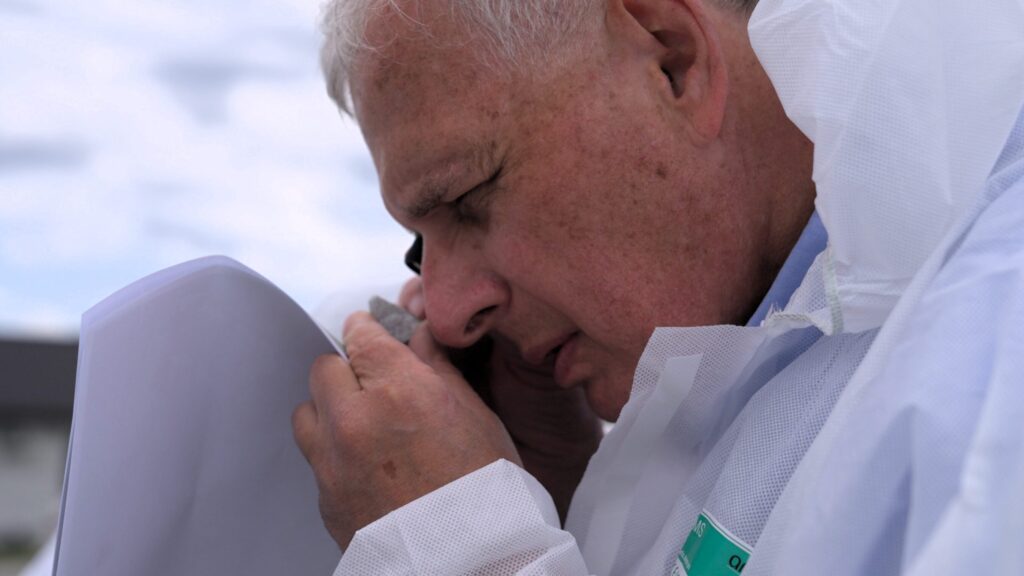
Dr. Tamás Weiszburg, geologist and associate professor at ELTE, examining crushed stone in Szombathely, May 2026
Certain restrictions do, however, apply to substances as well — and it was partly those restrictions that led to the closure of the Burgenland quarries.
Tripped Up by a Regulatory Inspection
The Burgenland authorities shut down four quarries in December 2025; whether the closures will be permanent is not yet clear. To manage the situation, the provincial government set up a task force composed of environmental and health experts, lawyers, administrators, and researchers.
We meet Andreas Temmel, deputy head of office and the provincial government’s representative on the task force, in Eisenstadt.
Temmel explains that experts recommended the quarries be inspected partly on the basis of air-quality measurements. The other trigger was a tightening of EU rules for the protection of workers exposed to asbestos, which took effect on January 1 of this year. Before that date, regulators needed to verify whether the new occupational exposure limits could be met.
“In the case of asbestos there is only one specific, measurable limit value, and that is the occupational limit applying to workers,” Temmel says.
“Up until December 2025, the limit was 100,000 fibers per cubic meter. The labor inspectorate checked compliance regularly, and the quarries did meet the requirements. As of January the limit was lowered to 10,000 fibers, and it will be tightened further from 2029.”
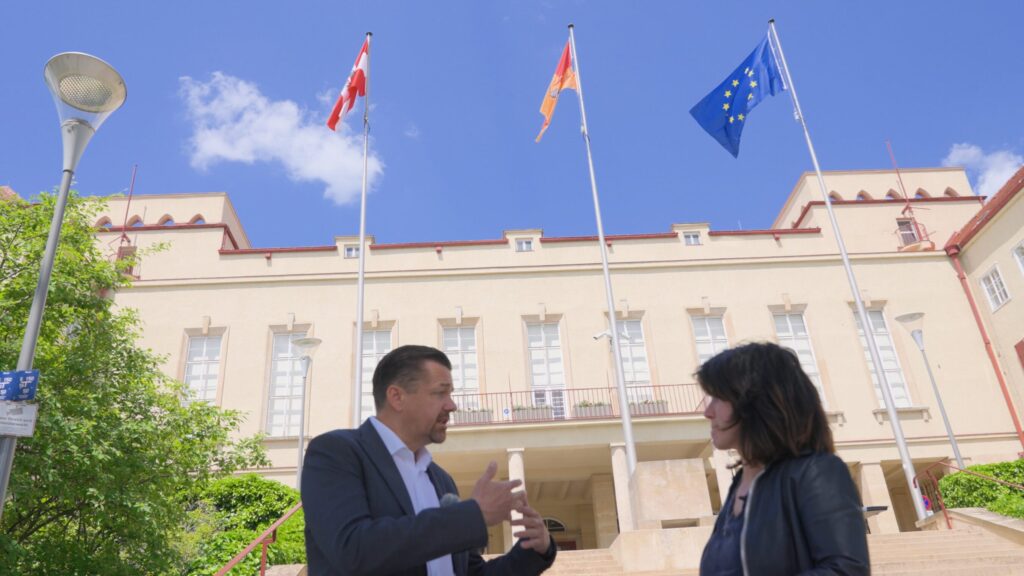
Andreas Temmel, deputy head of office, Land Burgenland / Government of Burgenland Province | Eisenstadt, May 2026
The closure order for the quarries reveals that the official inspection detected significant quantities of asbestos at all four sites. That finding matters, because once asbestos content exceeds certain thresholds, different EU rules kick in — though here, too, various actors interpret those rules in conflicting ways.
Endless Legal Wrangling
“In the EU, both products and substances must be labeled once their concentration exceeds 0.1 percent by mass — meaning the label has to state that the material contains asbestos,” Andreas Temmel says. “Determining the asbestos content and labeling the product accordingly is the quarry’s responsibility, so if they failed to meet any of those obligations in the past, the liability falls on them. Our office and the competent authority are currently conducting reviews to determine whether labeling was in fact required.” That said, the regulation requiring labeling does not block the substance from being placed on the market.
Greenpeace sees it differently. Stefan Stadler, a science and investigative analyst at Greenpeace Austria, tells Átlátszó in response to our inquiry that above 0.1 percent by mass, the regulation unambiguously places asbestos in the carcinogenic category — and trade in carcinogenic substances is prohibited. According to Greenpeace, the rules on carcinogenicity should apply to asbestos-bearing rock as well, at least above the 0.1 percent threshold.
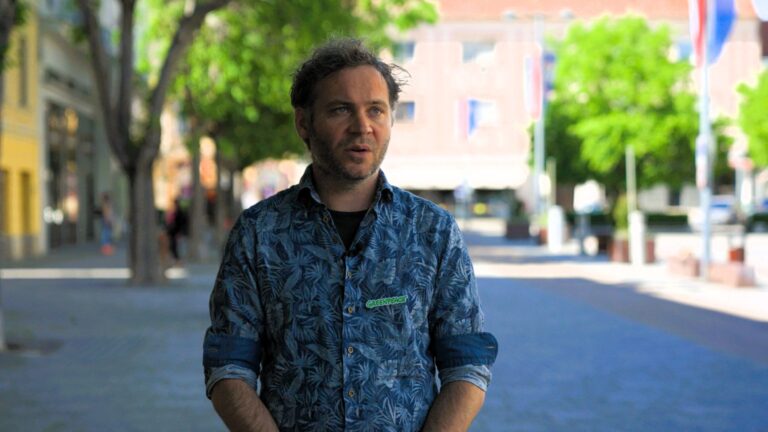
Stefan Stadler, Greenpeace Austria | May 2026
In a letter to the Burgenland provincial government, the competent Austrian ministry took the position that, while the EU rules on placing such material on the market are not unambiguous, “it can be presumed that the release into the environment of asbestos naturally occurring in Burgenland could have been prevented under the legislation already in force.”
“Of course, it’s not as if there are no legal provisions that can somehow be stretched to cover this,” Dr. Weiszburg says. “The problem is that there is no explicit prohibition. Member states are not required to adopt rules stricter than the EU’s, and as a rule, authorities only act when something forces them to.”
Weiszburg expects that “someone will be made to take the fall, and criminal proceedings will follow. The party that can be held to account, and probably will be, is the quarry owner — most likely on labeling grounds, in my view.”
“The expert reports are gradually being finalized,” Andreas Temmel, deputy head of office of the Burgenland provincial government, tells Átlátszó. “Because we’re dealing with national-level legislation, the relevant authorities and ourselves will coordinate with the competent ministries. The plan is for a decision on the fate of the closed quarries to be reached by the end of June.”
The Quarries Say Everything Is Fine
In a statement sent to our paper, the industry association representing the four shuttered Burgenland quarries says that neither the measurements conducted by Greenpeace in Austria nor those carried out in Hungary followed the proper methodology, and that the results are not credible. “Our impression is that these measurements were either performed unprofessionally or that deliberately falsified values were made public,” they insist. On the basis of visual inspection on site, they argue that the crushed stones found in Szombathely — with one exception — did not come from their quarries, and they categorically reject any suggestion that documentation was falsified.
“One must not confuse added asbestos fibers with fibers occurring naturally in minerals, since the latter are firmly bound within the rock and are therefore harmless,” they write.
“We would also note that people breathe air, not stones.”
A press release issued by the association just days ago cites a German professor in support of its claim that “no one in Burgenland need fear the stones from the quarries in question, whether they were used to surface parking lots and streets or as a base layer for roads.”
A brief search reveals that the cited “internationally recognized expert” professor also holds business interests in the stone-quarrying sector.
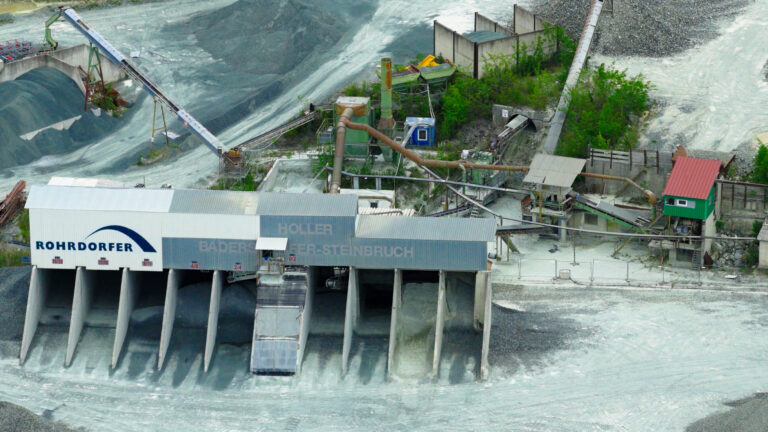
Quarry in Badersdorf | Burgenland, Austria
“As long as asbestos-bearing rock stays inside the mountain, there is of course no problem with it,” Dr. Weiszburg says. “The trouble is that, in a number of towns now, asbestos has been detected not only in the rock but in the air as well.”
“Our office’s position is that the mere presence of the rock does not in itself pose a danger — essentially not even if pedestrians walk on it,” Andreas Temmel says. “But once it’s subject to heavier vehicle traffic, or heavy trucks are driving over it, that’s clearly a problem, because at that point the rock starts to break down. We believe that busy roads should, at the time of construction, be given some form of solid surface dressing.”
How Dangerous Is It?
“When these very, very tiny fibrils enter the air as fine particulate dust and are then drawn into our lungs — into the alveoli and possibly the region of the pleura — there is no easy way for the body to clear them out,” Dr. Erzsébet Harman-Tóth, geologist and director of the ELTE Museum of Natural History, tells us amid the museum’s mineral-filled glass display cases.
“These are chemically resistant fibrous minerals; they don’t break down in the lungs, and over time they cause scarring and inflammation. That impairs respiratory capacity and gas exchange, and over the long term the constant inflammation can trigger faulty cell division, mutation, and tumor formation. There are two relevant cancer types: lung cancer, which can have many causes, and pleural mesothelioma, which doctors essentially link only to asbestos.”
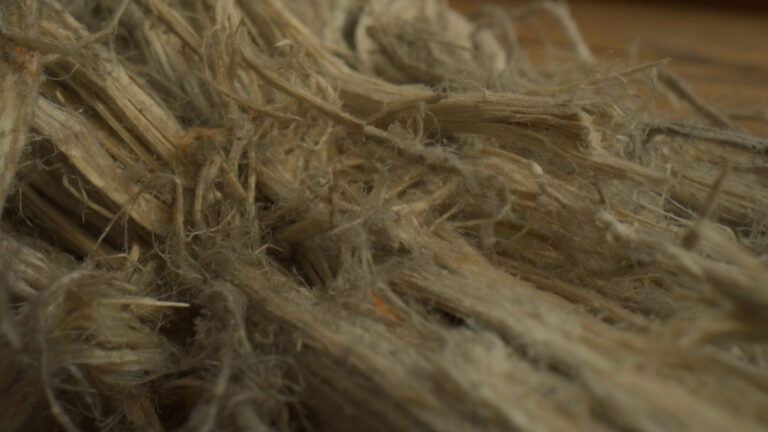
Asbestos fibers
The people most exposed to the health risk posed by the fibers are the workers who mine or process asbestos — those who work in dusty conditions without adequate protective equipment. “The longer a person inhales asbestos dust, and the greater the quantity inhaled, the higher the chance of developing a related illness, sometimes after a latency period of several decades,” the geologist says.
“The word asbestos, by the way, means ‘unsoilable’ or ‘inextinguishable,’ referring to the fact that these are fibrous materials that could be woven and spun into textiles,” Dr. Harman-Tóth explains. “The cloth made from it was even used as a cremation shroud — the dead were wrapped in it and placed on the pyre, and because the asbestos shroud did not burn, the ashes of the deceased did not mix with the ashes of the wood. Even in antiquity it was used as wicks for oil lamps, because asbestos fibers soak up oil without themselves burning away.”
For a long time, then, asbestos was treated as a miracle material — until science caught up with its devastating health effects.
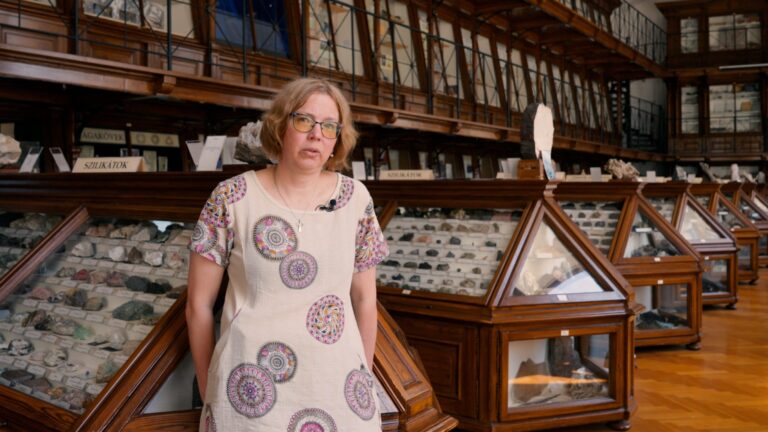
Dr. Erzsébet Harman-Tóth, geologist and director of the ELTE Museum of Natural History | Budapest, May 2026
Perhaps the best-known cautionary tale is that of Wittenoom in Australia, where a large-scale asbestos mine operated from 1943 to 1966. “It was an underground operation, mined at depth; the material was brought up, crushed, the asbestos was separated out, and then sent off for processing. People worked in dreadful conditions, in heavy dust,” Dr. Harman-Tóth recalls. “What’s more, because the whole area had an extremely dry, dusty climate, the extracted rock was spread over the town’s roads, the schoolyard, the playgrounds, everywhere. Out of a community of 12,000, more than 2,000 people have died to date from illnesses linked to asbestos exposure — including some who never worked in the mine.”
Not a Habsburg Plot
A conspiracy theory making the rounds in Hungary holds that the Austrian quarries are poisoning only Hungarians — that the operators would never sell the same junk in their own country. “That’s nonsense. Some people like to play that angle up, but it isn’t that the Austrians kept the cream for themselves and shipped the dregs, the hazardous waste, our way. There’s a scandal in Austria, too — the same rock was used there,” Dr. Weiszburg says.
Andreas Temmel believes it will be extremely difficult to trace where the asbestos-bearing rock ended up. “Beyond the four Burgenland quarries in question, there are another 14 in Austria producing this kind of rock. Over the past decades, any building-materials dealer could have bought it and resold it — to Austria, to Hungary, or to any other country.”
Greenpeace Austria began investigating and taking measurements after the four Burgenland quarries were shut down. “At first we only encountered asbestos-bearing rock in Burgenland, but later we found it in other provinces too, in all sorts of places: in asphalt, next to playgrounds and hospitals, on construction sites — everywhere,” says Stefan Stadler of Greenpeace Austria.
Quarry in Badersdorf | Burgenland, Austria
It Turns Up in Talcum Powder and Necklaces, Too
Asbestos can appear in some quite startling forms. The talc that serves as the base for talcum powder, for instance, very frequently occurs in nature alongside other minerals — including asbestos. People can even come into contact with asbestos-bearing rock through jewelry and necklaces.
“I’m holding a string of beads made of the same stone we collected in one of the affected streets in Szombathely,” Dr. Harman-Tóth says, displaying it. “The label says serpentine chrysolite matte bead — these can be bought just about anywhere for a few thousand forints. You can see the little white layers in the beads — that’s where the chrysotile asbestos fibers are. So if I wear this around my neck and it wears down with daily use, those tiny fibrils can easily come loose, and I’ll breathe them in.”
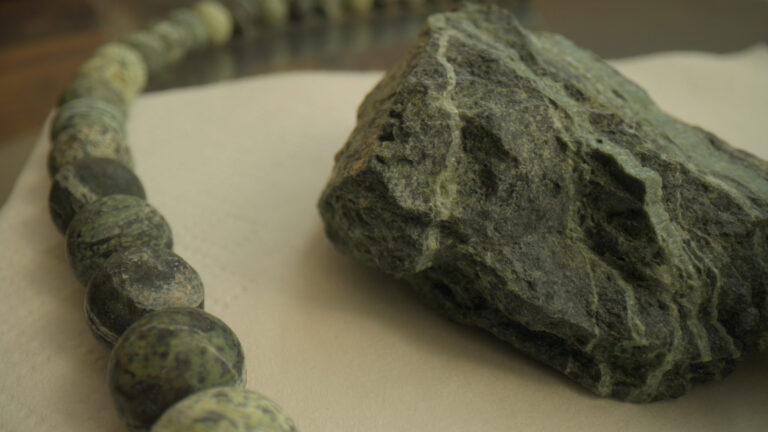
Serpentinite rock and a necklace made from it, ELTE Museum of Natural History | Budapest, May 2026
Certain varieties of quartz — falcon’s eye, tiger’s eye, cat’s eye — also contain asbestos fibers. “They’re essentially embedded in the quartz, but if you drop the stone and it breaks, they can be released into the environment — as can happen at the point where beads are drilled for stringing,” the geologist explains.
“Quartz can cause silicosis, and asbestos asbestosis, so it’s a potent combination. Of course, the amount of dust contained in a string of beads is in no way comparable to the dust load a worker handling asbestos absorbs over several decades.”
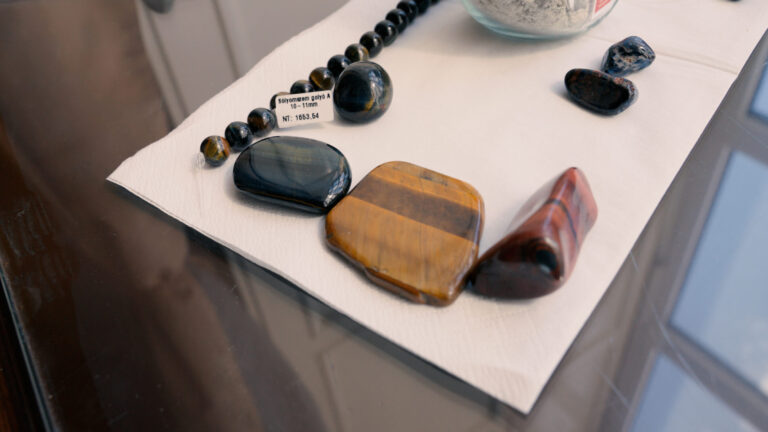
Falcon’s eye, tiger’s eye, and cat’s eye at the ELTE Museum of Natural History | Budapest, May 2026
Regulation Is Needed
“For decades now, people have been trying — and lately we’ve been trying as well — to draw legislators’ attention to the fact that this is a regulatory gap,” Dr. Weiszburg says. “You really can’t accuse Brussels of disliking the act of regulating things, so I genuinely cannot fathom why this still hasn’t been properly regulated.”
The problem has now plainly manifested itself in Burgenland and Hungary, but it can cause the same kind of trouble when a tunnel is bored through a mountain range, or when fields are plowed in certain areas. “We know Europe’s geology extremely well; we know where the areas are — thank goodness, none of them in Hungary — in which asbestos could have formed,” the geologist says. “Those areas need to be mapped, and the rules need to spell out what can’t be done there. For example, opening a quarry.”
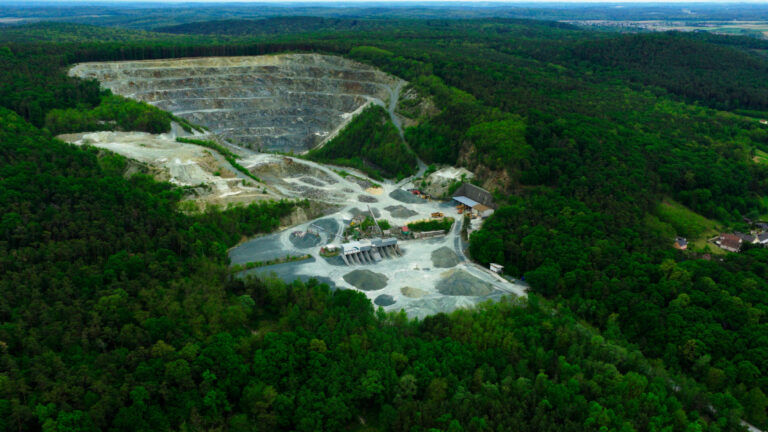
Quarry in Badersdorf | Burgenland, Austria
“In history class we learned that the Neolithic was followed by the Copper Age, the Bronze Age, the Iron Age — making it sound as though we’d left the Stone Age behind,” Weiszburg says. “We have not. Humanity has never used as much stone as it is using in the twenty-first century. Stone is an incredibly important thing, and stone is fundamentally our friend — but this legal loophole needs to be closed.”
The European Commission did not respond to our inquiry.
This investigation was originally published in Hungarian on Atlatszo.hu.
Subscribe to Goulash, our original VSquare newsletter that delivers the best investigative journalism from Central Europe straight to your inbox!


An economist, former policy director at an environmentally-focused think tank, Orsolya Fülöp was a freelancer at Magyar Narancs and Atlatszo. She specializes in investigating controversial environmental issues, from burning landfills to leaking nuclear power plants. She also manages Atlatszo’s international projects.