




The Disinformation Machine Behind Czech and Slovak Anti-Wind Farm Campaigns
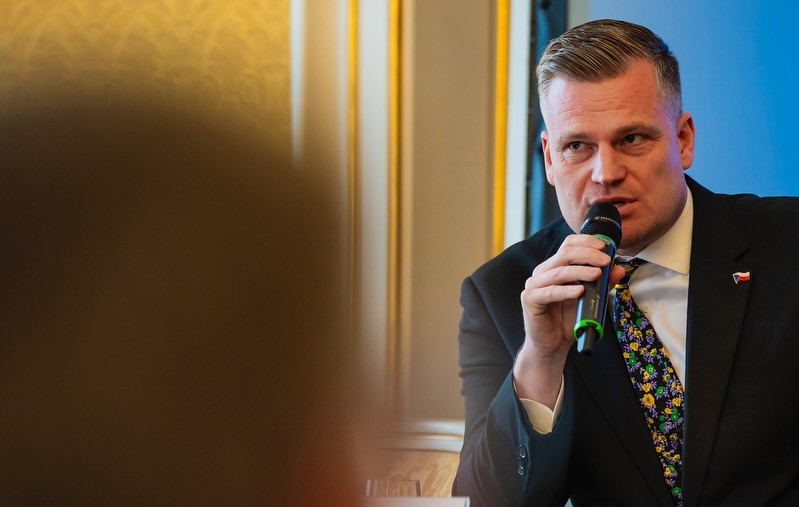
Illustration: Facebook of Filip Turek 2026-03-05


Illustration: Facebook of Filip Turek 2026-03-05
Leading politicians from Andrej Babiš’s government are attacking wind turbines, and the movement against them is gaining ground throughout the Czech Republic. But surprising help is coming from Slovakia, and specifically from a yogi with a passion for Eastern spirituality and Slavic culture. According to the findings of the Investigative Center of Ján Kuciak (ICJK) and Deník Referendum, wind turbine opponents are becoming active on Facebook, and Slovaks committed to the anti-turbine movement are “exporting” their disinformation to the Czech Republic.
At the beginning of February of this year, a referendum was held in the village of Dedina Mládeže in southern Slovakia. In that referendum, residents rejected the construction of wind farms in the village’s vicinity. This is not an isolated case. Similar referendums were held last year. Back in the summer, the daily SME pointed out that movements against wind energy have grown significantly stronger.
Some opponents of wind power try to motivate local residents to resist by using various hoaxes and false information in their arguments. Among other things, they claim that the infrasound coming from the turbines is dangerous to people’s health and that real estate in their vicinity will lose value. They participate in public discussions about the construction of wind power plants and write petitions.
Wind power’s opponents are also uniting online. An analysis by the Czech daily Referendum and the Ján Kuciak Investigative Center found that arguments against wind farms are spreading intensively on social networks, especially in Facebook groups. Interestingly, Slovak activists are also “exporting” their often fabricated claims to the Czech Republic, where they have become important players in the fight against wind turbines.
In the Czech Republic, government politicians are also speaking out on this topic. “It is a disaster that has no impact on our energy mix,” Filip Turek, the newly appointed government plenipotentiary for climate policy and the Green Deal and an unsuccessful candidate for the post of Minister of the Environment, said recently. Meanwhile, other representatives of parties in the Czech coalition are also spreading disinformation about wind farms.
The situation in Slovakia is very similar. As part of the Recovery and Resilience Plan, the country has committed to supporting the development of wind energy. However, the current Minister of the Environment and Deputy Prime Minister considers wind farms to be “unnecessary.” Back in June of last year, Tomáš Taraba stated that “The Ministry of the Environment does not plan to support the construction of wind farms, on the contrary, we want to have strong control over it … I have already defined in the past that we will also tighten the conditions in the process, when the consent of municipalities, the consent of transmission system operators with the connection and many other things will be required.”
The source of Czech opposition to wind turbines is often the Slovak website zapravdu.sk, run by Slovak yogi Daniel Máčovský. Together with his colleague Katarína Ondrušová, he is among the most prominent figures in the current movement against wind farms—and not only in Slovakia. For her part, since last year, Ondrušová has also appeared at public meetings in Czech municipalities. These connections show that opposition to wind energy may no longer be just the spontaneous reactions of local communities, but a coordinated movement that extends beyond the borders of Slovakia.
Climate disinformation expert Vojtěch Pecka points out that, while the outrage of some parts of the public is understandable to an extent, it is often based on false or exaggerated information. He also points to insufficient communication from the state administration, which creates a vacuum that these players fill.
A recent analysis by the Prague-based Association for International Affairs (AMO) also pointed to the strong influence of the Slovak yogi and his website on Czech anti-wind movements. AMO’s analysis directly identifies him as an ideological source and presents Máčovský’s Facebook group as “a key Slovak node” on the social network.
Slovak Yogi and the Disinformation Scene Against Wind Turbines
The domain Zapravdu.sk was registered at the end of 2017 by the civic association Bhaku Joga Centrum, the declared goals of which are “promotion of Bhakti Yoga (selfless love for God)” and “support of cultural and spiritual understanding between the West and the East, especially between Hinduism and Christianity.” There is no mention of the issue of wind farms.
The organization, like the Zapravdu.sk website, is led by Daniel Máčovský, a “Himalayan yogi” who popularizes not only Eastern spirituality but also the idea of Slavic culture.
In addition to attacks on wind farms, Máčovský also offers “Mother Glory coins” on his website. These are supposed to symbolize the rebirth of the nation. Máčovský also uses the middle name Slobodan on Facebook.
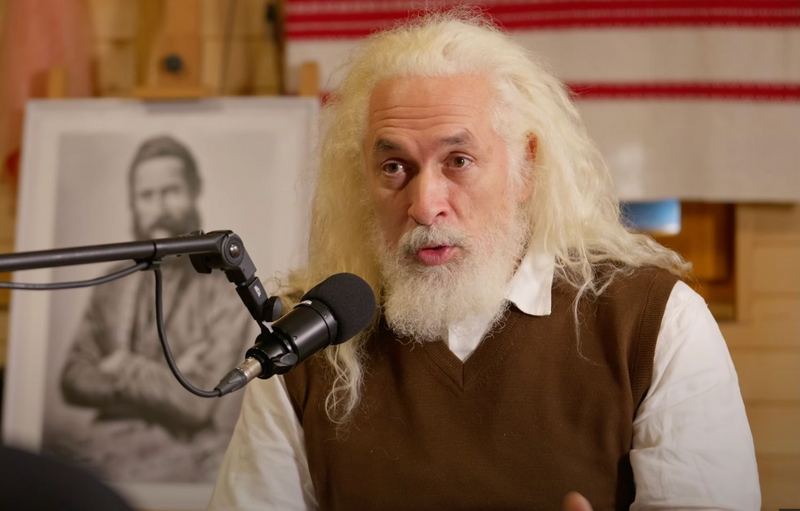
Slovak “Himalayan” yogi Daniel Slobodan Máčovský, also known as Swami Dayananda, is a successful organizer of the movement against wind farms not in Slovakia but and in the Czech Republic. Source: Youtube/Reprofoto
Máčovský began to focus on the issue of wind farms last year. Since last March, he has been publishing articles on his website about the alleged negative impacts of wind farms. He is also one of the administrators of the Facebook group “For the truth about wind farms.” The group has more than 6,000 members and is currently one of the most active anti-wind forums in Slovakia. It was also founded in March 2025. Máčovský writes about protecting the country from the “turbine plague.”
“Whether it’s vaccinations or now wind turbines, when they want to interfere with my freedom or space, it turns me on,” Máčovský told the daily Referendum of his motivation to fight against wind turbines. He says he became active during the coronavirus pandemic.
He cites plans to build a wind farm near his home—specifically, the plan by the Nuclear Energy Company Slovakia (JESS) to build almost 70 wind turbines near Hlohovec—as the initial impetus for his opposition to wind turbines.
In May of last year, Máčovský helped initiate a nationwide petition against the construction of wind farms, which was followed up in June with another petition against not only the construction of wind farms, but also solar power plants, battery storage facilities, and incinerators.
In addition to Máčovský, several other associations and groups united by the promotion of Slavic culture, opposition to climate policy, and against the COVID-19 vaccine, are behind the petition. Among them is the Slavica association, whose honorary member, microbiologist Soňa Peková, is also a star of the disinformation scene, known for spreading refuted lies about Covid.
According to Czech sociologist Vojtěch Pecka, campaigns against wind farms have intensified significantly over the past year. However, this phenomenon is not limited to Slovakia or the Czech Republic, and similar strategies have been evident abroad for a long time. Pecka points to an article published on the Evidence Ninja website, which describes a study from the US that shows that lobby groups promoting fossil fuel extraction are systematically spreading panic in connection with the construction of wind farms on the coasts, claiming that the turbines kill whales.
A Guide to Stopping the Construction of Wind Farms
In the aforementioned petitions, Máčovský demanded that residents of municipalities decide on each wind farm project in referendums. He then actively promoted them in his Facebook group “For the Truth About Wind Farms.” He also advised his Facebook group members on how to contact local residents or municipal councils in areas where wind farms are planned and how to initiate a referendum.
He also educates those interested in how to fight against wind farms, advising them to write petitions and distribute leaflets, and offers his arguments for discussion. He also publishes instructions on his website Zapravdu.sk.
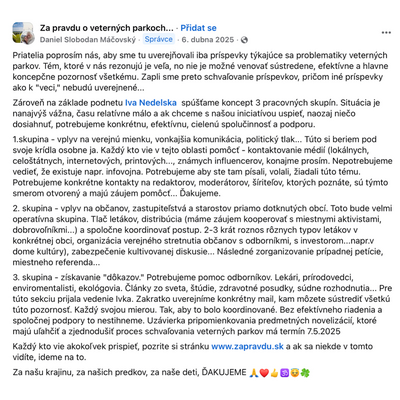
Daniel Máčovský is organizing an anti-wind movement via his Facebook group and on his website Zapravdu.sk. Source: Facebook
His main arguments against wind turbines are the health damage caused by so-called infrasound. With links to Máčovský’s materials on the Zapravdu.sk website, these arguments also appear on Czech websites and Facebook groups against wind turbines.
However, according to Zděnka Vandasová from the Czech National Institute of Public Health, Máčovský’s claims are unfounded. Noise from wind turbines can be unpleasant, but specific health consequences have not been proven, and whether they exist at all is controversial.
According to Vandasová, infrasound, i.e. sound with low frequencies inaudible to the human ear, is not specific to wind turbines. “It is part of traffic noise or common sounds of nature, such as the rustling of trees in the wind or noise from household appliances. There is no evidence that infrasound or low-frequency sound from wind turbines has a more significant impact on residents than other audible noise,” Vandasová told Deník Referendum.
However, Vandasová also admits that many people may experience significant discomfort from the noise of wind turbines and the visual effects of rotating blades. “However, this is what the permitting process is for. Without excluding the negative impacts of power plants on the lives of people in the area, the project will not receive a building permit,” Vandasová added, stressing that controversial projects may also be subject to hygiene investigations.
In addition to infrasound, Máčovský warns of a drop in property prices near wind farms. According to experts, however, this is at best a prejudice. David Slavata from the Mining Institute of the Technical University of Ostrava and Bohumil Frantál from the Academy of Sciences addressed this issue in a comparative study . The researchers compared two comparable municipalities in six locations: one with wind farms and one without them. In only one of the municipalities did property prices fall (by approximately five percent) between 2014 and 2024.
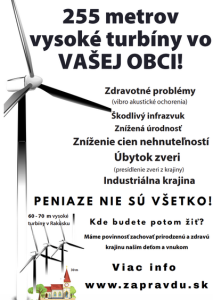
Source: zapravdu.sk
Máčovský defends himself against these objections by claiming that there are hundreds of scientific studies on the negative effects of wind turbines. He even offers a book on his website summarizing these alleged studies. He asks 37 euros for it.
Slovak Disinformation Spreads in the Czech Republic
Máčovský’s campaign does not end at the Slovak border. “My colleague, a good friend Katarína Ondrušová, travels to the Czech Republic more,” the yogi fighting against wind energy told a reporter from Deník Referendum. He claims that Ondrušová has been working on the topic of wind farms for six years.
Katarína Ondrušová is a local MP in the village of Dubovce, located just fifteen kilometers from Hodonín in the Czech Republic. Last summer, in an interview with the disinformation outlet Slobodný steleač, she introduced herself as a representative of the associations Pokojný vietor and Cesta k prameňu [Calm wind and a Journey to the spring] – by the way, the same title goes to Daniel Máčovský’s book, in which the yogi writes about his “spiritual mastery . ”
So far, she has been present for discussions about wind power plants in the village of Milín and in the village of Velká Skrovnice, where the Czech investment company Redwood Capital wanted to build seven wind turbines.
According to Mayor of Velká Skrovnice, Pavel Chalupa, locals were initially in favor of the project. However, at the end of the summer, opponents started a Facebook group called “Větrníky Skrovnice (Wind Turbines of Skrovnice),” where they began sharing arguments against wind turbines. “Gradually, public opinion turned against the project,” Chalupa told Deník Referendum.
According to Chalupa, the situation escalated during a discussion organized by the municipality, which included deputies of the developer and energy experts from the Ministry of the Environment. As a recording of the discussion shows, Ondrušová was the first speaker in the open discussion. “She was sitting there with a bunch of complete strangers at a table and then she took the floor,” recalls Mayor Chalupa. Ondrušová said that “the worst are the noise and infrasound.” She also claimed that people living near wind farms have trouble sleeping and “their blood pressure is soaring.” According to the mayor, this scared the locals and the ensuing debate was tense.
According to Chalupa, Ondrušová was invited to the discussion by local opponents of the power plants, who also initiated a petition after the discussion. The council ultimately ended negotiations with the investor.
“I accept that wind farms are huge and not very pretty, but I don’t agree that they would destroy our community,” says the mayor. He also believes that they would benefit the entire Czech Republic. “In addition, the investor offered the community a rent of the land of twice its current annual budget,” he adds.
At the beginning of February this year, Katarína Ondrušová spoke in the village of Mimoň at a discussion, the topic of which was the planned wind farm project in Ralsko. It is being prepared by the ČEZ group. Ondrušová warned, “It affects insects and bees. Pieces fly from the blades into the soil, which irreversibly damage it. (…) Life ends within a radius of up to fifteen kilometers around the turbine,” Ondrušová said, terrifying the audience.
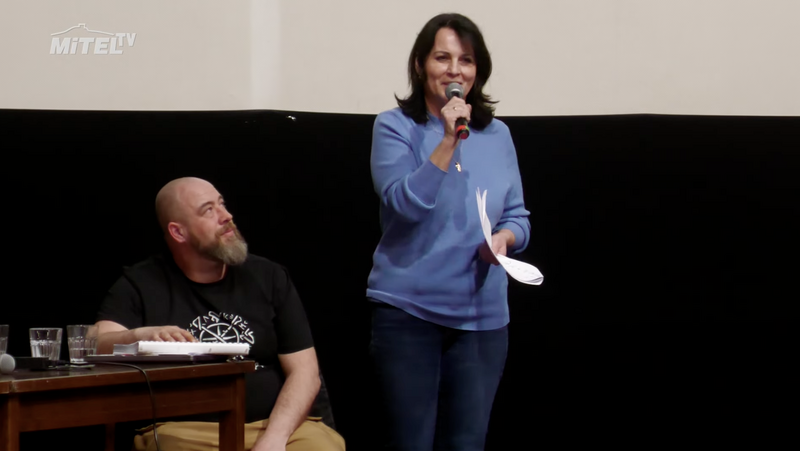
Katarína Ondrušová at a discussion in the Czech village of Mimoň. Source: Youtube/Reprofoto
At the same time, she appreciated that the opposition to wind farms has renewed Czech-Slovak relations. “Investors will tell you A, we are trying to tell you B. … We are trying to give you information that mayors will not give you…,” she said.
Hand in Hand with the Far Right
Katarína Ondrušová also regularly participates in discussions with representatives of far-right parties in the Czech Republic. In Milín, Libor Vondráček, a member of the Czech Parliament who, as chairman of the Svobodní party, was on the SPD candidate list, spoke next to her. The mayor of the village, Vladimír Vojáček, said that he did not know Ondrušová and did not know who invited her.
In mid-February of this year, she spoke at a discussion in the village of Věžky dedicated to the Haná wind farm project, which is being prepared by the company Jipocar. In addition to Ondrušová, the discussion was also attended by former SPD candidate for mayor of Prague Tomia Okamura, energy expert Hynek Beran, and senator Jana Zwyrtek Hamplová, also known for her disinformation about COVID-19 and Ukrainians spreading tuberculosis in the Czech Republic, for which she eventually apologized .
When asked by the daily Referendum, Daniel Máčovský said that he and Ondrušová were invited to the Czech Republic by local opponents of wind farms. He also mentioned a meeting with Hynek Beran and other opponents at which the participants exchanged experiences and coordinated their joint action.
Máčovský also added that his activities are financed by small donors who contribute via the Zapravda.sk website. In addition to the payment of 4,725 euros for the printing of Máčovský’s book on the negative effects of wind farms, the statements show an expense of 100 euros at the MOL gas station in Průhonice near Prague. The account currently has a little over 1,400 euros.
” Connection to Russia? I Wish…”
In a December report on the Czech Television program Reportéři, Štěpán Chalupa, chairman of the Czech Chamber for Renewable Energy Sources, said that Russia’s support for these activities cannot be ruled out. According to Chalupa, it is in Russia’s strategic interest to keep Europe dependent on natural gas.
“I have no ties to the Russian Federation or any other foreign state and I categorically reject such accusations as false and discrediting. For some, it may be incomprehensible today that a person defends their home, their country and the health of its inhabitants exclusively with their own money and in their free time,” Katarína Ondrušová said in response to our question about a possible connection with Russia. She claims that she pays for all her trips to the Czech Republic with her own resources.
Máčovský reacted similarly. “I would be happy if someone paid us and I would not be ashamed of it,” he said when asked if the money for his activities came from Russia. He categorically rejects suspicions of cooperation with Russia, calling them “disgusting lies.” “This has simply become some kind of manipulative and disgusting lie that everything that does not suit us comes from Russia,” he said.
On the other hand, he expressed surprise that his activities do not have the support of political parties. “I find it very strange that no political party in Slovakia has taken up this agenda,” he added. For now, however, he claims that he carries out his activities against wind farms in his free time and with family resources and funds from small donors who contribute to his transparent account.
Although Ondrušová and Máčovský deny any connection to Russia, the fact remains that they operate in a community of disinformation media, which does have possible connection to Russian influence operations as revealed by the Czech editorial team Voxpot.
In January 2026, Máčovský gave an interview to the website Hlavné správy, which is also listed on the website Konspiratori.sk as a disinformation outlet. This website has previously been implicated in a case of suspected cooperation with Russia. In 2022, Denník N published a video in which a Russian embassy employee recruits a colleague of Ondrušová and Máčovský, Bohuš Garbár, who was later convicted of espionage and accepting bribes from the Russian GRU.
A Little Truth and a Big Lie
According to sociologist and climate disinformation expert Vojtěch Pecka, there is no single clear reason that people engage in opposition to wind turbines. It is rather a combination of tendencies towards conspiratorial thinking, fear of endangering the country, and possibly economic and geopolitical interests. “These people are often convinced that they are saving something,” explains Pecka.
But he also points out that, while the outrage of some members of the public is understandable to an extent, it is often based on false or exaggerated information. “Powerful actors linked to the fossil fuel industry and the long-term influence of Russian information operations that systematically question renewable energy sources and the European Union’s climate policy also play a significant role.”
According to Peck, disinformation campaigns rarely work with completely fabricated claims. More often, they are based on partially true information that is deliberately distorted. “It’s rare to find something that is completely fabricated. Usually, some basis of truth is taken and then significantly exaggerated,” Peck says, adding that people who do not have time to thoroughly verify information often only check the part of the message that may actually be true and do not realize that the rest is misleading.
As an example, he cites the claim that microplastics are released from wind turbine blades. According to him, they can be released during mechanical damage, but this is a completely negligible fraction compared to the main sources of microplastics, which include, for example, tire wear when driving a car.
This investigation was originally published in Slovak on ICJK.sk.
Subscribe to Goulash, our original VSquare newsletter that delivers the best investigative journalism from Central Europe straight to your inbox!

Karin Kőváry Sólymos is a Slovak journalist at the Investigative Center of Ján Kuciak. Previously, she was an editor and presenter at the Hungarian channel of the Slovak public service media. During her university years, she was an analyst for the only fact-checking portal in Slovakia. She was a recipient of the Novinarska Cena 2022.