




Investigating the Orbán Era and Surviving Its Attacks: Átlátszó at 15
Photo: Átlátszó 2026-07-31


Fifteen years ago, Átlátszó began as a largely unfunded experiment: a nonprofit investigative newsroom designed to protect journalists from the political and business pressures constraining Hungary’s media. It went on to expose the hidden wealth, public-money schemes and environmental abuses of the Orbán era — all while surviving police action, smear campaigns and an escalating effort to portray independent journalism as a national security threat. On its 15th anniversary, founder Tamás Bodoky reflects on the investigations that defined the outlet, the struggle to keep it alive and Átlátszó’s role in Hungary’s post-Orbán future.
Why did you launch Átlátszó 15 years ago, and under what circumstances was it founded?
After I left Hungary’s largest news site, Index, I couldn’t find a newsroom where I would have wanted to continue doing investigative journalism. I became convinced that Hungary needed a nonprofit investigative newspaper or publisher — one where journalistic freedom would not be limited by political or business entanglements at the ownership or publisher level. I wasn’t able to secure funding for the project in advance, so Átlátszó essentially began as an experiment in 2011. But because it proved successful, that experiment has continued ever since.
Among other accusations, the now-defunct Sovereignty Protection Office claimed in 2024 that Átlátszó had been launched with Western funding. Nothing could have been further from the truth. In fact, when we launched, several Western embassies contacted us nervously because our whistleblower platform was called MagyarLeaks. We had to reassure them that we had no geopolitical ambitions and would “only” be collecting and publishing information about Hungarian public affairs.
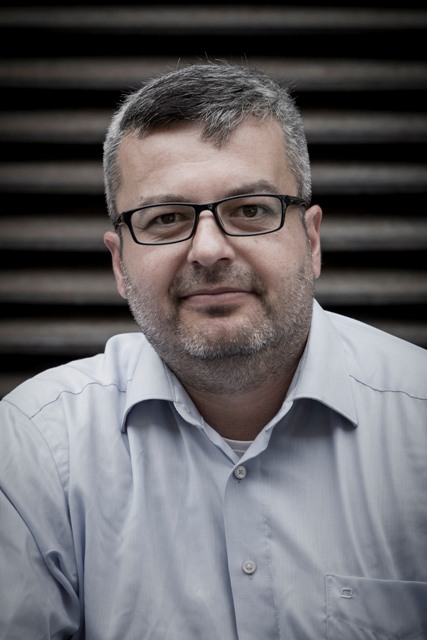
Tamás Bodoky. Photo: Átlátszó
What did you want to do differently from other Hungarian online news outlets?
Before founding Átlátszó, I repeatedly found that my investigative work was being restricted for reasons that had nothing to do with journalism. I therefore believed we needed a nonprofit publisher where an outlet’s advertisers or its owner’s business partners would never be off-limits, and where the publisher would defend its journalists rather than retreat when an article came under political or legal attack.
I saw no point in launching yet another website devoted to daily news. I wanted to produce original, newsworthy investigations based on our own reporting, primarily by following the flow of public money.
In addition to traditional reporting and source development, we planned to obtain exclusive information through freedom-of-information requests, litigation when necessary and leaks. For that purpose, we created a secure, anonymous whistleblower platform. We verify all materials submitted through that platform through independent journalistic research.
Freedom-of-information requests and leaks complement one another. On several occasions, documents we failed to obtain through official records requests were eventually leaked to us.
Which stories over the years are you proudest of?
There are many. I am especially proud of the cases where we were the first to uncover issues that later developed into major national stories.
Examples include the estate-building and business empire of Lőrinc Mészáros, the former mayor of Felcsút; the enrichment of the prime minister’s son-in-law through public money; the private jets and yachts secretly used by government politicians and oligarchs close to the ruling party; the creative use of European Union funds by politically connected actors; and the environmental problems connected to the arrival of the battery industry in Hungary.
We were the first in Hungary to conduct camera-drone investigations, and we also launched a freedom of information request system that anyone can use.
Around a decade ago, it became clear that restrictions on press freedom were hitting local communities outside Budapest particularly hard. We recruited regional journalists and investigated countless local cases. These included the now internationally notorious canopy walkway in Nyírmártonfalva, which was built after the surrounding forest had been cut down, and a roundabout in Zalaegerszeg that appeared to lead from nowhere to nowhere and was even featured by CNN during the most recent election campaign.
What were the most serious attacks you faced from the Orbán regime?
The Orbán regime wanted to replace the entire Hungarian press with loyalists and they were hostile toward us from the beginning. The first major scandal was the source-protection case in 2011. Authorities wanted to identify the source of one of our articles, and the police seized a hard drive from my apartment roughly two weeks after we launched. After a successful appeal to the Constitutional Court, the case ultimately resulted in stronger legal safeguards for journalistic source protection. Then came the Norwegian Civil Fund affair in 2014, with articles smearing us and threats issued in the form of political statements. The government raided the foundation distributing the grants, and, as a beneficiary, we ended up on some kind of blacklist.
Later, during the government’s campaign to drive the Open Society Foundations out of Hungary, we were attacked as George Soros’s “bloggers” and even labeled as his “governors.” The government-aligned Civil Unity Forum also targeted us after a successful investigation in which we uncovered how much money it had received from a state-owned company and went undercover on one of its trips to Warsaw.
The rhetoric of these attacks grew steadily more aggressive over the past decade. Toward the end of the Orbán era, we were being described as a national security threat and accused of treason. The government even created a state authority, the Sovereignty Protection Office, which selected Transparency International Hungary and Átlátszó as the first organizations to investigate.
Had there not been a change of government this year, I do not believe we would have survived another four years. There was a clear government intention to ban Átlátszó.
How large is your team, how much have you grown over the years, and how are you funded?
At the beginning, a handful of volunteers assisted me while I worked as Átlátszó’s only journalist. Today, we have approximately 10 full-time employees and roughly the same number of freelance journalists and videographers, in addition to administrative staff, lawyers and IT specialists.
We operate on a very limited budget. Approximately half of our funding comes from our audience in the form of small donations and allocations of 1 percent of personal income tax. The other half comes from international institutional donors and grants.
We have not been able to expand further in recent years, but we are making significant efforts to improve our long-term sustainability. We regularly campaign for reader contributions, and we have also recognized that video reports are much more effective than text-only articles at reaching younger audiences.
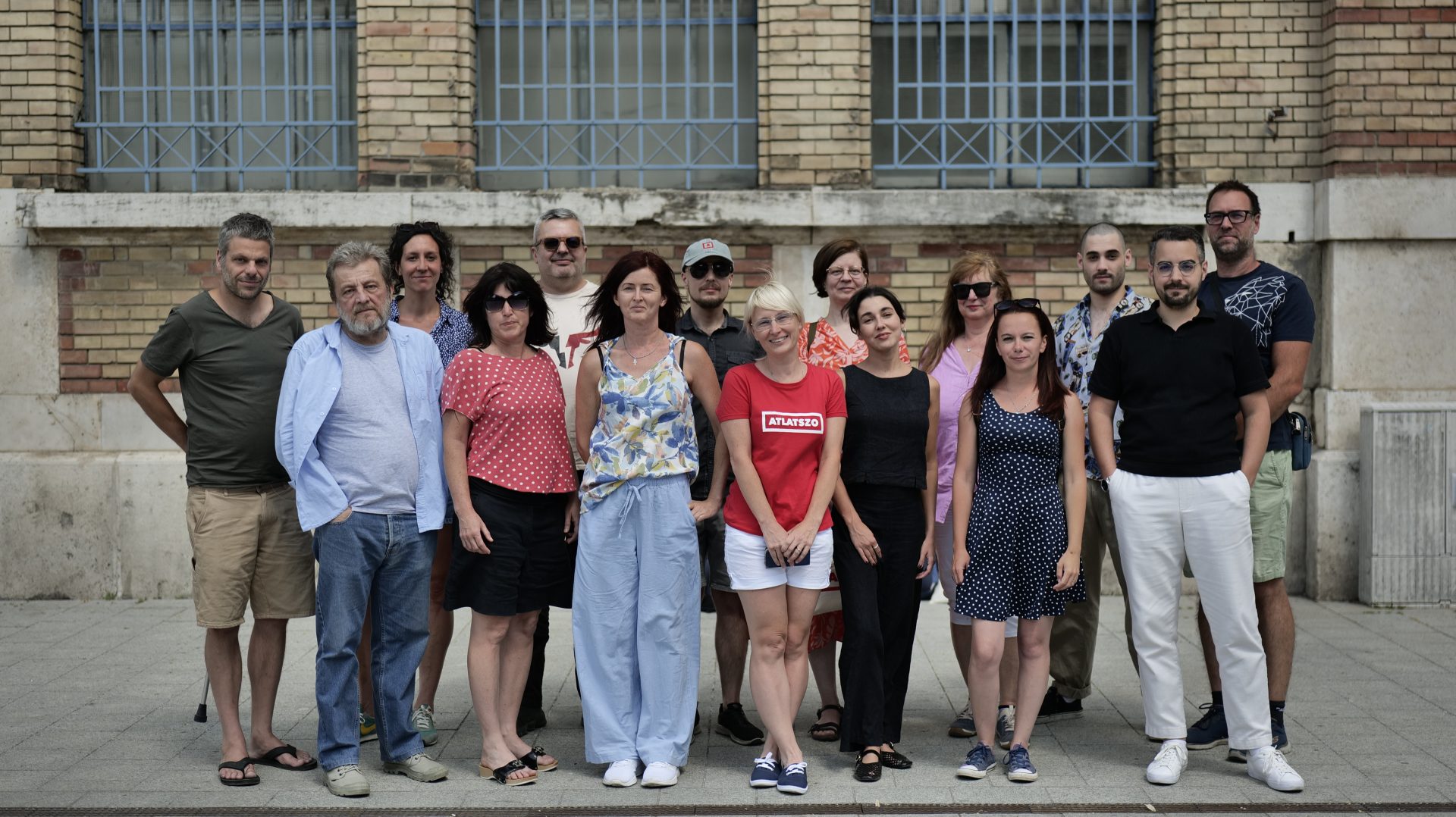
Átlátszó’s current team. Photo: Átlátszó
What role do you think the independent Hungarian media will play after Orbán’s fall? Do you expect the sector to face a crisis as readership and funding decline?
Independent Hungarian media will remain essential after Orbán’s fall. The new government must also be scrutinized and made accountable. Moreover, many events and abuses from the past 16 years have still not been fully investigated from a journalistic perspective.
The major question is: how much of this work the Hungarian public and international donor organizations will be willing to finance? If these sources of funding suddenly disappear, it could indeed trigger a crisis or a broader transformation of the sector.
At the same time, I hope new funding opportunities will become available both to Átlátszó and to the independent media more broadly. In a market as small as Hungary’s, I do not consider the idea of public funding through an independent press fund inherently problematic. Another possibility would be an additional 1 percent income-tax designation that taxpayers could allocate to news organizations, modeled on the existing system for supporting civil society organizations.
In this context, I believe it is important to draw a clearer distinction between for-profit media companies that operate in the advertising market and nonprofit news organizations. During the Orbán era, we saw large commercial media companies begin to behave like civil society organizations by seeking crowdfunding and collecting the 1 percent tax allocations intended for nonprofits. That did not necessarily benefit smaller nonprofit publishers.
What are Átlátszó’s plans for the next 15 years?
Surviving the Orbán era meant planning only one year at a time, and even then, we encountered plenty of unpleasant surprises. As a result, we do not have a fixed 15-year plan.
Our minimum objective is to make our current level of operations sustainable while relying increasingly on revenue from our readers. Developing our video content is another major priority. Alongside written investigations, we want to produce more video reports because they reach much larger audiences and provide a far more effective way of connecting with younger generations.
After years of fighting a war of attrition at home, we also want to reconnect with international journalism networks and participate in more cross-border investigations.
Beyond political stories of national importance, we want to investigate issues that would not normally attract the attention of the mainstream media. In addition to monitoring the spending of public money, we want to do much more work on environmental and rural stories. Because of climate change, interest in agricultural stories and the problems facing rural communities has grown enormously.
Subscribe to “Goulash”, our newsletter with original scoops and the best investigative journalism from Central Europe, written by Szabolcs Panyi. Get it in your inbox every second Thursday!

VSquare’s Budapest-based lead investigative editor in charge of Central European investigations, Szabolcs Panyi is also a Hungarian investigative journalist at Direkt36. He covers national security, foreign policy, and Russian and Chinese influence. He was a European Press Prize finalist in 2018 and 2021.