What an Election Can Change: Hungarians Trust Their Government, Slovaks Fear for Democracy
Photo: Globsec 2026-11-19


The GLOBSEC Trends 2026: The Reality Check report analyzed public attitudes across Europe, this year expanding on the Central Eastern European countries countries usually included in the survey on topics such as security, democracy and resilience, trust in institutions and strategic partnerships. The findings of this report are based on a quantitative public opinion survey carried out between May 11 and 19 2026 in 14 countries: Bulgaria, Czechia, Estonia, France, Germany, Hungary, Latvia, Lithuania, Poland, Romania, Slovakia, Ukraine, the United Kingdom and the United States.
Katarína Klingová, a research lead at the Center for Democracy & Resilience at the GLOBSEC Policy Institute, spoke to VSquare about the 2026 report, which she co-authored. Katarína previously worked with Transparency International Slovakia and the European Commission. We look at the recent democratic and security developments in the V4 region.

Source: Archive of Katarína Klingová
Since last year, Hungary has undergone a major political shift. Péter Magyar’s Tisza party won the election, ending Viktor Orbán’s 16 years in power. Elsewhere in the V4 region, Poland is in the midst of a Constitutional Tribunal crisis, with Prime Minister Donald Tusk and President Karol Nawrocki locked in a showdown. Slovakia is awaiting next year’s parliamentary election, while its governing coalition currently lacks a majority. Respondents in your survey identified corruption and the weakening of democratic checks and balances as major threats. Based on what we’re seeing, what can we expect from the region in the future?
We’ve seen a lot of change in the region. The change of government in Hungary after 16 years of Orbán brought a great deal of optimism, though problems continue. Hungary is the only post-Soviet country out of the 14 we surveyed where a majority (55%) say democracy is strong, and 71% of Hungarian respondents trust their government and its ability to function. But Magyar’s government also carries a lot of responsibility. The question is whether this enthusiasm will last and translate into the successful adoption of the reforms the government now needs to develop. The government has already been rewarded for what it has achieved so far. In October, the EU Council ended the 2022 conditionality procedure and released €4.2 billion. In recent days, we’ve also seen the households of several former ministers and six former state secretaries raided, with police finding millions of euros in cash, including foreign currency, hidden in all sorts of places, from homes to forests. I think this is a step Hungarian voters wanted to see.
Democracy is a process. Elections can certainly help change a country’s direction toward a more democratic path and restore checks and balances. There is now more unity in the region, and Hungary no longer stands out as a “Trojan horse of Moscow,” blocking reforms at the EU level and sliding further into democratic decline. After the 2023 election, Slovakia followed Hungary closely down the same path of democratic decline. It took Hungarians 16 years and a great deal of effort, but they showed that democratic principles are alive, that people want change and want to be involved, and that democracy in the region can recover. It remains an open question whether Slovakia or Czechia will become the new Hungary and start blocking reforms.
What we observed in Hungary for several years was nothing new. It followed the Kremlin playbook: attacks on and capture of public media, attacks on civil society organizations, and capture of public institutions. It was the European Union that blocked or helped to block these moves. In Slovakia’s case, even the Constitutional Court ruled against unconstitutional policies to stop them from developing further. In the long term, what we’re seeing is that governing majorities are reshaping institutions in Poland, Slovakia, and, partially, the Czech Republic. Brussels can set conditions and benchmarks, but it cannot resolve these conflicts. The fight for democracy has to happen domestically, and citizens themselves need to defend their independent institutions.
I’d like to talk about recent events in the Czech Republic. When we spoke last year, we discussed how the Czech Republic scored rather high on trust in traditional media (57%). This year, 73% of Czech respondents believe their democracy works, the highest share among the 14 countries surveyed. In the last few days, we’ve seen a direct impact of this mindset in the biggest demonstration in Prague since 1989. How do these strong sentiments compare with the rest of the region? Why is this such a strong point of agreement among the Czech public?
In the Czech Republic, trust in the government and its functioning stands at 55%, second only to Hungary, which is the most optimistic. However, only one third of Czech respondents are optimistic about their future. So Czechs value a functioning democracy and appear ready to defend it when it is threatened, as the protests show.
We do see attempts to cause democratic decline similar to those we observed in Hungary and Slovakia. But Czechia is at an earlier stage, the government faces more resistance, and the institutions are somewhat stronger. The president, for example, is an important counterweight to the government. Returning to the national broadcaster, 52% of respondents say they typically get their information from national TV news. That makes the independence of the Czech public broadcaster, whether television or radio, extremely important, and it is exactly what Czechs are fighting for.
Poland and the Czech Republic have both held elections recently. What can we expect from the 2027 elections in Slovakia?
There is never a dull moment in Slovakia. Our data shows that Slovak respondents are the most worried in Central Europe when it comes to democracy: 69% see democracy in their country as under threat, 49% name corruption as a reason for a failing democracy, and only 40% trust the courts. People clearly see what is happening. The government has been adopting, or attempting to adopt, legislative amendments and new laws that protect government members facing criminal corruption charges, and people notice.
There are high expectations for the 2027 elections, and we will see how the situation develops. The question is whether the opposition parties can convince voters and form a strong governing coalition that can start the reforms that are needed. We can also see this in the newly adopted multi-annual budget. Coalition members have said very openly that this budget and the spending planned for 2027 are largely electoral and aimed at satisfying their voters. There are very few plans or visions that go beyond 2027. This shows that the government’s priority is to win the elections and stay in power. The big question is whether it will succeed.
According to some of your results, Slovakia and Bulgaria favor less democratic governments, and both countries see Russia as one of their two most important strategic partners. Are these countries truly the “odd ones out” in terms of pro-Russian sentiment in the region?
Bulgaria and Slovakia are not the only outliers. We see similar patterns in Hungary as well. These countries are alike in several indicators, despite the change of the Hungarian government. Hungary is a positive outlier on questions about democracy, but changes in people’s values, their perception of strategic partners, and their exposure to the Kremlin propaganda narratives voiced by the Orbán government for 16 years will not happen overnight.
These three countries are also among the most vulnerable to Kremlin propaganda. But even in the Czech Republic, 42% of people think that Ukraine oppressed Russian speakers and that this justified the invasion, and 31% believe the West provoked the war. In addition, 52% of Czech respondents say they would buy Russian energy if prices were high, because people in all these countries are experiencing crises connected to the war, and energy prices are hitting them hard. Even in Poland, where 80% of people see Russia as a security threat, 41% of respondents would buy Russian energy if prices became too high.
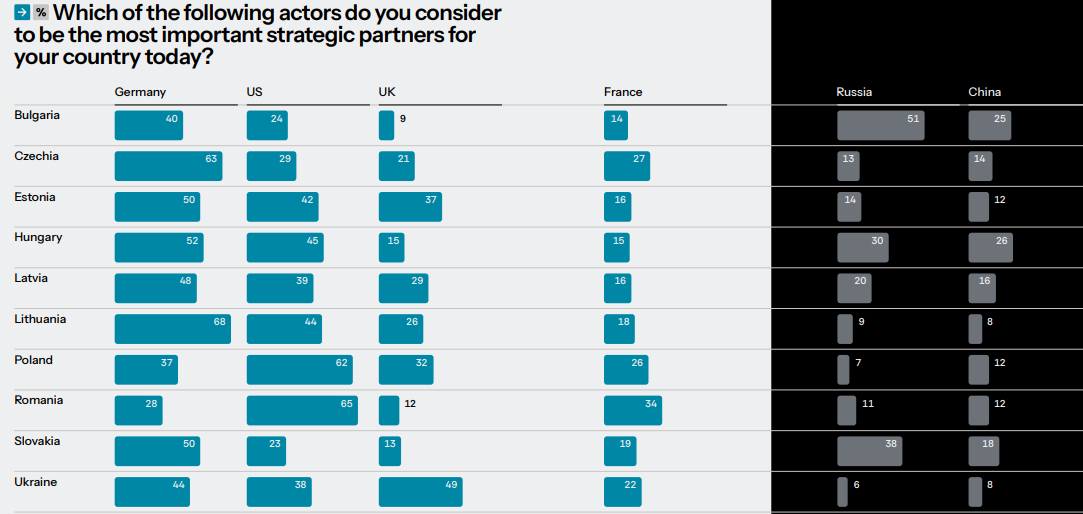
Source: Globsec Trends 2026 report, p. 45
Lastly, let’s talk about security. In the survey, you asked people about the concept of a European army and about NATO in the region. Is there a big difference in people’s minds?
Our defense data shows that Europe wants to be stronger and more self-reliant within NATO, not outside it. In Europe, 78% of respondents want to build defense capacities alongside NATO, and 77% of respondents in NATO member countries would vote to stay in the Alliance. A majority also believe in deterrence, seeing NATO as an important tool that protects them from foreign invasion. 2026 was a turbulent year for transatlantic relations, but it is not a question of a European army versus NATO. The public doesn’t see it as a choice or an either-or situation. In most countries, the same majority that wants to stay in NATO also wants a European army. The idea of an EU army is best read as a demand for a stronger Europe and as insurance against US unpredictability.
In Europe, 77% of respondents understand the American role in European security, but they also want to be less dependent on the United States. At the same time, only 50% of European respondents currently believe that Europe could defend itself without American support.
Tying back to the US, which was included in your survey for the first time, I’d like to talk about the peace talks the US has been facilitating between Russia and Ukraine, which recently involved some European countries (France, Germany, Italy, Poland, and the UK). From the standpoint of national politics and public support, do these negotiations have any prospects?
Our data shows clearly that Europeans stand behind Ukraine and understand that Ukraine is fighting for their democracy as well. Support for Ukraine holds, but views on the peace terms are divided. Across Europe, 62% of respondents believe Europe should continue to support Ukraine regardless of US involvement, which again reflects the turbulence in transatlantic relations. At the same time, 76% of US respondents agree that support for Ukraine should continue, so the American public has a somewhat different view from its administration. Across all the survey countries, 82% of respondents insist that any peace settlement must provide credible long-term security for Ukraine.
So the data tells us that people want to support Ukraine. They would rather have longer peace talks and support Ukraine in its fight for full independence and territorial sovereignty than pursue a quick peace that would not last and would offer no long-term security guarantees. The framework involving France, Germany, Italy, Poland, and the UK is pragmatic, and it is good that European representatives will be at the table, because peace should not be negotiated without Europe. The table includes the countries that would be heavily involved in providing guarantees, money, and troops, and it brings in Poland as the voice of the Eastern flank.
Subscribe to “Goulash”, our newsletter with original scoops and the best investigative journalism from Central Europe, written by Szabolcs Panyi. Get it in your inbox every second Thursday!

Tamara is a journalist from Slovakia, currently based in the Netherlands. Besides VSquare, she writes for The European Correspondent.