




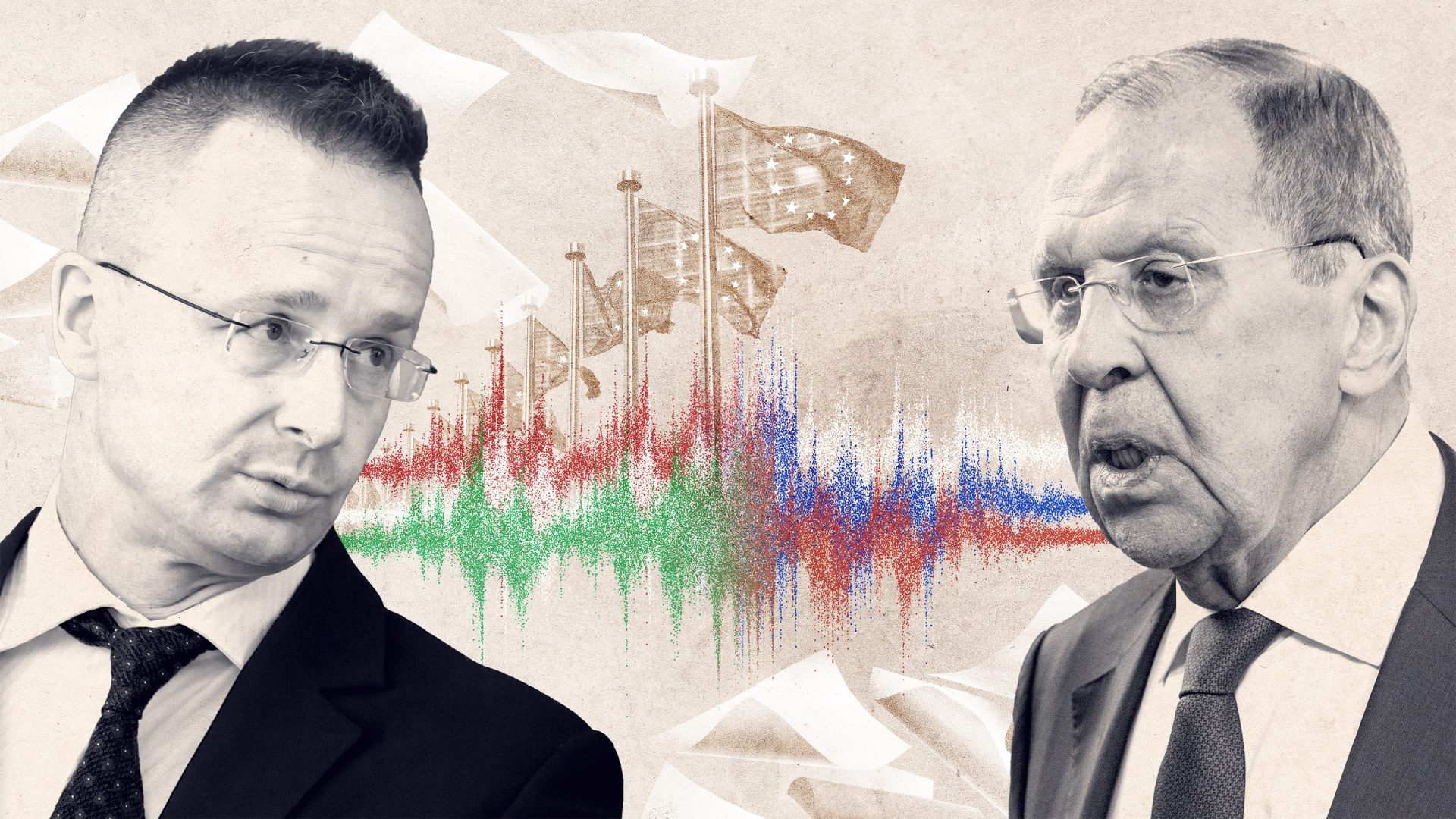
Kremlin Hotline: How Hungary Coordinates With Russia Blocking Ukraine From the EU
Anna Gielewska, Szabolcs Panyi (VSquare)
Holger Roonemaa, Ilya Ber (Delfi Estonia)
Michael Weiss (The Insider)
Lukáš Diko, Karin Kőváry Sólymos (ICJK)
Illustration: Linda Vainomäe / Delfi Estonia 2026-04-08


Anna Gielewska, Szabolcs Panyi (VSquare)
Holger Roonemaa, Ilya Ber (Delfi Estonia)
Michael Weiss (The Insider)
Lukáš Diko, Karin Kőváry Sólymos (ICJK)
Illustration: Linda Vainomäe / Delfi Estonia 2026-04-08
- Budapest systematically weaponized the issue of Hungarian minority rights in Ukraine to stall EU accession negotiations.
- Péter Szijjártó offered Sergey Lavrov to send EU documents through the Hungarian Embassy in Moscow.
- Hungary and Slovakia, acting as Kremlin friends in the EU, pushed against restrictions of Russian energy supplies.
- Budapest also supported the Kremlin’s “achievements” of the Alaska Summit.
- Leaked audio reveals a strikingly deferential, submissive attitude from Szijjártó toward Lavrov.
- This is the second part of our investigation, you can find the first part here.
On December 14, 2023, at the European Council meeting in Brussels, EU leaders gathered to open accession negotiations with Ukraine and Moldova. They faced strong opposition from one of their own: Hungary. Prime Minister Viktor Orbán had threatened to veto the decision and used the issue as leverage in his disputes with Brussels over more than €22 billion in EU cohesion and recovery funds frozen due to Hungary’s rule-of-law violations.
Orbán, as usual, was accompanied by Foreign Minister Péter Szijjártó, who during one of the breaks went out of the meeting room to call his Russian colleague Sergey Lavrov.
“Peter, how are you? I’m doing good,” Lavrov greeted Szijjártó, who dutifully explained how negotiations were going and what Hungary’s plan for the meeting entailed. Lavrov certainly liked what he heard. “Ok, good, yes, yes, excellent,” the Russian said. “Sometimes good-willed direct blackmailing is the best option.”
Except Hungary’s blackmail did not work this time.
Viktor Orbán left the room during the vote on opening Ukraine’s EU accession talks, part of a pre-arranged move – Germany’s chancellor sent Orbán out of the room for coffee – that allowed the other 26 leaders to adopt the decision unanimously while Hungary abstained, and managed to save face. Szijjártó nevertheless stayed behind to witness the negotiations, keeping the Kremlin abreast with a near-contemporaneous play-by-play.
Recordings of Lavrov-Szijjártó calls dating from 2023 to 2025 were obtained and confirmed by a consortium of investigative news outlets consisting of VSquare, FRONTSTORY, Delfi Estonia, The Insider, and the Investigative Center of Ján Kuciak (ICJK).
The first part of our investigation showed how Szijjártó acted at the request of Lavrov to push for the removal of Russian billionaire Alisher Usmanov’s sister from EU sanctions lists. It also revealed how Hungary’s top diplomat coordinated with Russia’s Energy Minister Pavel Sorokin to run interference on behalf of dozens of Russian companies and banks slated for restrictions as part of the EU’s 18th Russia sanctions package, which was under discussion in the early summer of 2025.
Yet Szijjártó’s role as Lavrov’s informant was by no means confined to disclosing sensitive discussions and protocols within the EU. Throughout their many phone calls, Szijjártó provided Lavrov with an invaluable stream of information about how a supposedly united Western coalition was preparing to increase pressure on Russia to end its war of aggression.
Hungary, at all turns, offered itself to Russia as something approximating a fifth column in Brussels: Szijjártó ever eager to liaise with Lavrov and seek his counsel (or permission) to take actions that were disadvantageous to the EU and Ukraine but highly advantageous to Moscow. As one intelligence officer put it in our first installment, their relationship was more akin to a spy handler and agent in the field than to two peer foreign ministers.
These new disclosures come as Orbán’s government faces the greatest threat to its hold on power in a decade and a half. Hungary’s parliamentary election is on April 12, and his ruling Fidesz party trailing by as many as twenty points in the polls behind opposition party Tisza, led by a former Orbán loyalist turned rival Péter Magyar.
Meanwhile, both Russia and the United States have intervened in Hungary’s sovereign affairs on behalf of Orbán with Kremlin assets in place on the ground. As VSquare previously reported, the Russians have sent military intelligence operatives and “political technologists” to Hungary to sow disinformation and social media-borne narratives that depict Ukraine as an architect of misrule and subversion in Hungary, with a loss for Fidesz amounting to inevitable war.
The Americans, for their part, have sent their vice president to Budapest to support Orban’s regime in the final campaign days. Yesterday J.D. Vance headlined a rally for the embattled right-wing leader he has called “one of the only true statesmen in Europe” and to blame the EU and Ukraine for doing what he himself was there to do: sway a democratic election.
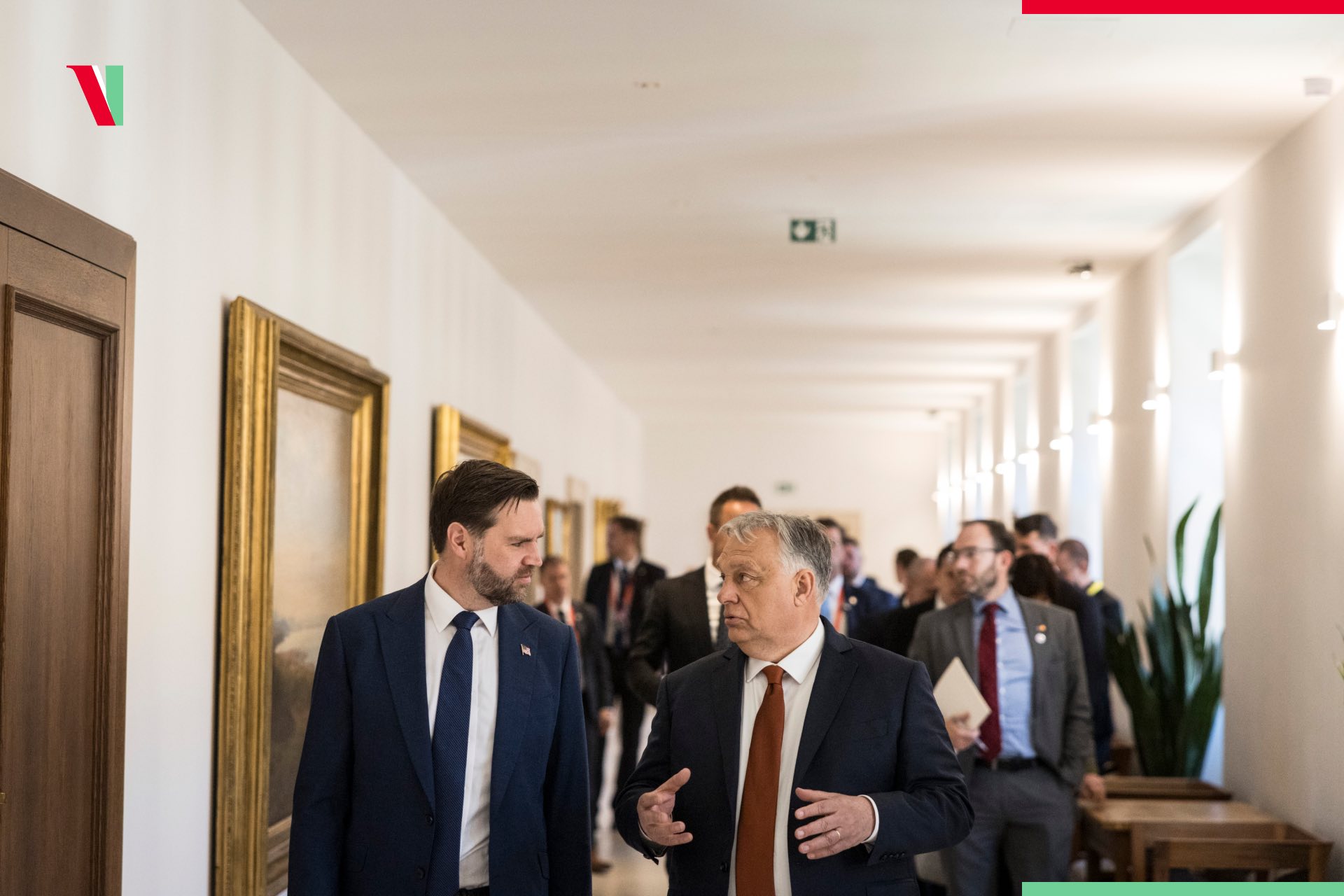
Source: Facebook of Viktor Orbán
***
On July 2, 2024, the same day that Orbán visited Ukrainian President Volodymyr Zelensky in Kyiv, Szijjártó again rang his “dear friend” Lavrov to “brief him” not only on what had transpired between two mutually suspicious European leaders in a war-ravaged capital. The timing of this call was crucial, as it came a week before a NATO Summit in Washington, D.C., where Western support for Kyiv, such as the newly created NATO Security Assistance and Training for Ukraine in Wiesbaden, Germany, would be marquee items on the agenda. A minimum baseline pledge of €40 billion for the coming year was agreed at that summit. Allies also affirmed that Ukraine’s path to NATO membership was “irreversible,” though they declined to issue a formal membership invitation.
A pre-summit deal brokered by NATO Secretary General Jens Stoltenberg allowed Hungary to opt out of the NATO-Ukraine coordination mission entirely — with no Hungarian personnel or funds involved — in exchange for Budapest not blocking the other 31 allies from proceeding.
In his call with Lavrov, Szijjártó wanted to know whether Russian President Vladimir Putin would receive Orbán before the NATO Summit “anywhere in Russia,” as “the prime minister is absolutely flexible when it comes to location.” According to Szijjártó, Orbán wanted to explain to Putin the “consequence of that meeting in Kyiv.”
Lavrov asked in what capacity Orbán would be talking to Putin: as the Hungarian prime minister, or as the “Chair of European Union” , meaning a rotating position eligible to all member states..Just a day before, on July 1, Hungary started its six-month presidency, which Orbán subsequently used to launch what he called a “peace mission.” Critics in the EU later labeled his attempt to commandeer the EU’s statecraft via-a-vis Ukraine and Russia as “troll diplomacy.”
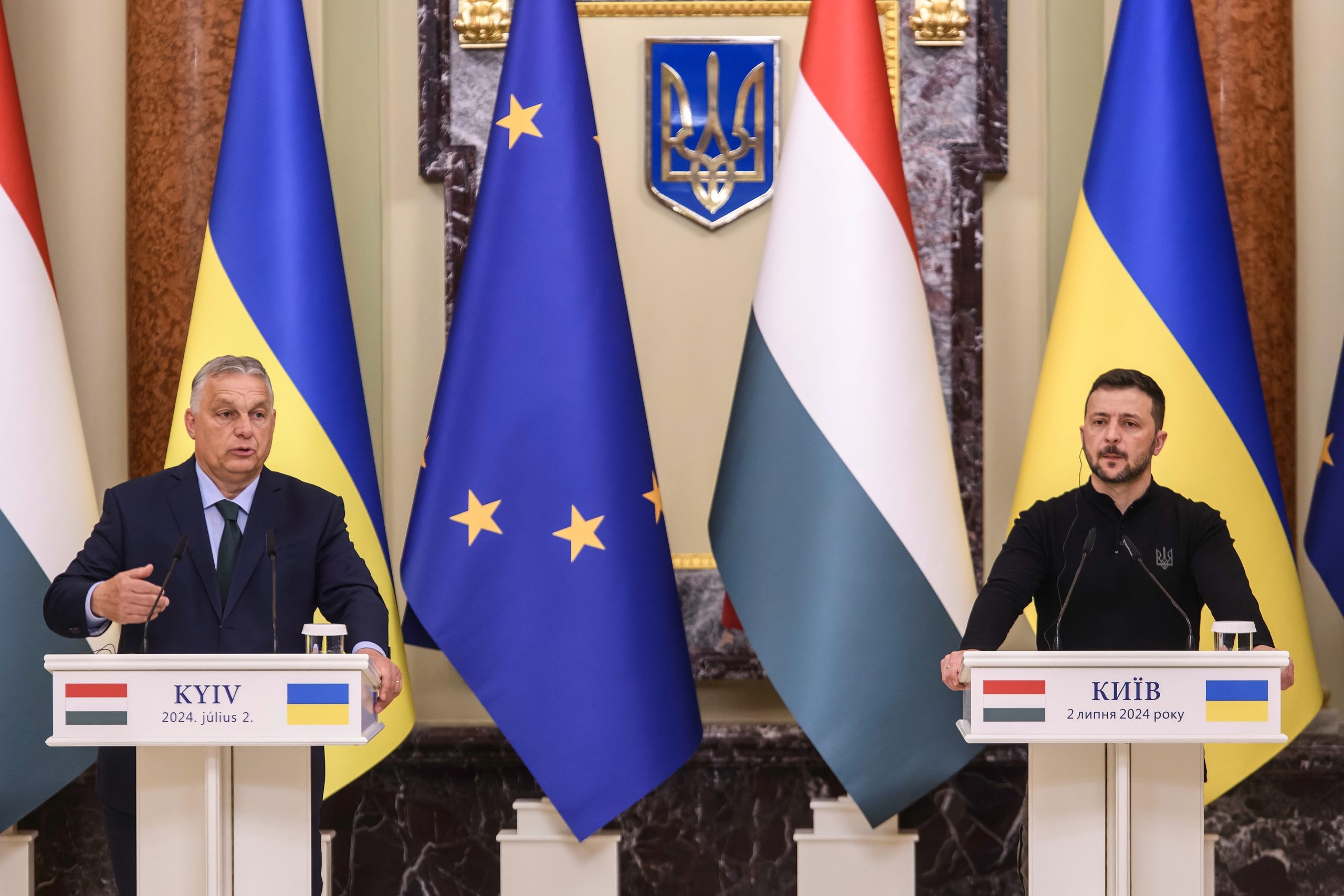
Viktor Orban and Volodymyr Zelensky at a joint news briefing in Kyiv, Ukraine, Source: Shutterstock
“We cannot divide the two, but I think that it increases [the] significance, that he is the Chair of European Union” [sic], Szijjártó responded.
Most important, Orbán’s plan to meet Putin — conveyed by Szijjártó to Lavrov in their call — was kept secret from Hungary’s EU and NATO allies, who only learned about it from VSquare’s reporting on July 4, a day before the scheduled visit. The secrecy was deliberate, European officials told VSquare, a calculated move to prevent allies from pushing back and potentially blocking the meeting. One official described it at the time as a blatant violation of basic diplomatic norms between partners.
Putin wasted no time exploiting the photo-op, opening the meeting by describing Orbán as a representative of the EU itself — precisely the scenario Western capitals had feared. As the Lavrov–Szijjártó conversation revealed, it was also a scenario that had been secretly choreographed between Budapest and Moscow in advance. When the news of the meeting broke, EU representatives were quick to stress that Orbán spoke only for Hungary, not the bloc as a whole. But that was not how either Orbán or Putin saw it, as the leaked phone calls between Szijjártó and Lavrov now make clear.
“Now it emerges from their phone call that he went as the representative of the Council”, a high-ranking EU official, who is not authorized to speak on the record, told our consortium. “It is wild how Szijjártó begs for an invitation for Orbán to Moscow, and it is very embarrassing to do that in the case of the aggressor. Quite clearly, the Hungarians [were] deceiving the European Union.”
As it happens, that call wasn’t a one-way request. Lavrov had his own favor to ask of Szijjártó:
S.Lavrov: Look, I wanted also to call and check about [the] compromise you reached with [the] European Union on opening of the negotiations for Ukraine on accession. And there were reports that the decisive role was played by the language of national minorities.
Szijarto: Absolutely. It was the case.
S.Lavrov: We are trying to get hold of the exact document, but…
Szijarto: I will send it to you. It’s not a problem.
(…)
S.Lavrov: Ok, Peter, if you can send me the document, I would appreciate this.
Szijarto: I immediately do it. I send it to my embassy in Moscow, and my ambassador will forward it to your chief of staff, and then it’s at your disposal.”
It is not clear from the conversation exactly what document Szijjártó promised to send Lavrov through the Hungarian embassy in Moscow. The Hungarian Foreign Ministry, asked by our consortium about the details, did not respond to our request for comment.
The high-ranking EU official said “with 99 percent certainty” that the document Szijjártó promised to send to Lavrov was the negotiation framework, which by then was already public. “I don’t understand why Lavrov even played this game with him at all. This framework is a public document.”
One possibility, according to a senior Western intelligence official, was that Lavrov was simply testing the limits to which Szijjártó would go to provide information to Russia. “It’s almost like a loyalty test to judge an asset’s willingness to follow orders or comply with tasking assignments,” the official said. “This is like recruitment 101.”
However, according to the high-ranking EU diplomat it’s not even about a handler-agent situation but rather Szijjarto “just being a useful idiot”.
***
A major topic preoccupying both foreign ministers was minority rights in Ukraine, long seen as the Kremlin’s pretext for justifying military action not just against one nextdoor neighbor, but anywhere ethnic Russians or Russian-speakers reside.
A few weeks before the July 2, 2024 call, diplomatic tensions between Hungary and the EU reached a climax. Budapest was again blocking funds for Ukraine, while the EU was working on mechanisms to circumvent its veto. At stake was a list of 11 points presented by Hungary concerning the rights of the Hungarian minority in Ukraine’s Transcarpathia region, a population estimated at around 100,000. Fulfilling these demands was a condition the Orbán government insisted upon in exchange for its support regarding Ukraine’s EU accession negotiations.
Meanwhile, Brussels had its own grievances with Budapest over the latter’s handling of refugees from the war. On June 13, 2024, the Court of Justice of the European Union (CJEU) imposed a €200 million fine on Hungary for violating EU asylum regulations.
We now have evidence that, while Orbán and Szijjártó were officially campaigning for the rights of ethnic Hungarians in Ukraine, the Hungarian Foreign Ministry was conspiring with Lavrov to advance the cause of Russian minority rights in the country.
In one Szijjártó-Lavrov conversation, dated June 17, they discussed the matter at length. Szijjártó boasts about feeling great after meeting with politicians in Brussels: “Although usually they shout at me…at the end of the day I always tell myself at least I had fun.”
“Yeah, you know, you know how to handle them,” replied Lavrov. Szijjártó then delved into a detailed account of his discussions with the EU regarding Hungary’s eleven points and “how to give back those rights we have already had.” Lavrov, however, steered the conversation back to Russians in Ukraine and how a failure to honor what the Kremlin demanded might deter or derail Ukraine’s accession process. Szijjártó replied that respect for minority rights was a universal principle regulating the Council of Europe – “one day it is your minority and then the next day ours” – an answer which evidently satisfied Lavrov.
“You know, Sergey,” Szijjártó affirmed, “I am always at your disposal”.
“It makes me want to vomit how Szijjártó discusses with the aggressor how to put pressure on Ukraine, saying here that today it is our minorities, tomorrow it is your minorities,” the high-ranking EU official said. “At the same time, the negotiation framework says that Ukraine must follow all its international obligations, and bilateral agreements with EU member states regarding these issues. Szijjártó is actually also lying to Lavrov, because the negotiation framework does not refer to other countries or minorities, but only speaks about Ukraine’s agreements with EU member states.”
In the same conversation, the Hungarian Foreign Minister also shared his interaction with Canada’s then Prime Minister Justin Trudeau, an outspoken supporter of Ukraine, to whom Szijjártó communicated the importance of keeping a direct line with Russia open in order to achieve a swift end to the war. “And we can deliver any kind of messages, we can make any kind of contacts,” Szijjártó relayed Lavrov his comment to Trudeau. “And, you know, Trudeau was nodding: ‘How good! How good!’ And I said: Okay, prime minister, now you are nodding, but then please do not consider being in touch with Russia as a bad thing.”
“Yeah. Trudeau is a disaster,” Lavrov said.
Before they signed off, Szijjártó shared his idea — already approved by Orbán — to convene a session of the Hungarian-Russian intergovernmental commission. “Do you have any negative feeling about it?,” he asked, making sure his contact didn’t. Lavrov assured him: “No, not at all. Not at all. Not at all. Only positive.”
Thus incentivized, Szijjártó said he planned to reach out to Russian Minister of Health Mikhail Murashko, co-chair of the Hungarian-Russian intergovernmental committee, to convene the meeting in Budapest.
***
On June 19, 2025, during the Saint Petersburg International Economic Forum, Szijjártó met with Russian Deputy Prime Ministers Denis Manturov and Alexander Novak to discuss energy supplies. On June 22, Szijjártó called Lavrov to brief him on his talks with Lavrov’s own colleagues, who had already given the Russian a read-out of their conversation. “I told them that you know we are fighting again with stupid idiot proposal of [the] European Commission to cut us from the energy sources from Russia. And you know I ask them to make sure that your presidential decree is going to be prolonged which allows us to pay for the gas through the OTP,” Szijjártó said, referring to a prominent Budapest-based bank catering to nations in Central and Eastern Europe, including Ukraine. “You know this is valued to the first of July and I ask them to make sure that it will be expanded.”
Szijjártó was alluding to his dispute with the European Commission’s proposal in 2025 to phase out Russian energy imports into the EU. The Commission first announced the REPowerEU roadmap and then proposed legally binding regulations intended to bring an end to Russian gas imports by the end of 2027. The mechanism was designed to circumvent a potential veto by Budapest and Bratislava, as it did not rely solely on sanctions requiring unanimity.
From Orbán’s perspective, that proposal wasn’t just a threat to Hungary’s general “relations with Russia,” but about a very specific interest: maintaining supplies of raw materials and payment instruments that enabled the continued purchase of Russian gas.
At the end of June 2025, Szijjártó announced that Russia had extended the decree allowing Hungary to pay for gas via OTP Bank until October 2025, which explains the part of the conversation regarding the need to extend the Russian decree before July 1. Most notably, it again confirms coordination between Budapest and Moscow.
Szijjártó also mentioned coordination with Juraj Blanár, the Slovak foreign minister, and the battle within the EU Council. In June 2025, Hungary and Slovakia blocked the 18th EU sanctions package, arguing that parallel EU plans to cut off Russian energy supplies threatened their energy security. Prime Minister Robert Fico went so far as to call the Commission’s plan “economic suicide” in the absence of alternatives to Russian gas, oil, and nuclear fuel.
The Szijjártó-Lavrov conversation reveals not merely “friendly contacts” with Moscow, but, once again, a coordinated Budapest–Bratislava line that influenced decisions across the entire EU. As EU sanctions require unanimity, even a single country can block them. Hungary and Slovakia therefore exploited their position by linking the issue of sanctions to that of energy.
In response to our questions, the Slovak Ministry of Foreign Affairs stated that “[t]his matter is not being coordinated at the level of the [EU] Foreign Affairs Council.” Blanár stated in July 2025: “Our blocking of the 18th sanctions package proved crucial in reaching some sort of agreement to mitigate the impacts of the thoughtless disconnection from affordable energy sources from Russia.”
Lavrov greatly appreciated this Russia-friendly attitude, which he praised in another conversation with Szijjártó on August 16, 2025, this one mostly focused on the recently concluded meeting between Putin and Trump in Anchorage, Alaska.
“We know that our friends like Viktor Orbán and yourself and Robert Fico understand us,” Lavrov assured Szijjártó, naming Slovakia’s Russia-friendly prime minister. “And for the rest, it’s up to them to decide whether they are grown-ups or still immature politicians.”
In the same call, Szijjártó tried to glean more behind-the-scenes details of the Alaska summit, which failed to produce an agreement on Ukraine but caused enormous consternation in Europe that a final settlement to the war – if not the future of European security – was being discussed over the heads of EU and NATO allies, and of Ukraine itself.
What especially interested Szijjártó was the canceled lunch between Putin and Trump and the Russian president’s hasty departure from U.S. soil after less than three hours of bilateral talks. Was this “not a signal of bad mood or disappointment between the two of you?”
Lavrov assured him that in fact the joint meal “was never cancelled. And the lunch is not something which I would really like, knowing the American gastronomic art.”
S.Lavrov: Hello!
P.Szijjártó: Hello, Sergey! It’s Peter speaking.
S.Lavrov: Yes, how are you, Peter?
P.Szijjártó: Sorry for calling you, it must be very late now in Moscow already.
S.Lavrov: No, it’s only nine thirty.
P.Szijjártó: But you had a very long day, I understand, very demanding.
S.Lavrov: Well, the longer the day, the longer we live.
P.Szijjártó: God, that’s right. That’s right. I just wanted to congratulate because I understand there was some success. I see how concerned our European friends are, but I just wanted to make sure that you know that Hungary supports all kind of efforts and all kind of achievements you have reached today.
S.Lavrov: Yes, we appreciate the statement by the Prime Minister and this was a very straightforward statement. And I believe this is something which other Europeans should take note of.
P.Szijjártó: They usually do and then they put it in the framework of financial sanctions against us. So you know.
S.Lavrov: [laughing]
P.Szijjártó: [laughing] That’s how they do it. But can I ask you Sergey whether that went well as it is being portrayed in the media?
S.Lavrov: Well, the president stated very clearly that it was a very useful and successful summit during the joint press conference. And then Trump made a separate interview to the Fox News where he said all the right things, that on the scale of 10, he would give this summit a “10” and that the progress was very considerable. There is one or two issues as he said, and that now is the turn for Zelenskyy to take the deal. That’s exactly what was discussed and he accepted this sequence. We’ll see what is the result of Zelenskyy’s visit on Monday to Washington.
P.Szijjártó: And can I ask you whether you have made any forward progress on economic cooperation with the Americans to restart your economic and trade relationship, you know, because it has a…
S.Lavrov: It was not discussed, Peter.
P.Szijjártó: It was not discussed, aha, ok.
S.Lavrov: No.
P.Szijjártó: Okay. So the economy was not on the agenda.
S.Lavrov: It is the issue which was discussed in the past and it was very clearly stated by the Americans that if they can get Ukraine out of the way, there would be no limits.
P.Szijjártó: No limits. Uh-huh. Okay. But can we consider it more or less sure that as long as these encouraging negotiations are going on, the Americans will not implement any other sanctions?
S.Lavrov: We did not discuss sanctions.
P.Szijjártó: Oh, you didn’t discuss it at all?
S.Lavrov: No. There was a very friendly conversation on many things, including, you know, some just absolutely personal matters not related to any politics. But on Ukraine, we clearly explained, and I think Trump got the essence of it when he stated in the interview to the Fox News that a long-standing sustainable peace is much better than a ceasefire.
P.Szijjártó: Yeah.
S.Lavrov: That’s our position.
P.Szijjártó: Yeah, yeah, yeah. So root causes must be tackled.
S.Lavrov: Absolutely.
P.Szijjártó: And you think that now the Americans have a deeper understanding? Because I remember when President Trump came into office, he was very, let’s say, encouraged about a quick resolution of the situation, but now they understand it better that it’s not just about, you know, cutting it.
S.Lavrov: No, we did not discuss it, but some time ago he said that when he stated that he would resolve it in 24 hours, he was mistaken. No, we did not discuss this, Peter.
P.Szijjártó: Yeah, yeah, okay. I understood.
S.Lavrov: Basically, the presidents made a very detailed presentation at their joint press conference.
P.Szijjártó: Yeah, well, that’s good. If it was like that, as it was discussed, then it’s great. Because, do you know, there was a debrief for the EU ambassadors in Brussels today, and I did not feel that the Europeans would be very happy, you know? And that’s how I felt that things might have gone well.
S.Lavrov: Well, our purpose was to consider realistic ways of ending the war and not to please European ambassadors.
P.Szijjártó: Yeah, good, good, good. Yeah, yeah, I agree.
***
On August 12, 2025, EU leaders emphasised that “Ukraine has the right to decide its own fate,” and that they would continue to support Kyiv’s path to the EU. Hungary did not sign onto this statement. A few days later, EU leaders reiterated that the path to peace cannot be determined without Ukraine and that pressure on Russia must be maintained.
Hungary, as the above exchange makes clear, was acting as Russia’s representation with the EU, using its own energy security as a point of leverage to deny or water down EU decisions averse to the Kremlin. Moreover, Szijjártó’s allusion to the”root causes” of the war echoes a Russian trope: namely, that Moscow was forced into invading Ukraine because of NATO expansion or seemingly hostile moves by the United States and Europe undertaken since the end of the Cold War – moves to which Hungary, as both a NATO and EU member, were party to.
In public statements, Lavrov and the Kremlin consistently used the “root causes” phrase to reject the very idea of an unconditional ceasefire along the current line of contact in Ukraine – a policy adopted and then abandoned by the Trump White House – in favor of broader political and territorial concessions extending far beyond Ukraine’s sovereign borders. At stake, in short, was the future of Europe and America’s role in it, something which one European country – Hungary – was litigating on behalf of a hostile foreign adversary.
“As Szijjártó himself says to Lavrov,” the high-ranking EU official told us, “I am at your disposal. It really is so. Very embarrassing, disloyal [behavior toward Europe], he is like a little idiot who is being pushed and pulled.”
This investigation was published in collaboration with FRONTSTORY.PL, Delfi Estonia, The Insider, and the Investigative Center of Ján Kuciak (ICJK).
Subscribe to “Goulash”, our newsletter with original scoops and the best investigative journalism from Central Europe, written by Szabolcs Panyi. Get it in your inbox every second Thursday!

Co-founder and editor-in-chief at FRONTSTORY.PL, Wojciech Cieśla is an award-winning Polish journalist who, since 2016, has worked with Investigate Europe. He is the co-founder and chairman of Fundacja Reporterów (Reporters Foundation). He is based in Warsaw.

Anna Gielewska is co-founder and editor-in-chief of VSquare and co-founder of Polish investigative outlet FRONTSTORY.PL. She is also vice-chairwoman of Fundacja Reporterów (Reporters Foundation). A journalist specializing in investigating organized disinformation and propaganda, Gielewska was the John S. Knight Fellow at Stanford University (2019/20) and has been shortlisted for the Grand Press Award (2015, 2021, 2022) and the Daphne Caruana Galizia Award (2021, 2023). She was the recipient of the Novinarska Cena in 2022.

VSquare’s Budapest-based lead investigative editor in charge of Central European investigations, Szabolcs Panyi is also a Hungarian investigative journalist at Direkt36. He covers national security, foreign policy, and Russian and Chinese influence. He was a European Press Prize finalist in 2018 and 2021.

Head of the investigative desk at Delfi Estonia, Holger Roonemaa has extensively investigated topics related to national security, including Russia’s espionage, interference, and influence operations in Estonia and the wider region. He is a member of the International Consortium on Investigative Journalists (ICIJ). Estonia’s national media association named him the journalist of the year in 2020 and 2021.
Lukáš Diko is the editor-in-chief at the Investigative Center of Ján Kuciak (ICJK). An experienced journalist and media leader, he was previously director of news and journalism at RTVS and editor-in-chief of news at Markíza television.