




Artur Meets Russia: How a Former Polish Diplomat Became a Pro-Kremlin Influencer
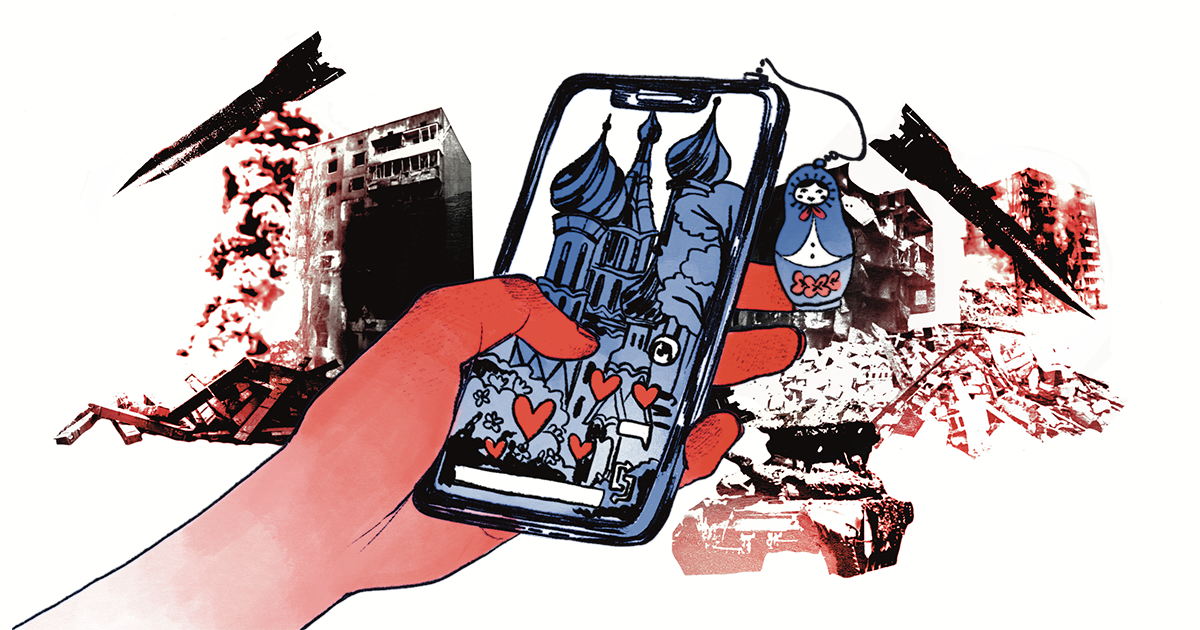
Illustration: Iwo Dziórzyński 2026-09-03


Illustration: Iwo Dziórzyński 2026-09-03
- Poland has its own version of the “Sasha Meets Russia” propaganda channel. It’s run by a former employee of the country’s diplomatic service
- That channel, “WMatrioszce” (“In the Matryoshka”), doesn’t mention the war, Russian politics and Putin, feeding viewers a reassuring dose of the everyday: Russia as a land of friendly people, an economic oasis, a place worth investing in
- With sanctions and ad suspension in place, a Westerner in Moscow has no realistic way to make a living from YouTube. So where is the money coming from? And how, exactly, is he making Putin’s regime more palatable for the Polish audience?
A man with fiery red hair strolls through Moscow’s Radisson Royal Hotel (formerly known as the “Ukraine Hotel”). He’s a Polish vlogger live-streaming a visit to a Rolls-Royce showroom. Before Russia’s full-scale invasion of Ukraine, this very spot inside the hotel housed the brand’s official dealership.
The showroom is still packed with luxury vehicles — even though Rolls-Royce Motor Cars, owned by BMW, stopped exporting to Russia in 2022. If anyone in the Russian Federation is still selling the firm’s cars, it’s purely down to sanctions-dodging and illegal imports routed through Belarus or Kazakhstan, though this isn’t spelled out on camera.
“The showroom’s been going eighteen years, all told,” the salesman says gloomily. “We were the official dealer.”
“And now, you might say, unofficial,” the vlogger chips in. “Well — these are the times we live in,” he says, trying to drop the subject.
“Because Rolls-Royce left Russia,” the salesman presses.
Cut. In the video, he won’t tell us more. Viewers never get an explanation: why exactly did the company leave, and where did the luxury cars in the Radisson Royal come from? Why is the showroom “unofficial”? The vloger swiftly changes the subject, gushing over the upholstery of models worth roughly €700,000.
The vlogger is Artur Siejka, a Polish citizen and sinologist by training and a long-serving former employee of Polish government agencies and institutions. In 2024, Siejka launched a set of social media channels under a single banner: “WMatrioszce” (meaning “in the matryoshka”). Across hundreds of posts, he shows his tens of thousands of followers a carefully curated Russia—or, more precisely, Moscow. The formula is always cut from the same cloth: a dash of folksy simplicity, a sprinkle of luxury, friendly locals, easy chatter. Not a word about the war, sanctions or Putin. The moment a Russian interviewee strays onto dangerous ground — touching on subjects forbidden in Putin’s Russia — Siejka intervenes. His channels are openly pro-Russian, brimming with enthusiasm for the social and civilizational achievements of a country that routinely jails its critics.
For example: While Siejka is filming an exclusive look at the lining of a roof of a Rolls-Royce Cullinan in Moscow — likely on the night of November 8 into November 9 2025 — the Russian army unleashes 450 drones and 45 missiles across Ukraine. Seven people are killed.
Politics? War? Don’t Ask
The first @wmatrioszce post lands on Instagram in April 2024: an out-of-context photo of schoolchildren in cadet uniforms. Over the next few days more content follows — scenes of everyday life in Moscow or vox pops in which Artur Siejka asks Muscovites what they make of Poles. According to the vlogger’s clips, most are friendly and pro-Polish.
The channel is built around lifestyle and travel formats: featuring daily life, people or local curiosities. On the one hand, @wmatrioszce serves up street interviews in which the smiling host chats with passers-by; on the other, candid kitchen-table conversations about identity with Moscow-based Poles who invite him and his camera into their flats. He glides nimbly between light subjects — from strolls through the monumental metro or visits to luxury boutiques and admiring glances at Socialist-Realist tower blocks, to painstaking price checks in neighbourhood discount and browsing job ads in local papers.
In the description under every post, Artur Siejka adds the following (reproduced verbatim): “This film is informational in nature, about the everyday life of the residents of Moscow/Russia and their mentality. I do not promote any theory or political narrative. The fact that I show my interlocutors’ statements in my films does not mean I agree with them. If my material, or the comments beneath it (which I do not moderate), provoke negative thoughts or feelings in the viewer, I encourage you to stop watching.”
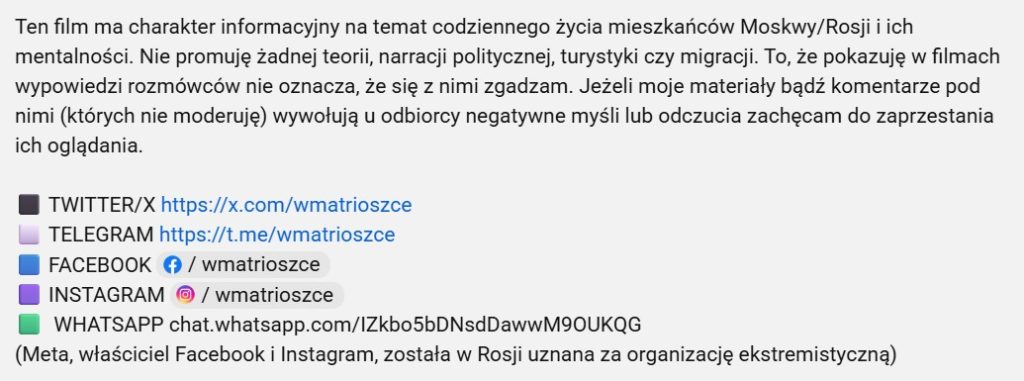
An excerpt from the description beneath the vlogger’s films / Source: YouTube @wmatrioszce
Only once, at the very start of his vlogging career — in a video titled Why I don’t talk about politics — does he openly acknowledge that calling for sanctions is a criminal offense in Russia (as is “discrediting” the army). Playing strictly by the Russian rulebook, Siejka steers clear of the war. Beneath his YouTube content, he tags links to his Facebook and Instagram accounts with the mandatory disclaimer reminding viewers that in Russia Meta is considered an “extremist organization.” Merely browsing or posting on Instagram is not, in itself, punishable in Russia. Yet because legal, officially registered Russian VPNs are obliged to block access to Meta’s services, the vlogger therefore has to use tools from the very Western providers the regime is actively combating. In some cases, however, it is willing to look the other way.
The channel sells itself as charmingly amateur. The conversations look unscripted and casual. Behind the scenes, however, the @wmatrioszce project is no amateur vlog – rather a deliberate strategy, carefully mapped out across multiple channels.
Artur Siejka admits he first had the idea to try his hand at being a Moscow-based influencer in 2022 (he has lived in Moscow with his Russian wife since 2020). He set up the @wmatrioszce profiles in late 2023 and began posting regularly a few months later. In May 2024, the YouTube channel launched — amassing a library of more than 500 videos and over 85,000 subscribers within two years. The YouTube output is systematically pushed onward: to Facebook, followed by more than 108,000 users; to TikTok (over 56,000 followers); and to a growing Instagram (38,000). X rounds out the picture (4,000), alongside Telegram and WhatsApp — messaging apps for smaller but strongly engaged communities.
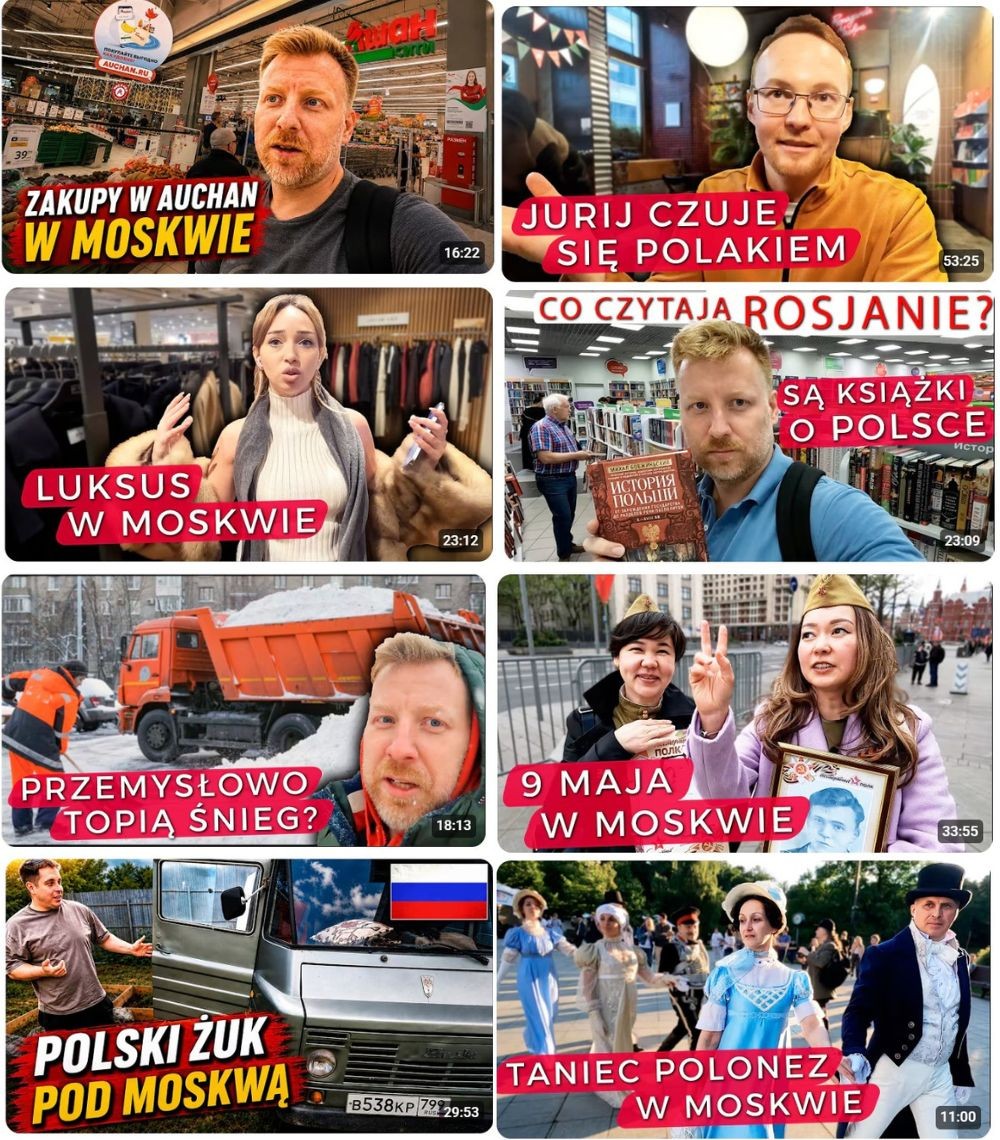
An overview of the @wmatrioszce content: lifestyle videos, “Polish” themes in Moscow, and state-funded public events/ Source: YouTube thumbnails, author’s compilation
The YouTube profile’s location is set to Poland, which helps the algorithms reach Siejka’s intended Polish audience. Potential monetization (earning from views) wouldn’t be possible from Russian territory. Since Russia began its full-scale war in Ukraine, Google has steadily cut the country off from monetization. In March 2022, it blocked the creation of new billing accounts; in August 2024 ad payouts were halted altogether. Since 2022, Google and YouTube ads have not been shown to users inside Russia. So to make any profit from his content at all, the vlogger would have had to build @wmatrioszce around a Western (and probably Polish) AdSense account and a bank account in the same location.
Meta policy is a similar story. In 2022, the company blocked monetization and ad-buying for accounts in the Russian Federation. Trading blows, the Kremlin outlawed the company as an “extremist organization.” That is probably why the @wmatrioszce Facebook blog officially operates out of Warsaw — even though Instagram’s algorithms correctly flag Russia as the account’s main location (the system continuously checks where the managing device logs in from). On X, a VPN places Siejka’s account in the Netherlands, but the technical fingerprints give him away: he connects through an iPhone tied to the Polish App Store — and a Polish billing address, too.
Vlogging by the Kremlin’s Playbook
Artur Siejka often streams live, filming touristic-like walks around Moscow and his own daily wanderings.
Fortune favors him. Time and again he’ll happen upon Poles who eagerly agree, on the spot, to appear in his Instagram reel. Other times, fans of the channel strike up a conversation with him mid-livestream.
In the bitter Moscow winter, Siejka manages — by pure coincidence, he assures the viewers — to get inside a snow-melting station. It plays out like an action film: after a brief negotiation, the snow hauling truck driver agrees to smuggle the Pole onto the site. Once there, he’s told not to leave the cab, but a station worker comes to the rescue, offering to film the process on Siejka’s phone.
Curious, that: in a country where strategic municipal facilities are tightly guarded, a foreigner holding the passport of a state listed by Russia as “unfriendly” drives into one such site with a camera. Artur Siejka did not respond to a request for more information about how this particular film came together.
The Russian provinces rarely feature. In a dispatch from Teriberka in the far north he shows a snowbound, deserted settlement, only to go on and describe the tourism boom that turned the fading village into a popular day-trip destination. In Murmansk he takes a cutter out onto the Arctic Ocean, samples the local venison and tours the icebreaker “Lenin” — a vessel of Atomflot, a subsidiary of the state-owned Rosatom.
There are things you won’t see in the matryoshka universe. Current affairs? Systematically sidestepped, just as promised. The war, Putin, sanctions, Ukraine? Likewise.
The unmoderated comments section, on the other hand, is pure politics. Posts parroting pro-Russian narratives are threaded through with voices backing Ukraine and rounding on the creator. The discussions play out in Polish or in Cyrillic. Because YouTube’s algorithms reward high volumes of interaction — whatever their content — the polarization actually helps build the channel’s reach and visibility.
Analyzing almost 60,000 comments beneath more than 500 “WMatrioszce” clips, we uncovered a cluster of 113 accounts that respond to the Russian material in a coordinated way. Nearly 250 profiles consistently drop their comments within one narrow 10-minute window.
In front of the camera, the YouTuber plays the affable boy-next-door. He never mentions how he made his way into Russia, what he lives on, what he did back in Poland, or how he spent his time before he started making pro-Russian content. He glosses over his professional past entirely, and mentions his family only in passing. In one of his early videos he explains: “In 2020 we returned to Moscow. That’s important in the context of current world events. It’s a backdrop I’d rather not delve into.”
It wasn’t until May 2026 that Siejka finally publicly acknowledged running the @wmatrioszce project for the first time. He mentioned it briefly on his personal LinkedIn and Facebook. In two sentences: “Two years ago I made a difficult and, I suppose, risky decision. I started a YouTube channel, ‘wmatrioszce.’ From Moscow.”
And that’s it. What’s so difficult and risky about running a YouTube channel in Russia? He doesn’t say. But Siejka is right — it is precarious work. How risky, however, depends on who’s running the vlog.
Did Somebody Say “Sanctions”?
In March 2026, Artur Siejka boards what’s known as the “propaganda train” at a Moscow metro station — a special service promoting Russia Today (RT), a broadcaster under EU sanctions. The vlogger reports from carriages plastered with dates from the station’s history, appeals to follow RT’s channels, and slogans about the supposed “censorship” the Kremlin’s mouthpiece is battling in the West.
The clip vanishes from the @wmatrioszce profiles, but keeps circulating through the Russian information ecosystem. RT’s official VKontakte page boasts about footage from “a popular Polish blogger.” On Telegram it is shared by Alexei Zhuravlyov — a State Duma deputy notorious for his threats against Poland. He insists that every opportunity must be seized to push the Russian perspective to the “collective West,” a mission at which RT is scoring with a “hundred-percent success.” The MT News channel publishes screenshots of glowing comments from Siejka’s supposed viewers, complete with Russian translations, presenting them as proof of the broadcaster’s popularity.
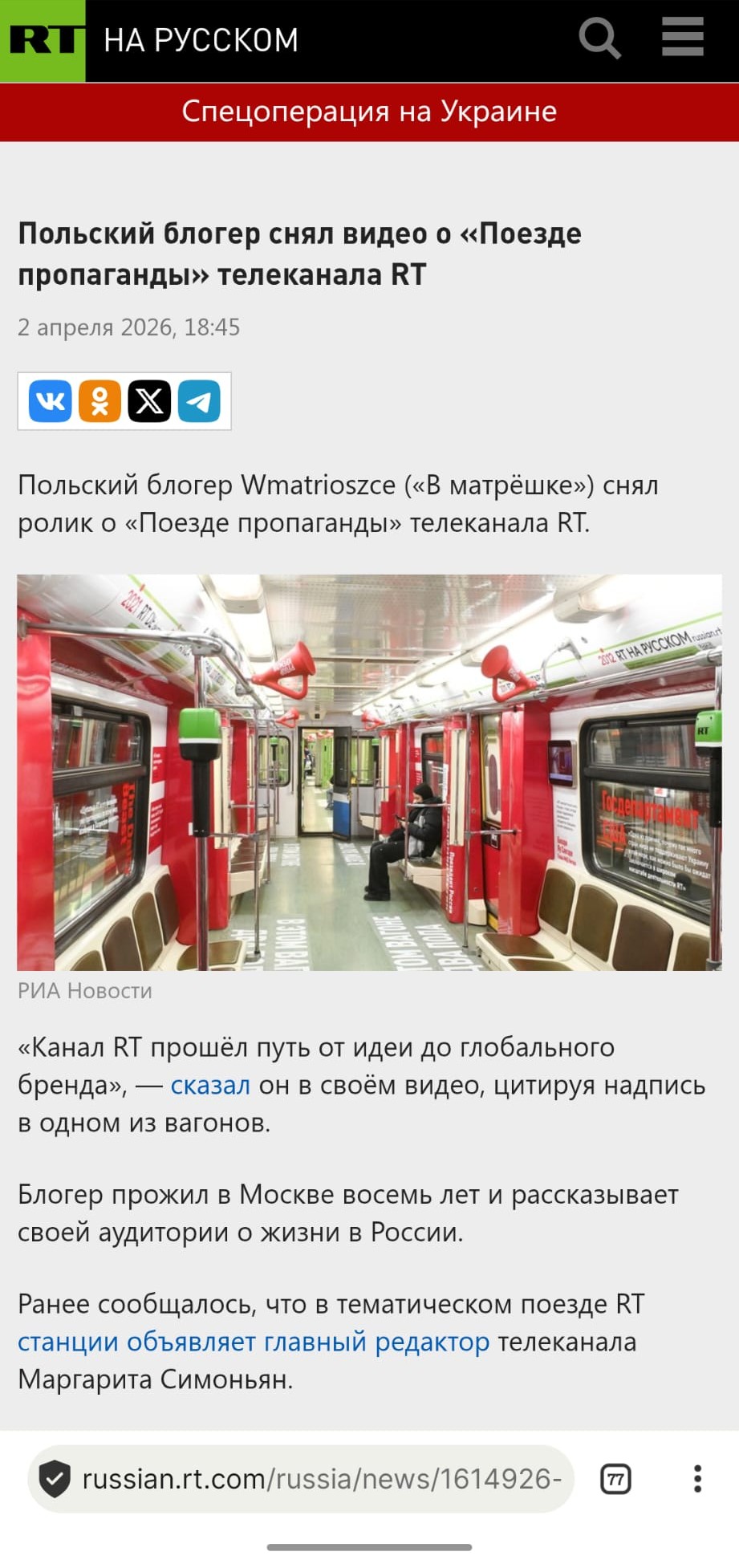
An article on RT’s website reporting on the “propaganda train” video made by the blogger / Source: https://ru.rt.com/ym32
Artur Siejka does not tell us whether he took the video down himself out of fear of accusations that he’d breached the platforms’ terms, or whether the Russia Today material was removed by moderators.
And the EU sanctions? Those would only catch up with Siejka if someone could prove a flow of funds from sanctioned entities. As long as the vlogger is merely strolling through the metro and showing his viewers an RT train, he remains untouchable under Western free-speech protections.
Google has suspended monetization for Russian publishers and banned content that “denies, minimises or trivialises well-documented violent events” — a category that includes Russia’s invasion of Ukraine. Pulling its services from Russia means creators there cannot earn from Google ads.
“Pure political propaganda skirting the edge of the law, unlabelled political ads, bot networks — these are being curbed ever more effectively by the digital platforms and by state action,” argues Jakub Szymik, founder of the CEE Digital Democracy Watch. “This explains the use of tools so soft and seemingly innocent that any backlash looks ridiculous.”
We asked Google whether the unmoderated publication of statements from people echoing the propaganda term “special military operation,” along with the circumvention of geoblocks from Moscow using a VPN and EU bank accounts, breached its YouTube Partner Programme (YPP) terms. The answer: neither the @wmatrioszce channel nor the slices of Russian public life it documents — including state festivals or the Rosatom icebreaker — violate the platform’s guidelines.
“Even though most of the content on accounts like @wmatrioszce masquerades as innocent travel blogging, the most popular posts point to fundamentally political matters: the shared origins of Poles and Russians, the supposed safety of Moscow’s streets, personal and political freedoms in the Russian Federation,” Szymik notes. “In the broader context, these narratives align perfectly with strategic goals — normalising Russia’s image among the Western public, laying the groundwork for anti-Polish and anti-Western sentiment, and eroding trust in the state.”
“WMatrioszce” may be registered in Poland, but in practice it operates in Russia. And Russian law imposes reporting obligations and financial restrictions on large creators — plus the threat of penalties for content deemed political, war-related, “extremist,” anti-war, LGBT, as well as content that touches upon sanctions, “foreign agents” and “undesirable organizations.” Once a YouTube channel crosses the magic threshold of 10,000 followers, the rules require its owner to hand over identifying information to Roskomnadzor, Russia’s media and telecoms regulator. Artur Siejka does not tell us whether he is in contact with Roskomnadzor.
In Russia, simply opening YouTube is no crime, but the platform is throttled or partially blocked. Many videos, including some of Siejka’s, are copied en masse and re-uploaded to Russian alternative platforms such as 4K-Video.ru or dtub.ru.
YouTube does not publicly disclose the monetization status of individual channels. An account based outside Russia — in Poland, say — could in theory earn from viewers outside Russia. But that raises questions. Where is Artur Siejka a tax-paying resident? Into which account, in which country, does he receive payment? Does he draw on contributions from Russia via micro-payment platforms? Does the money land in an account in Russia or in the EU? We sent these questions to him and received no answer.
The potential flow of funds from Poland and the West into Russia, where the vlogger lives, raises questions too. The SWIFT system no longer works for most banks in Russia. Visa and Mastercard have pulled out of the market. Getting around these blocks and moving earnings from Meta’s or Google’s platforms eastward isn’t impossible, but it would take some gymnastics: crypto transactions, non-bank payment operators, accounts in intermediary countries — or physically carrying cash.
An alternative explanation is that Siejka’s Polish revenue is simply piling up in an account in Warsaw, while he funds his life in Russia’s eye-wateringly expensive capital from other sources.
The Moscow-Beijing Axis
Artur Siejka’s nonobvious career begins more than two decades ago. We don’t learn where he comes from or what his youth was like. The vlogger guards that information and doesn’t share it.
From what he leaves online himself, we know that in 2001 and 2002 he traveled to Moscow for summer language courses at the Pushkin Institute, one of the most prestigious centres for teaching Russian to foreigners. What he does between 2001 and 2004 is unknown. In 2004, he takes up Chinese studies at the University of Warsaw. He spends the 2007/08 academic year in Beijing at Capital Normal University, a public institution co-funded by the city authorities and China’s Ministry of Education. There he meets his future wife, the Russian Anna Chelnokova — a sinologist, like him.
After finishing his master’s in 2010 he moves to Moscow (because of his wife, as he himself admits). Anna Chelnokova-Siejka graduates that same year with a degree in cultural studies from Moscow State Linguistic University (MSLU).
For the next four years Artur Siejka works as a translator and business consultant for companies navigating the Russian and Chinese markets. From 2010 on his name pops up in mentions of a Polish firm, EastLink Consulting. In a 2012 article on the business outlet Bankier.pl about the expansion of Polish companies, he is introduced as “a China-market analyst from EastLink Consulting.” We checked: no company by that name was ever registered in Poland, nor was it listed as a sole proprietorship. Most likely, EastLink Consulting was an informal expert brand— a moniker for providing commentary on the Chinese market, covering topics like livestock and poultry prices. The web domain expires in 2019, and today, the project leaves no digital trace.
Around the same time, Siejka takes up work with Sotres, a Polish consultancy, while still operating independently. He runs promotional campaigns for LOT Polish Airlines, the Polish Tourism Organization and the Polish Investment and Trade Agency. He brokers commercial contacts for clients in Russia, Poland and India, among others. People from his professional circle at the time remember him as a shrewd dealmaker. “He travelled a lot, he had connections,” they recall.
Between 2013 and 2018, Siejka’s wife holds a “New Sinologist” scholarship funded by the Confucius Institute. This state-run institution is widely regarded as a pillar of Chinese soft power – for years, Western intelligence agencies have treated it as part of the PRC’s economic intelligence apparatus.
In 2014, the future vlogger lands a post at the Polish embassy Trade and Investment Promotion Section in Beijing, and the entire family relocates to China. The outpost serves under the Ministry of Economy, independently of the Foreign Affairs Ministry. As head of the section, Siejka holds a diplomatic passport and, with the rank of Second Secretary, formally represents Polish interests in China.
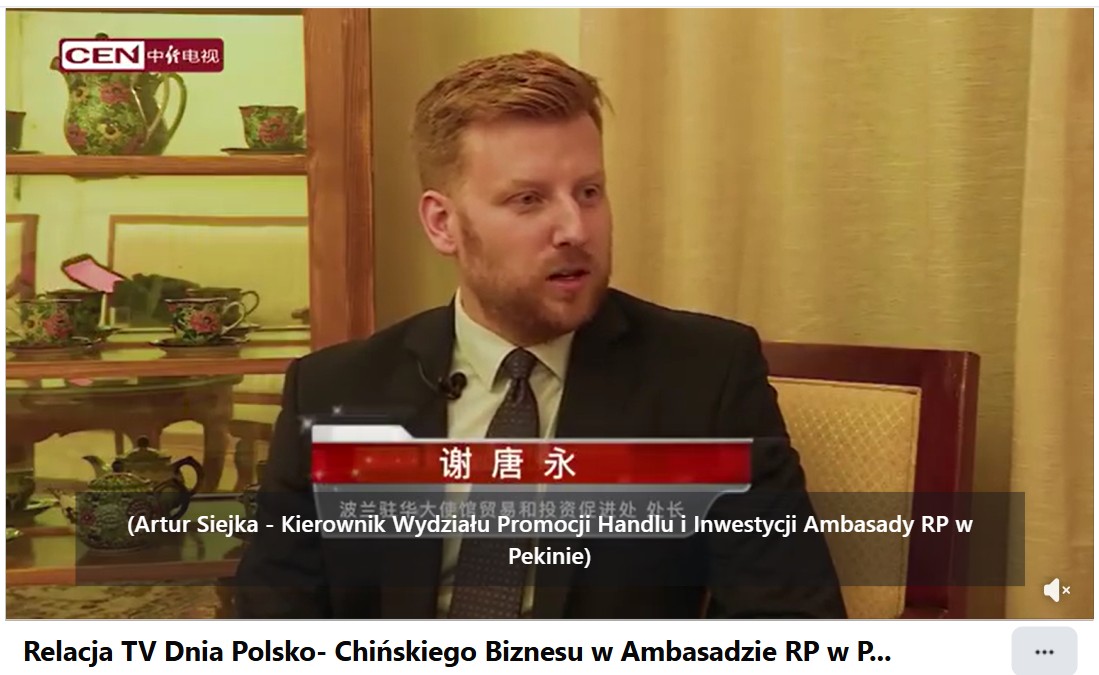
Poland–China Business Day. Artur Siejka as head of a state mission attached to the Polish Embassy in a Chinese media report / Source: https://www.facebook.com/watch/?v=890669174441601
It remains unclear how deeply the diplomat’s Russian wife is involved in his professional projects, but in 2017, she surfaces in a photo from a Belt and Road Initiative event, manning a Polish-Chinese promotional food stall.
Anna Chelnokova goes on to defend a doctorate on the history of Chinese thought and culture at Beijing Normal University. She later works as an assistant professor back at her alma mater, MSLU, and in 2025 takes up a position at the prestigious Higher School of Economics in Moscow.
MSLU trains language cadres for the military and the Foreign Ministry, works with Russian diplomatic institutions, and hosts events attended by FSB personnel. It is part of Russia’s talent pipeline for diplomacy, the military, information security, and foreign influence. HSE University has similarly strong and openly acknowledged ties to the Russian state apparatus: it was founded by the government of the Russian Federation, and describes itself as a centre supporting the presidential administration and the government.
In 2018, Siejka loses his diplomatic immunity. At that time, a political earthquake hits Polish economic diplomacy: the ruling Law and Justice (PiS) government scraps the old trade sections, long criticized as bureaucratic and ineffective. Their role is handed over to newly created Foreign Trade Offices.
By this time, Siejka has considerable experience, knows the Chinese market well, and speaks several languages. His career within the state apparatus comes to an end.
Meet Mr Xie Tangyong
Even with the diplomatic chapter closed, Artur Siejka does not leave Beijing. He pivots back to the private sector, taking up a role representing the Polish-Chinese Business Council. In the Chinese media he goes by as Mr Xie Tangyong (谢唐永). In 2018 he turns up at the Maison Shanghai interior-design fair, and takes part in the signing of an agreement between Peking University’s blockchain research centre and FutureNet — a financial pyramid scheme later exposed by cross-border investigation by FRONTSTORY.PL and partners.
That same year, he invests in a part-time MBA at Peking University’s Guanghua School of Management, spending the equivalent of what is today some 428,000 yuan — nearly €55,000. Where does a low-ranking diplomat find that kind of money? Officially, he is a student until 2022, but it is only in May 2024 — shortly after @wmatrioszce launched — that he finally takes a trip to Beijing for his master’s defence.
“He worked at the embassy’s trade section in Beijing, I think, and he was definitely in China in 2023,” a source at the Polish Ministry of the Economy tells us. “I know that when he was recently in China again, the head of mission wouldn’t let him stay at the embassy. He was complaining about it all over town afterwards.”
Another source, this time from the Ministry of Foreign Affairs: “I know who you mean. He’s been barred from the Beijing embassy for a long time. I call him ‘Siey-KÁ’ — stressing the last syllable, the Russian way. I don’t know whether he does what he does out of hardship, or because someone’s paying him.”
2018 is an eventful year in the vlogger’s career: that autumn, he registers a business under a Warsaw address, listed with a Chinese phone number and under the banner Promocja Zagraniczna Artur Siejka (“Foreign Promotion”). Declared scope of activity? “From public relations and biotech research to funfairs and funeral planning.”
In November, the firm carries out its first commission for Poland’s state agricultural agency (KOWR). For arranging one-day B2B meetings in Beijing for Polish producers, along with a tour of local supermarkets (an industry “store check”), Siejka collects 27,000 złoty — around €5,700 at the prevailing rate.
Ties with the state body deepen quickly. The following year, KOWR tasks Siejka with simple logistics — arranging local transport for Polish exhibitors at trade fairs in Shanghai and Hong Kong (contracts of roughly 8,000 złoty each, equivalent of around €1,700 at the time).
2020 brings another twist. The Siejkas return to Moscow, and the former official’s Polish business undergoes a radical reset. Renamed “Hello Poland Artur Siejka,”the firm now specializes in information services and the wholesale trade of Polish food.
That pivot is no accident. It lays the groundwork for the next batch of commissions the company gets from KOWR in 2021. For setting up accounts on Chinese social media platforms and running the Poland tastes good campaign for one year, Siejka bills the state for over €21,000 gross at then-current rates. He is required to deliver four articles for WeChat and at least twenty posts for Weibo every month.
How does he land a contract running the Polish government’s promotional channels in China? KOWR points to his expert knowledge of the Chinese market and diplomatic experience. During the pandemic, the contract was signed in January 2021 as a no-bid deal. Its low value (under €30,000) exempted it from public procurement rules.
In May 2022, KOWR signs a second, identical contract to continue running WeChat and Weibo. In all, for administering government profiles from January 2021 to June 2023, Artur Siejka pockets a gross total of €40,000.
Shots, Sun, and Hitching Rides
Although Siejka records most of his clips in and around Moscow, churning out hundreds of posts takes time and flexibility. He often films in the middle of the day or late in the evening, meeting his subjects for walks lasting several hours. Then come the logistically demanding excursions, like trips up to the Arctic Ocean or back to Beijing. It could just be a private hobby — a form of personal tourism — but it’s always done solo. He never brings his family along on these far-flung journeys.
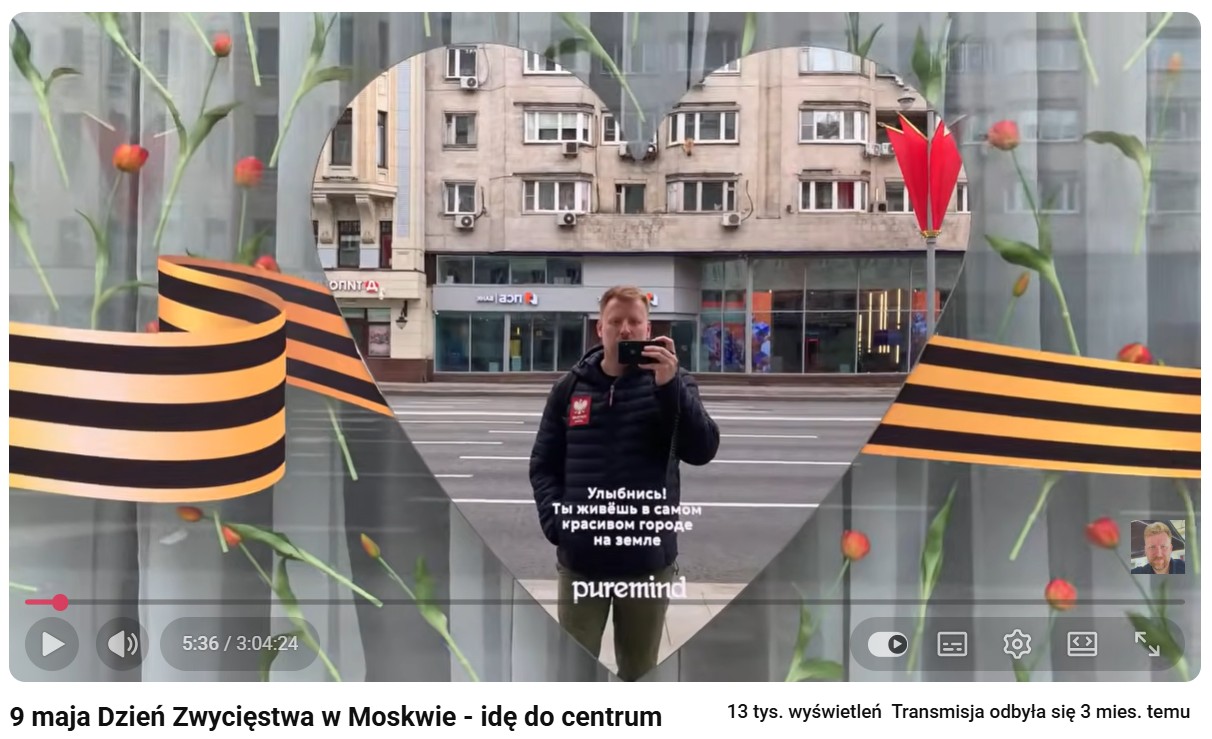
Siejka reports on the Victory Day celebrations. A St George’s ribbon — the orange-and-black emblem of Russian military pride — in a Moscow shop window; a Polish eagle on his chest / Source: https://www.youtube.com/watch?v=IDRWX0RhpxQ
In April 2026, Artur Siejka meticulously documents a hitchhiking expedition, aiming to reach Poland in time for Easter. He covers the 1,200-kilometer route through Belarus in 46 hours, hopping between the cars of 11 drivers. The Russian and Belarusian drivers are, as ever, kind and courteous: they like Poles and press vodka on him (often drinking at the wheel themselves). In Warsaw, he visits family and friends, and hosts a livestreamed meet-up for @wmatrioszce fans (a dozen or so turn up).
Next comes a livestream on a bus headed to Królewiec (which he refers to by its Russian name, Kaliningrad), followed by a flight to Moscow. There, across May, June, and July, he busies himself organizing gatherings for the local Polish community.
Guests are treated to delicacies: pizza, cebularze (an onion flatbread from eastern Poland), cheesecake, bigos (hunter’s stew). The price of admission is a payment of around 1,000 roubles — a mere €10 — to a card number at T-Bank. Who the account belongs to is unknown, but the bank itself sits on the EU sanctions lists. And while a whip-round like this is hardly a great commercial enterprise, staging paid meet-ups with viewers is hard to file under the ordinary “satisfying basic needs” that is exempt from the restrictions. Raising money by directly using the infrastructure of a sanctioned entity carries a risk of breaching the rules.
What does Artur Siejka do for a living? The funding of what he himself calls “blogging” is murky. Does his wife’s career provide the family a solid enough financial cushion? What do they live on in a sanctioned state — let alone in Moscow, the most expensive city in the Russian Federation?
We asked Artur Siejka about this several times. We received no answer.
“Summer in Full Swing”
Thursday, June 11, a sunny midday. It’s a regular working day — including in Moscow, which is gearing up to celebrate the state holiday of Russia Day the very next morning. Artur Siejka starts a spontaneous YouTube stream. A few dozen people tune in to watch a live broadcast of his idyllic stroll along the beach in the Strogino district.
“You can sit in the shade, kids digging in the sand — summer’s in full swing,” he remarks.
June 11 marks the 1,569th day of Putin’s full-scale invasion of Ukraine, which means the conflict has now lasted longer than the First World War. From Siejka, of course, not a word about politics. Off camera, Moscow has just endured its fourth consecutive night under fire from Ukrainian drones, forcing the emergency closure of Vnukovo and Zhukovsky airports. Across the country 330 Ukrainian craft were counted; Russia replied with a strike of more than 220 drones and missiles. The exchange of blows hits ordinary Russians in the wallet. A few days later a drone strike on Gazprom Neft’s refinery in south-eastern Moscow deepens the fuel crisis. South of the capital, drivers queue at the pumps, and according to witnesses some stations ration sales and take cash only.
Artur Siejka is not alone in burnishing Russia’s image. “Naïve” travel vloggers and by local and foreign creators alike — among them Alexandra Jost, added to the EU sanctions lists in June 2026 — are also pushing out Russia-friendly travel content. The American-Russian influencer known as ”Sasha Meets Russia” had amassed around 300,000 followers across platforms before YouTube and Instagram blocked her accounts in March 2025. As journalists at Novaya Gazeta Europe and iStories proved, she worked for state television and also received grants from the Kremlin’s Presidential Fund for Cultural Initiatives.
There is no evidence that what Artur Siejka does is Kremlin-funded or an influence operation. But his venture occupies a niche that plays perfectly into the Russian narrative. By showing a normal, likeable, appealing Russia in Polish, while giving a wide berth to any conversation about the costs – political and moral – of the war Russia is waging, the image of Putin’s country is being softened. Softened by a man who spent years inside the Polish diplomatic system on one of the most important fronts of Polish foreign policy. His profiles show only the curiosities of everyday life in Russia, where everything seems orderly and safe. They create the effect of normalizing an oppressive regime in wartime.
The question is what awaits Siejka’s viewers once the last matryoshka is opened.
This investigation was originally published in Polish on FRONSTORY.pl.
Subscribe to “Goulash”, our newsletter with original scoops and the best investigative journalism from Central Europe, written by Szabolcs Panyi. Get it in your inbox every second Thursday!