




As Wagner Marched Toward Moscow, Szijjártó Offered Help. Lavrov Laughed


Three years ago, Yevgeny Prigozhin’s mercenary army rose up against Moscow. Hungary’s foreign minister, Péter Szijjártó, quickly called his Russian friend in concern. Here is a previously unpublished Szijjártó-Lavrov phone call from VSquare’s Kremlin Hotline investigation.
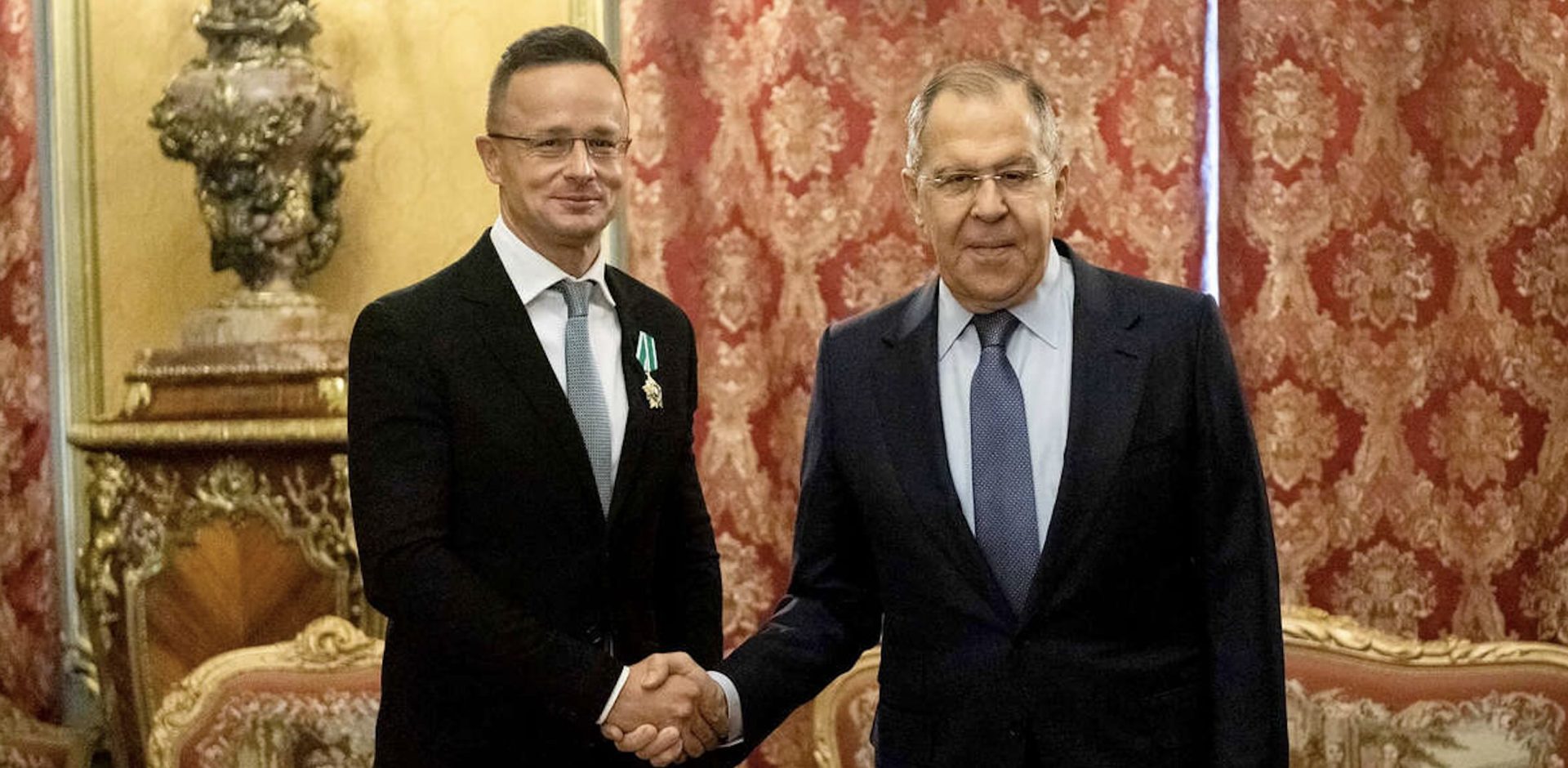
“Hello, I just wanted to know if things are under control and that you are OK?” — this is how a June 24, 2023 phone call begins, with Hungarian Foreign Minister Péter Szijjártó sounding rather concerned about the safety of his Russian counterpart and friend, Sergey Lavrov.
The previous evening, on June 23, Yevgeny Prigozhin, the leader of the Wagner private military company, had openly turned against Russia’s military leadership. Prigozhin claimed that the Russian army had struck one of Wagner’s camps, and he vowed revenge against Defense Minister Sergey Shoigu and Chief of the General Staff Valery Gerasimov.
Moscow denied attacking the Wagner camp, while the FSB opened a criminal case against Prigozhin for armed rebellion. During the night, however, Wagner units crossed from the Ukrainian front into Russia, then entered Rostov, where they seized the area around the headquarters of Russia’s Southern Military District.
Within hours, an internal Kremlin conflict had turned into an open military crisis.
Prigozhin insisted that he had not launched a coup, but only a “march for justice” against the army leadership. But the images told a different story: armed mercenaries were occupying the streets of a major Russian city, while another Wagner column was heading toward Moscow. On the morning of June 24, Vladimir Putin called the action a treason and warned of the danger of civil war.
It was in this situation that Szijjártó called his friend Sergey Lavrov to find out how serious the situation was — and, at the same time, to offer the Russian foreign minister “personal” help.
The transcript of this June 24, 2023 phone call was obtained by a consortium consisting of VSquare, Poland’s FRONTSTORY, Russia’s The Insider, Estonia’s Delfi, and Slovakia’s Ján Kuciak Investigative Center as part of our Kremlin Hotline project.
Based on the transcripts and audio recordings we obtained, we revealed in late March and early April that, at the request — or instruction — of Sergey Lavrov and other Russian officials, Szijjártó, in cooperation with the Slovak government, helped remove Russian individuals, banks, and companies from the European Union’s sanctions list.
In the second part of our series, we also showed how Szijjártó handed over an EU document at Lavrov’s request, and how the Orbán government used the issue of Hungarian minority rights in coordination with the Russians to block Ukraine’s EU accession.
But we did not use all of the material from the conversations we obtained in those earlier articles. One such unpublished transcript was the phone call that took place during the Wagner rebellion. It is interesting less for its content than for the gestures made by the Hungarian side — and for the willingness to offer help.
I don’t need anything. There is no problem.
Although the wider public had not previously known about this phone call, it was performed on May 14, 2026, at a special event at Fotografiska Tallinn, where journalism and theater met.
Together with Holger Roonemaa, co-author on the Kremlin Hotline project, we discussed our joint investigation, the Orbán government’s smear campaign, political developments in Hungary, and Russian influence — while two young Estonian actors, playing Szijjártó and Lavrov, read from their phone conversations. Péter Szijjártó was played by Herman Pihlak, while Sergey Lavrov was played by Karl Birnbaum.
The full recording of the English-language discussion and performance, which runs for one hour and 17 minutes, is available online.
The phone transcripts shared with the actors were performed with minor changes. For example, in the conversation during the Wagner rebellion — which begins around the 56-minute mark — the script was supplemented with explicit references to Wagner for clarity. At the very end, during the goodbyes, the actors also departed from the script for comic effect.
The original English-language transcript of the June 24, 2023 phone call:
Szijjártó: Hello, I just wanted to know if things are under control and that you are OK?
Lavrov: Absolutely under control, President has said everything that was needed. Don’t worry, we will keep it quiet.
Szijjártó: Have you stopped their (Wagner) advance towards Moscow?
Lavrov: The army is in control. I don’t follow the events live. The army knows perfectly well what to do.
Szijjártó: So these are just fake news that the president and prime minister have left Moscow?
Lavrov: These news have been debunked hours ago already. Don’t worry and don’t believe what the social media is saying.
Szijjártó: Are they (Wagner) in Voronezh and Rostov?
Lavrov: I don’t follow everything from hour to hour. The army is on the ground and they have all the capabilities and knowledge on what to do.
Szijjártó: So you personally are completely fine?
Lavrov: Absolutely. More than fine.
Szijjártó: Well, if you ever need anything personally, just let me know.
Lavrov: (laughing). I don’t need anything. There is no problem. Thank you for calling.
(more goodbyes)
The phone call took place on the afternoon of June 24, 2023. We know this from the content of the conversation.
That afternoon, based on flight-tracking data, several Telegram channels and news sites reported that one of Putin’s presidential Il-96 aircraft had taken off from Moscow and headed northwest, toward St. Petersburg and the Valdai residence near Tver, before disappearing from radar. Reports quickly began spreading on social media that Putin and other top Russian state leaders had left Moscow.
This is what Szijjártó asks Lavrov about on the call. Lavrov immediately corrects him, saying the reports are false and had already been debunked.
Indeed, Kremlin spokesman Dmitry Peskov claimed that afternoon that Putin was working in the Kremlin. After similar rumors began circulating about Prime Minister Mikhail Mishustin — with some Telegram channels claiming he had also flown to St. Petersburg — the government press service said Mishustin was at his workplace and holding government meetings.
The rebellion came to an unexpected end that same evening, on June 24. The Wagner columns advancing toward Moscow stopped, and Prigozhin announced that he was turning his men back because he did not want to spill Russian blood. According to the Kremlin, a deal had been brokered by Belarusian President Alexander Lukashenko: Prigozhin would be allowed to leave for Belarus, and Wagner fighters would not be punished.
But two months later, on August 23, 2023, Prigozhin’s plane was blown up while flying from Moscow to St. Petersburg. In addition to the Wagner leader, nine other people were killed in the attack.
You can read the original Kremlin Hotline investigation here:
Kremlin Hotline: Hungary Colluded with Russia to Delist Sanctioned Oligarchs, Firms and Banks
Kremlin Hotline: How Hungary Coordinates with Russia to Block Ukraine from the EU
Subscribe to “Goulash”, our newsletter with original scoops and the best investigative journalism from Central Europe, written by Szabolcs Panyi. Get it in your inbox every second Thursday!

VSquare’s Budapest-based lead investigative editor in charge of Central European investigations, Szabolcs Panyi is also a Hungarian investigative journalist at Direkt36. He covers national security, foreign policy, and Russian and Chinese influence. He was a European Press Prize finalist in 2018 and 2021.