




Head of Surveillance Team Says We Should Be Grateful He Spied on Kuciak
Illustration: OCCRP/Kočner's Library, Wikimedia Commons, VSquare 2026-10-07


Illustration: OCCRP/Kočner's Library, Wikimedia Commons, VSquare 2026-10-07
Nearly 10 years ago, Marian Kočner asked Peter Tóth to set up surveillance of journalists and politicians allegedly for his future online show Na pranieri (“At the Pillory”) on YouTube. Now, almost a decade later, the main trial over violations of the right to privacy and confidentiality of oral communication finally began at Bratislava I District Court. Kočner and Tóth took their seats as defendants alongside three members of the surveillance team: — Miroslav Kriak, Juraj Škrip, and Štefan Mlynarčík. Judge Ivan Alman, however, postponed the proceedings indefinitely.
The hearing, held in the largest courtroom of Bratislava’s Palace of Justice, lasted only about 30 minutes. All the defendants appeared, and as did some of the roughly thirty injured parties, including journalists Eugen Korda, Marek Vagovič, and Zuzana Petková. They witnessed Marian Kočner’s emphatic “no” and Peter Tóth’s forceful “absolutely not” when the judge asked whether either would seek a plea deal. Judge Alman reprimanded Tóth for his response. All the defendants declined a plea agreement, and all likewise pleaded not guilty.
Defense attorneys for Kočner and Škrip challenged the prosecutor’s indictment, arguing that the elements of a crime were not present in this case and that the conduct described did not amount to a criminal offense. Defendant Peter Tóth then asked to speak and filed a motion to dismiss the criminal proceedings on the grounds that the statute of limitations had expired. He promptly had the motion delivered to all parties in the case.
Judge Alman then took the floor and announced that he was postponing the proceedings indefinitely for personal reasons, adding that it was not yet clear whether he would continue presiding over the case. Given health considerations, the case may be reassigned to a new panel of judges.
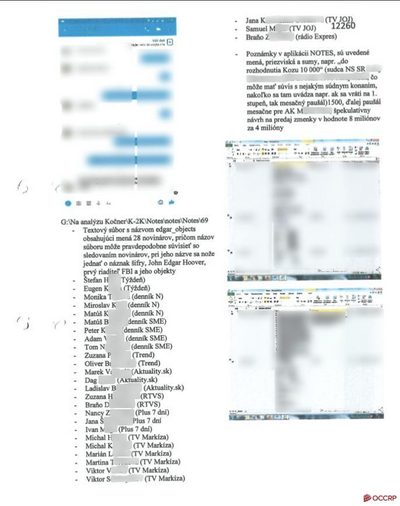
List of the names of the journalists placed under surveillance, found in the “edgar_objects” document in the investigative file. Source: Kočner’s Library/OCCRP
Kriak: “Be Grateful We Were Watching Kuciak”
According to the indictment, at the turn of 2016–2017, Kočner allegedly asked Tóth to begin surveilling specific journalists, intending to use the material for his future online show Na pranieri, which he planned to broadcast on his Facebook page. Tóth then brought Miroslav Kriak into the operation, and Kriak in turn recruited police officer Štefan Mlynarčík and recording equipment expert Juraj Škrip, who, at the time, headed the material hardship and social benefits department at the Central Labor Office. Over several months, they gathered photographic and written surveillance material on the journalists.
Among the material collected were photographs of investigative journalist Ján Kuciak, whom Kočner added to the list of surveillance targets only later. Kuciak and his fiancee, Martina Kušnírová, were murdered in February 2018 at their home in Veľká Mača. The surveillance material on Kuciak gathered by the team was found on a USB drive during a search of Kočner’s home carried out after the murder. The killers and the middleman are already serving long prison sentences, while Marian Kočner and Alena Zsuzsová are facing charges at the Specialized Criminal Court for ordering the investigative journalist’s murder. Kočner’s former associate, the aforementioned ex-intelligence officer Peter Tóth, has already testified against him.
Leaving the courthouse after the surveillance hearing, Tóth declined to speak to the media. However, fellow defendant Miroslav Kriak— a former StB officer who later worked for the Slovak Information Service (SIS) and most recently headed methodology at the Financial Administration’s Criminal Office — was happy to talk. He claimed that it was his own tip about a planned attempt on the life of Oskar Fegyveres, the witness to the kidnapping of President Michal Kováč’s son, that saved Fegyveres’s life at the last moment. He also claimed to have taken part in numerous significant operations that he says he’ll carry to his grave.
Regarding the journalist surveillance case, Kriak claimed the original assignment was to monitor locations— namely the bar Next Apache and later the bar U Krajniaka — and not specific individuals. “I had good reason to believe the assignment came from the intelligence service,” Kriak said in a surprising statement after the hearing. “This wasn’t the only assignment I received from the intelligence services,” he added, though he declined to clarify whether Peter Tóth was still officially working for the SIS at the time of the assignment, despite having supposedly left the agency. Kriak also claimed he had no idea the surveillance material was being passed along to Kočner as well.
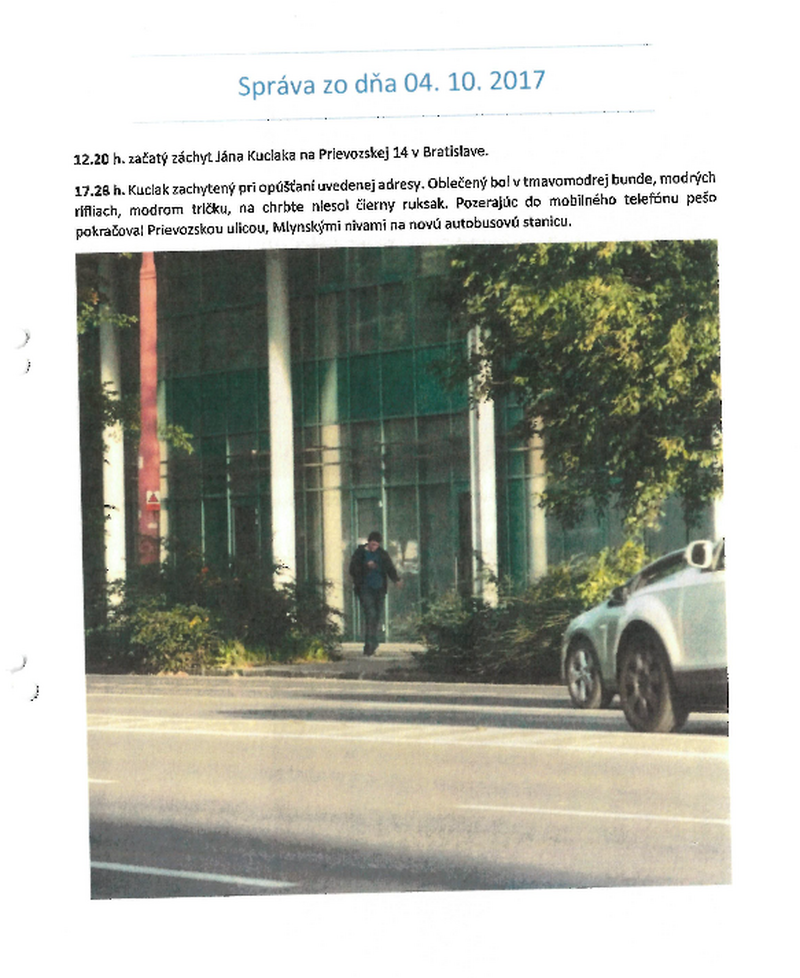
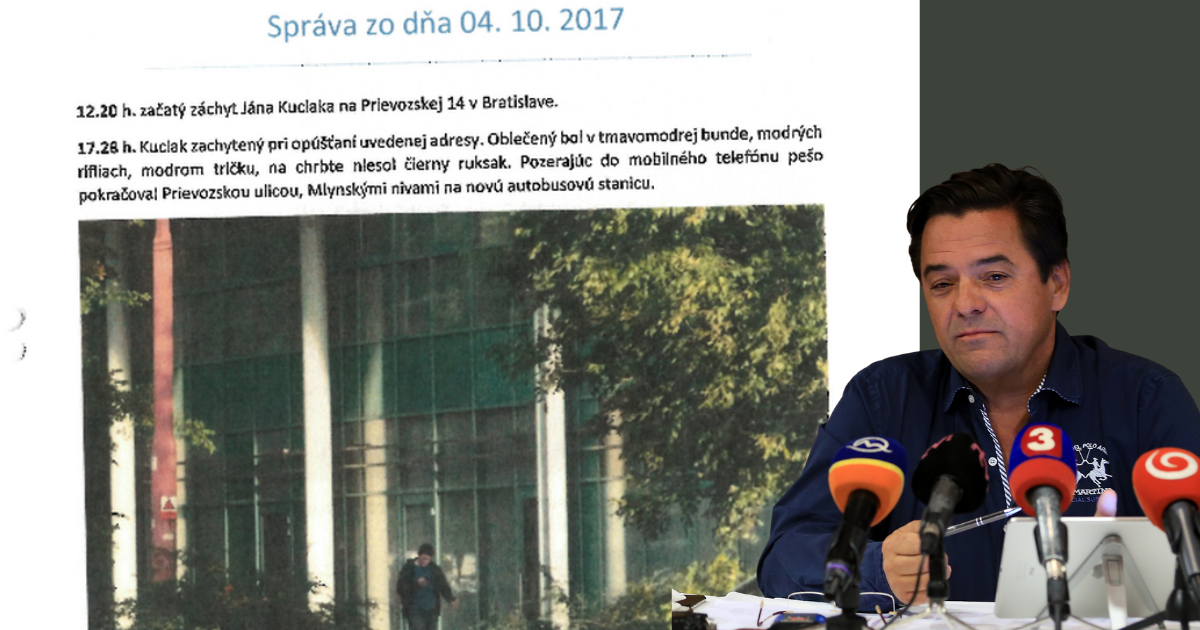
A report from the first day of surveillance on Ján Kuciak. Source: OCCRP/Kočner’s Library
Petková: “Kriak’s Claim Is Ridiculous”
One of the injured parties who came in person for the start of the main hearing was investigative journalist Zuzana Petková, now head of the Let’s Stop Corruption Foundation. “It left me with a pretty bad feeling, because we’ve been waiting nine years for justice. Back then, Kočner’s team was watching us and gathering information that Kočner apparently later used to order Ján Kuciak’s murder. According to the case file, I was followed for about a week — they were there when I walked my son to daycare, they tracked who I was meeting with, and there’s video and photo material that includes my sons. They stopped the surveillance because, in their words, I led an uninteresting life,” Petková said, recalling events from years ago.
She doesn’t believe Kriak’s claim that the order to surveil journalists came from within the SIS. “I find that ridiculous, and I don’t believe it at all. Based on the communications in the case file between him and Tóth, they were very close — they shared confidential information — and I don’t believe Tóth wouldn’t have told him something that important. And even if he hadn’t told him, their communication continued even after it came out what Kočner had used their surveillance material for. If I’d been in Mr. Kriak’s position and found out a friend had used me like that, I would have cut off contact with him,” explained the head of the Let’s Stop Corruption Foundation. She said she couldn’t yet comment on Peter Tóth’s motion to dismiss the case due to the statute of limitations: “I need to look into it more closely. Tóth is citing a three-year limitation period — I don’t know if that’s a result of the amendments to the criminal code pushed through by the Fico government.”
Other Cases of Surveilled Journalists
In his testimony, Tóth repeatedly claims that Kočner gave him a document—sometime around the turn of 2016 and 2017—containing a list of journalists he wanted to have monitored.
Meanwhile, among the documents recovered from Kočner’s electronic devices is a text file titled “edgar_objects.” “Edgar” appears to have been a code name for the entire operation. It may be a reference to John Edgar Hoover, the first director of the FBI, who was known for having prominent Americans of his era placed under surveillance and for collecting compromising information on them.
The “edgar_objects” file contains 28 names, mostly journalists, whom Kočner had put under surveillance. The surveillance began in the first half of 2017, and Tóth passed the results to Kočner on a rolling basis on USB drives. Ján Kuciak was not among those being watched at that point. According to evidence in the investigation file, which the ICJK analyzed as part of its Kočner’s Library project, Kočner made Kuciak a target of the surveillance team only after Kuciak received a threatening phone call from him in September 2017.
Kočner later claimed in court that the purpose of the operation was to gather compromising information and tabloid-style photos of journalists, which he would then publish on his YouTube media outlet, “Na pranieri” (“At the Pillory”). He said the outlet was still in the planning stage, but though it did not yet exist, it had a Facebook page.
The journalists under surveillance included Monika Tódová of Denník N, Zuzana Petková, head of the Let’s Stop Corruption Foundation, Marek Vagovič, Eugen Korda, and many other journalists across all of Slovak media.
This investigation was originally published in Slovak on ICJK.sk.
Subscribe to Goulash, our original VSquare newsletter that delivers the best investigative journalism from Central Europe straight to your inbox!