


How Russian Propaganda Uses 1956 to Reach Hungary’s Far Right and Far Left


Seventy years after the Hungarian Revolution of 1956, Russian propaganda is promoting contradictory interpretations of the anti-Soviet uprising to different political audiences. While far-right pro-Russian groups in Hungary portray Vladimir Putin’s Russia as being “on the same side” as the 1956 freedom fighters, Russian state media describes the revolution in the same terms as Ukraine’s Euromaidan, a Western-orchestrated fascist insurgency. The latter narrative has also gained traction among far-left pro-Russian organizations in Hungary.
The Hungarian Revolution began on October 23 1956 as a popular uprising against the country’s Soviet-backed communist dictatorship. It was crushed by the Soviet military in November, leaving thousands dead and forcing around 200,000 Hungarians to flee the country. Since the fall of Communism, the revolution, marked annually by a national holiday, has become a defining symbol of contemporary Hungarian identity.
As a side-effect, nearly all post-1989 mainstream Hungarian political parties started to claim that they are the true heirs of the 1956 revolutionaries. In recent years, this identification has become more and more conflicted as the Hungarian right has become increasingly sympathetic with Vladimir Putin’s Russia, a country that openly embraces the legacy of Soviet imperialism.
The contradiction is perfectly illustrated by a recent controversy over a speech given by László Toroczkai, leader of the far-right Mi Hazánk (Our Homeland) party. Toroczkai’s speech at last year’s October 23 commemoration argued that the 1956 revolutionaries had not fought against Russia, but “against an internationalist communist empire,” which should be treated entirely separately from the modern Russian Federation. Instead, Toroczkai argued, it is the European Union today that represents a similar imperial threat.
Prime Minister Péter Magyar condemned the statement as a distortion of history meant to serve Russian interests.
Toroczkai’s sentiment is not unique: similar arguments have circulated through pro-Russian Hungarian-language propaganda channels, including the Telegram channel Russians on the Side of Truth and the Saint Stephen Legion, a profile on VKontakte and Telegram claiming to represent Hungarian volunteers fighting alongside Russian forces in Ukraine.

Pictures shared by the Legion of St. Stephen. The group presents itself as a Hungarian-Russian volunteer unit fighting on the front lines in Ukraine, but no evidence has emerged to support the existence of such a unit. Source: VK, Lakmusz.hu
The so-called Saint Stephen Legion describes itself as an anti-communist, conservative and traditional community. In a post addressing this year’s anniversary of the 1956 revolution, the group also insisted that Putin’s Russia should not be associated with the Soviet Union, while shifting much of the responsibility for the crackdown on the revolution onto Hungary’s former communist leadership.
As Átlátszó previously reported, no evidence has emerged that the alleged Hungarian military unit Saint Stephen Legion actually exists, and the online group is run by Russian operatives who were also involved in the Hungarian edition of NewsFront.
Besides VK and Telegram, the message from the two Russian groups have also appeared on the website Nemzeti InternetFigyelő (National Internet Watch). The website was launched in 2009 as a sort of news aggregator for nationalist organizations and media, but it has increasingly adopted pro-Russian and anti-Ukrainian positions since 2014. Since 2026, its staff has included a correspondent based in Russia.
Russian state media describes 1956 as a product of Western intelligence
While messaging aimed at the Hungarian right-wing attempts to de-associate the Soviet Union and Putin’s Russia, the narrative promoted to Russian-speaking audiences in Russia is almost the exact opposite.
Although former Russian President Boris Yeltsin apologized for the Soviet intervention in 1992, and Putin expressed similar sentiments in 2006, Soviet-era interpretations of the events have increasingly returned to Russian public discourse. A Russian history textbook published in 2023 described the Hungarian revolutionaries as fascists.
Following criticism in Hungary, the Russian Embassy in Budapest emphasized Russia’s respect for Hungarian historical memory. During the 70th anniversary in October 2026, however, Russian state-affiliated media repeatedly presented the revolution as an operation organized by Western intelligence agencies. Moreover, unlike previous years, Russian diplomatic services did not show any gestures towards Hungary’s commemorations.
On October 19, the Russian Military Historical Society held a conference describing the 1956 uprising as a Cold War-era “color revolution.” Speakers alleged that Western intelligence services had planned the uprising and that thousands of armed veterans had been sent into Hungary from Western Europe. These allegations were presented without credible evidence.
Similar claims appeared on Russian state television and radio, where commentators compared the Hungarian Revolution to Ukraine’s 2014 Euromaidan protests and described both movements as Western-backed attempts to overthrow legitimate governments.
Soviet nostalgia and Russian symbols on Hungary’s far left
Russian propaganda has also found an audience among smaller Hungarian organizations identifying with the radical left. Some of these organizations received official recognition by Russian diplomacy, including the Hungarian Workers’ Party (a splinter of the pre-1989 state party), the Workers’ Militia Memorial Society, the Hungarian Anti-Fascist League and the Stromfeld Association (a historical society named after a military leader of the short-lived Hungarian Soviet Republic).
Several of these organizations preserve the symbols and historical narratives of Hungary’s former communist regime, and some portray the events of 1956 as a violent counter-revolution.
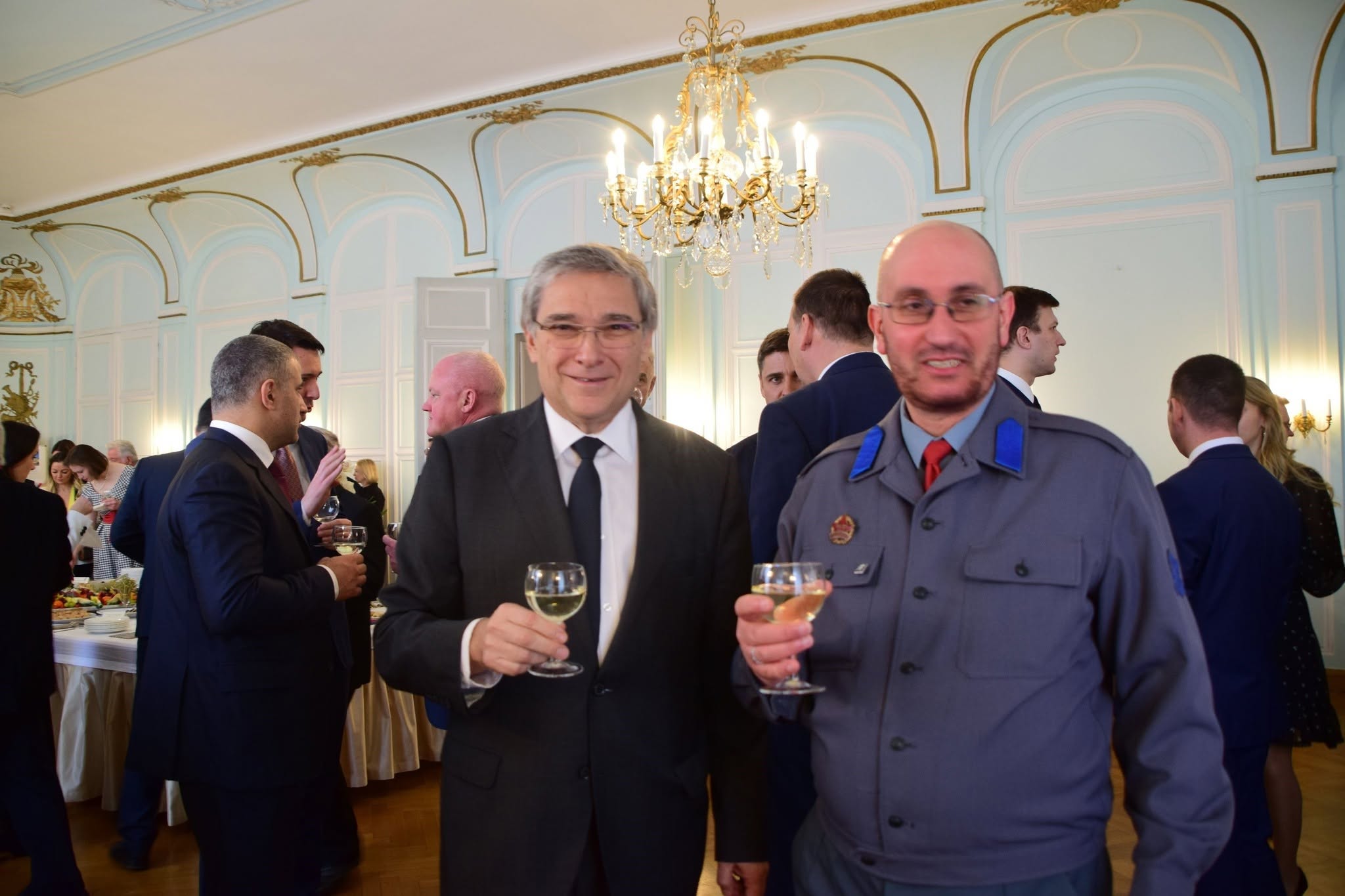
László Miklós Sej, president of the Workers’ Militia Memorial Society (right), at the Russian Embassy’s Victory Day celebration in 2024. Source: Facebook/Munkásőr Memorial Society
The Stromfeld Association attracted attention during this year’s anniversary by commemorating a military officer killed by revolutionaries in 1956, describing the militants as “a violent mob.” The Workers’ Militia Memorial Society has participated in official commemorations organized by the Russian Embassy.
Its members have also displayed the orange-and-black Saint George ribbon, a symbol widely associated with Russian military patriotism and support for the invasion of Ukraine.
In the days leading up to this year’s October 23rd commemorations, the Workers’ Militia Memorial Society came into conflict with the far-right Sixty-Four Counties Youth Movement (Hatvannégy Vármegy Ifjúsági Mozgalom, or HVIM, a group previously led by László Toroczkai) over a Facebook page promoting the communist interpretation of the revolution. The incident further highlights the strange ideological confusion of pro-Russian sentiment in Hungary, as HVIM itself is also an open supporter of Putin’s Russia.
Last year, HVIM was among the far-right Western groups that founded the International Sovereignist League (ISL) in Saint Petersburg, Russia. ISL is funded by Konstantin Malofeev, a media mogul sanctioned by the EU and the US for his involvement in the Donbas war. In a statement, HVIM praised the Russian Federation saying “Russia’s imperial character is also particularly worthy of recognition, as it has embodied the essence of traditional empires,” but also expressed frustration that Russian diplomats in Hungary are associating with far-left organizations.
Different ideologies, same geopolitical alignment
This phenomenon however, extends well beyond Hungary, with Western European American radical leftists, such as the American Communist Party and the Center for Political Innovation and certain European political groups supporting Russia through a combination of Soviet nostalgia, anti-Americanism and the belief that Moscow is fighting Western imperialism.
At the same time, far-right nationalist movements admire Putin’s Russia as a defender of traditional values, national sovereignty, and religious conservatism. These ideological positions seem fundamentally incompatible, yet both the far-left and far-right versions lead their adherents to support the Kremlin’s foreign policy and its war against Ukraine – in large part due to the Kremlin’s targeted messaging to these opposing groups.
The original version of this investigation was published in English (translated with artificial intelligence) on Átlátszó.hu. Read the Hungarian version here.
Subscribe to “Goulash”, our newsletter with original scoops and the best investigative journalism from Central Europe, written by Szabolcs Panyi. Get it in your inbox every second Thursday!

Zalán Zubor began working at Atlatszo.hu in 2022. Zubor covers topics related to Russian influence in Hungary and corresponding security risks, as well as the Hungarian government’s stance on the war in Ukraine and refugees in Hungary.