




International Burke Institute: The Academic Façade of a Russian Influence Operation
Illustration: ibi.institute 2026-10-08


Illustration: ibi.institute 2026-10-08
A think tank that presents itself as Israeli is, according to OpenAI and Meta, part of a Russian influence operation. Its sovereignty index and several of its studies have made their way into reputable media outlets and academic texts. Leaked documents show that the Moscow-based propaganda firm Social Design Agency (SDA) had planned influence operations as early as 2024.
The International Burke Institute (IBI) presents itself as an independent think tank based in Tel Aviv. On its website, ibi.institute, it publishes analyses of international politics and country reports, along with a list of hundreds of experts who supposedly work with it. One of them is Radim Polčák, vice rector of Masaryk University in Brno. He knew nothing about his supposed involvement until investigace.cz contacted him. He joins other experts whom IBI listed without their knowledge and who never collaborated with it. According to an OpenAI report from August, the institute was a central player in an influence operation linked to Russia.
OpenAI published its report on the newly uncovered Russian influence operation at the end of August 2026. It also said it had blocked the accounts that helped create it. According to OpenAI, the operation’s trail very likely leads to Russia. Its operators connected to ChatGPT accounts through VPNs, wrote their prompts in Russian, and had linguistic traces that would reveal the writer was not a native speaker removed from the texts.
IBI’s main product is its own ranking, the Burke Sovereignty Index. It claims to measure the “true sovereignty” of nearly 200 countries across seven areas, from politics and economics to the military and “cognitive sovereignty.” In the ranking, the United States is the most sovereign country, followed by China and Switzerland. Russia places fourth.
According to IBI, more than 100 experts from 50 countries worked on the index. Not all of them know it. The US think tank Council on Foreign Relations (CFR) found that IBI had listed at least three of its current or former experts on its website, and none of them had ever heard of the institute. UNICEF also denied any cooperation, even though IBI continued to present it as a partner institution. Francis Fukuyama and Noam Chomsky also appeared on the list, but neither has officially commented.
IBI also lists the Czech professor Radim Polčák among its experts. He told the investigace.cz newsroom that he had “no idea what this is about, and I have nothing to do with them.”
The operators promoting IBI also invested in social media advertising. Its content appeared on websites with names resembling magazines such as Forbes and Rolling Stone which imitated the original publications. Public traces also link IBI to real people in Israel.
Why Create a Fake Think Tank?
“The reach of this influence operation was modest,” wrote Jessica Brandt, former director of the Foreign Malign Influence Center, in an analysis for CFR. Brandt specializes in analyzing foreign influence operations. What she finds remarkable is something else: the construction of an extensive infrastructure, meaning an institution with supposed experts, studies, and its own index. According to Brandt, artificial intelligence makes it possible to produce targeted content at scale and makes it harder to identify who is behind it, so it “accelerates, though it does not fundamentally change,” foreign information operations.
The idea of an institute that would pose as a serious think tank and help Russia create the appearance of a favorable agenda is not new. As Le Monde pointed out, an almost identical concept appears in leaked internal documents from the SDA, a Moscow marketing agency sanctioned by the United States and the EU for influence operations against the West.
The investigace.cz newsroom has the full document, the title of which translates to “Project for an NGO/Institute/Think Tank in Israel,” and which, according to its metadata, was created on December 28, 2024. In it, SDA employees write, among other things, that from the perspective of Western media, opinion leaders, and prominent social media users, Russian narratives lack a legitimate source of information. SDA therefore considered the best option to be creating such a center in Israel. “The founders should be Israeli citizens with an academic degree in political science…The institute could send its research findings to major Western media and officially present materials that could then be cited in publications at any level.” The document also includes a marketing strategy for distributing the think tank’s outputs.
The domain ibi.institute was registered on February 22, 2025, less than two months after the document was created. As late as July 2025 it hosted only a parking page, and the institute became intensely active only at the end of the summer. There is, however, no evidence that Social Design Agency operates IBI, and we found no overlap between IBI’s technical infrastructure and SDA’s. Still, the institute’s plan shows that the idea of a fake think tank, one that helps create an environment suited to spreading a Russia-friendly interpretation of the world, is alive in the professional disinformation world.
The “True Sovereignty” of the World’s Countries
At first glance, the index does not look like propaganda. According to the information on IBI’s website, it measures a state’s “true autonomy.” In its methodology, IBI publishes a list of indicators and data sources and describes a combination of statistics and expert assessment. On that page, however, it does not present the actual expert responses or a detailed conversion of individual data points into the final scores. The methodology does not list EU or NATO membership as a separate indicator, but some of the accompanying texts describe belonging to these organizations as a limit on political or military autonomy.
This is the basis for conclusions such as Uruguay having higher political sovereignty than Czechia, because Uruguayan institutions “emerged without supranational constitutional pressure,” whereas Czechia has, since joining the EU, “transferred a significant part of its legislative, regulatory, and judicial powers to supranational structures.” The same text, however, credits Czechia with the economic benefits of European integration and the military benefits of NATO membership. Germany’s strategic autonomy is said to be limited by its integration into NATO “under American command.”
Russia, by contrast, is credited with conducting military operations “entirely independently.” Its profile also lists control of the domestic information space among its strengths: the section on information sovereignty describes the oversight of Roskomnadzor and the filtering of internet traffic. In the overall ranking, Russia places fourth. In military sovereignty, it receives 96.5 points out of 100, and the United States 96.
Besides the index, IBI’s website contains numerous articles by experts. But as OpenAI’s researchers pointed out, much of the content is actually copied from other websites. In a sample of 36 articles, 34 were found elsewhere on the internet. For example, a study by the Washington-based Migration Policy Institute was published on IBI’s website under the name of a supposed author, Kate Howell, even though the attached PDF is identical to the original and carries the names of the real authors. An archived snapshot from August 28, three days after OpenAI’s report was released, lists a different name, Kate Hooper, one of the study’s real authors.
When AI Helps with Promotion
According to OpenAI, ChatGPT was used to create social media posts promoting IBI’s articles. The researchers found them on Facebook and X, but also on Substack, LinkedIn, and Telegram.
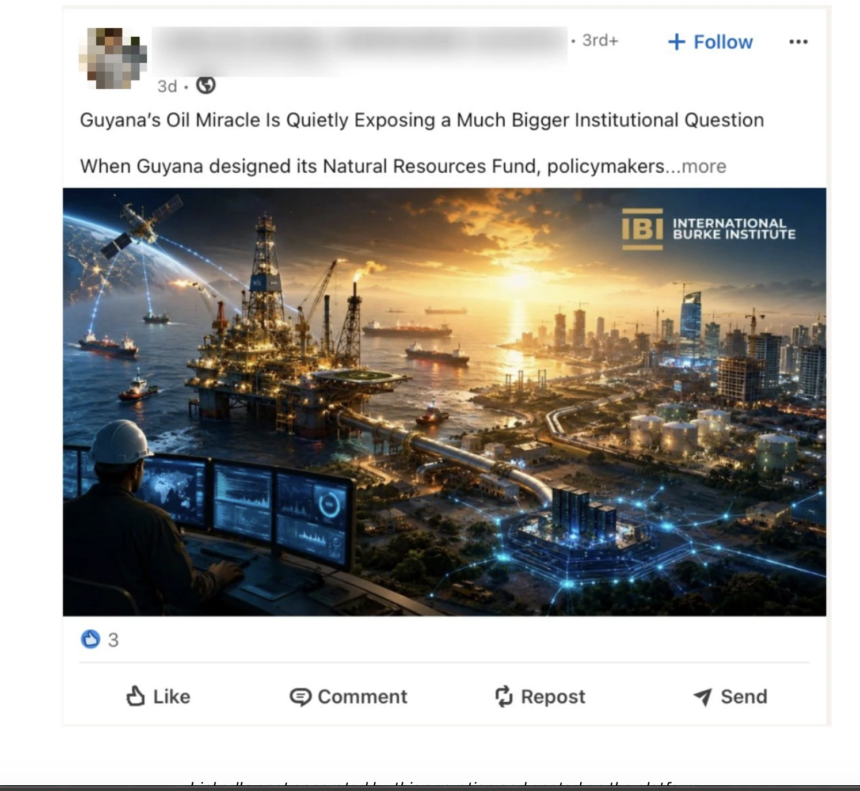
Example of a generated LinkedIn post by IBI, Source: OpenAI
According to the report, the operators did not use AI only to write posts. They also had it generate replies to posts by real Substack users, engaging with them actively and encouraging them to follow IBI’s channel.
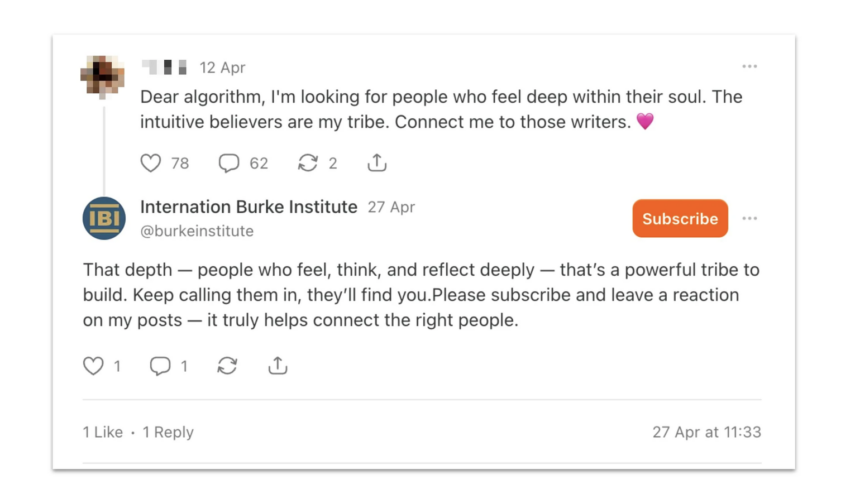
Example of a generated Substack comment, Source: OpenAI
OpenAI’s researchers describe two operators who used ChatGPT for the operation. According to the researchers, they first wrote German-language posts for the Telegram channel Lahme Ente (“Lame Duck”), which regularly criticized Ukraine, the EU, and the German government. The second created logos for about a dozen Telegram channels focused on Germany, the US, France, Poland, and Turkey. For the English-language channel American Observer, this operator created a profile picture and repeatedly had summaries of the channel’s activity prepared in Russian. Lahme Ente and American Observer spread IBI content, among other material.
Meta indirectly confirmed OpenAI’s findings. In its Adversarial Threat Report on actions against abuse of its platforms, it states that it removed a group of inauthentic accounts whose tasks included promoting IBI. For violating its policy against coordinated inauthentic behavior, it removed seven Facebook accounts, nine Facebook pages, and eight Instagram accounts. The pages had only about 200 followers on Facebook and 200 on Instagram combined. The operators spent roughly $6,400 (more than 130,000 Czech crowns) on promotion, paid mainly in US dollars, euros, and Guatemalan quetzals. According to Meta, these accounts had ties to actors in Russia.
Small clues found by the investigace.cz newsroom may also point to a Russian-speaking author. Several articles on IBI’s website contain Cyrillic letters in the middle of English text, such as the word “totaфl” in an article about Iran. Similarly, in a text about Belize and Mongolia published on the Foreign Policy Blogs website under the name of an IBI collaborator, the Russian word “удар” (“strike”) appears in the middle of an English sentence. These errors do not prove a Russian author on their own, but they fit the picture described by OpenAI.
Sponsored Articles and Scholarly Citations
Social media advertising was not the only way the institute’s content reached readers. According to investigace.cz, a nearly identical article promoting the Burke Sovereignty Index appeared on at least 25 news websites focused on India. The text pointed to alleged shortcomings in India’s “cognitive sovereignty” and contained links to the institute and its profile of India. One of the copies was published, for example, by Daily Gossip Online.
Investigace.cz also found signs of paid placement for an identical article about the index on forbeseu.com and rollingstonebritish.com, sites that imitate the Forbes and Rolling Stone brands. The links to IBI were marked as sponsored in the code of both pages, using the designation intended for paid placements.
The index’s figures have also appeared in scholarly publications. For example, the international organization The Future Society used IBI’s scores in its report on European sovereignty in artificial intelligence. Nothing in the citation suggests that the report’s authors knew about IBI’s origins or cooperated with the institute. Working papers on the index, signed by Igal Avanim and Gabriel Mart, among others, also appeared on the academic platforms APSA Preprints and SSRN. IBI’s index was also presented by its representative at an international conference in Dubai.
An AI Operation With Real Researchers?
The French daily Le Monde pointed out that IBI may be more than a virtual façade. Several people who appear as researchers connected with IBI, or who promote its index, live in Israel but were born or raised in Russia. Some of them have previously taken part in activities of the association Dor Moriah, which brings together Russian-speaking Israelis. According to Le Monde, Dor Moriah, unlike IBI, is properly registered in Israel and apparently uses the same bank account as the institute.
Grigory Pelman, director of international projects at Dor Moriah, represented the institute at an Israeli-Indian exhibition where Dor Moriah presents itself as the organizer of the OneFuture Forum. IBI’s content also reached established media. In December 2025, the Israeli website JNS, followed by the American Washington Jewish Week, published a commentary based on the Burke index. Its author presented herself as an IBI expert. In January 2026, the Telegram channels Lahme Ente and American Observer linked to the Washington Jewish Week article.
None of this proves that Dor Moriah runs or funds the operation, or that the people who work with it knew about the Russian involvement. OpenAI states that IBI may have been represented by “a handful of real people in Israel” when sending articles to media outlets and at conferences. But according to its report, OpenAI cannot determine their relationship to the institute or to the operators in Russia. Neither IBI nor Dor Moriah responded to Le Monde’s questions.
This is not the first time actors linked to Russia have used AI in influence operations. We have already written about this several times on investigace.cz. Before the German elections in February 2025, the Storm-1516 operation ran a network of more than 100 websites posing as regional German media outlets, which mostly published AI-paraphrased content. The Matryoshka campaign spread videos with fabricated statements by academics and cloned voices, as well as AI-generated images of a dark future for Germany under a CDU government.
The Russian network Pravda took a different route: last year alone, it produced at least 6.3 million articles on 286 websites in 49 languages, which almost nobody reads. Its real audience is intended to be the language models that learn from the internet.
Unlike these operations, however, in the case of the institute AI was used for more than mass-producing propaganda. It was part of a broader project to build a seemingly credible institution that others could then cite. According to OpenAI, the significance of the operation lies less in the audience it reached than in the infrastructure it built.
IBI itself rejects the accusations from OpenAI and Meta. In an unsigned statement dated August 26, quoted by the Jerusalem Post and responding to Le Monde’s article, the institute strongly rejects being called a fake think tank and being linked to foreign information operations. According to the statement, Israel provides a “natural environment for independent thinking and academic inquiry.” The statement does not address why its website published other authors’ studies under the names of people who did not write them.
The publication of OpenAI’s report did not stop the institute’s activity. The website continues to publish new texts. The profiles highlighted by OpenAI and the media, such as that of the supposed author Kate Howell, are no longer on the site. In their place, the real authors of the studies that the institute had previously claimed as their own have appeared.
The original version of this article was published in Czech on investigace.cz.
Subscribe to Goulash, our original VSquare newsletter that delivers the best investigative journalism from Central Europe straight to your inbox!

Josef Šlerka has worked as a data analyst and reporter at Czech Centre for Investigative Journalism since 2021. He used to head the Czech Fund for Independent Journalism (NFNZ). He is also the head of the Department of New Media Studies at Charles University in Prague.