




Toxic Cargo: Battery Waste Sent from Hungary to Poland Under False Labels
Illustration: company information provided by Opten Kft 2026-04-30


Illustration: company information provided by Opten Kft 2026-04-30
At the battery factory in Göd, Hungary, a significant portion of defective batteries are reclassified as normal battery products. The hazardous waste is then handed over to a transport company, IS Battery Materials Kft, which ships the disguised battery waste — with no hazard codes marked on the shipments — to various warehouses in Hungary and ultimately to a processing plant in Poland. This scheme was uncovered via documents that reached Átlátszó — and that show individual steps of the falsification operation.
The defective batteries illegally transported as normal battery products are stored at warehouses in Biatorbágy and Ecser, after which the shipments are either destroyed or taken to a waste processing plant in Poland.
According to documents obtained by Átlátszó, Samsung SDI has been using the practice of reclassifying a portion of the defective batteries produced at its Göd facility as product since 2020. This goods are then taken over by the Korean-owned transport company IS Battery Materials Kft. (ISBM) — formerly known as BTS Technology Kft. — places them in various Hungarian logistics warehouses that are not licensed for the storage of hazardous waste. They are then transported to a warehouse in Poland, from where they ultimately end up at the battery waste processing plant of a company called BTS Technology Sp. z o.o.
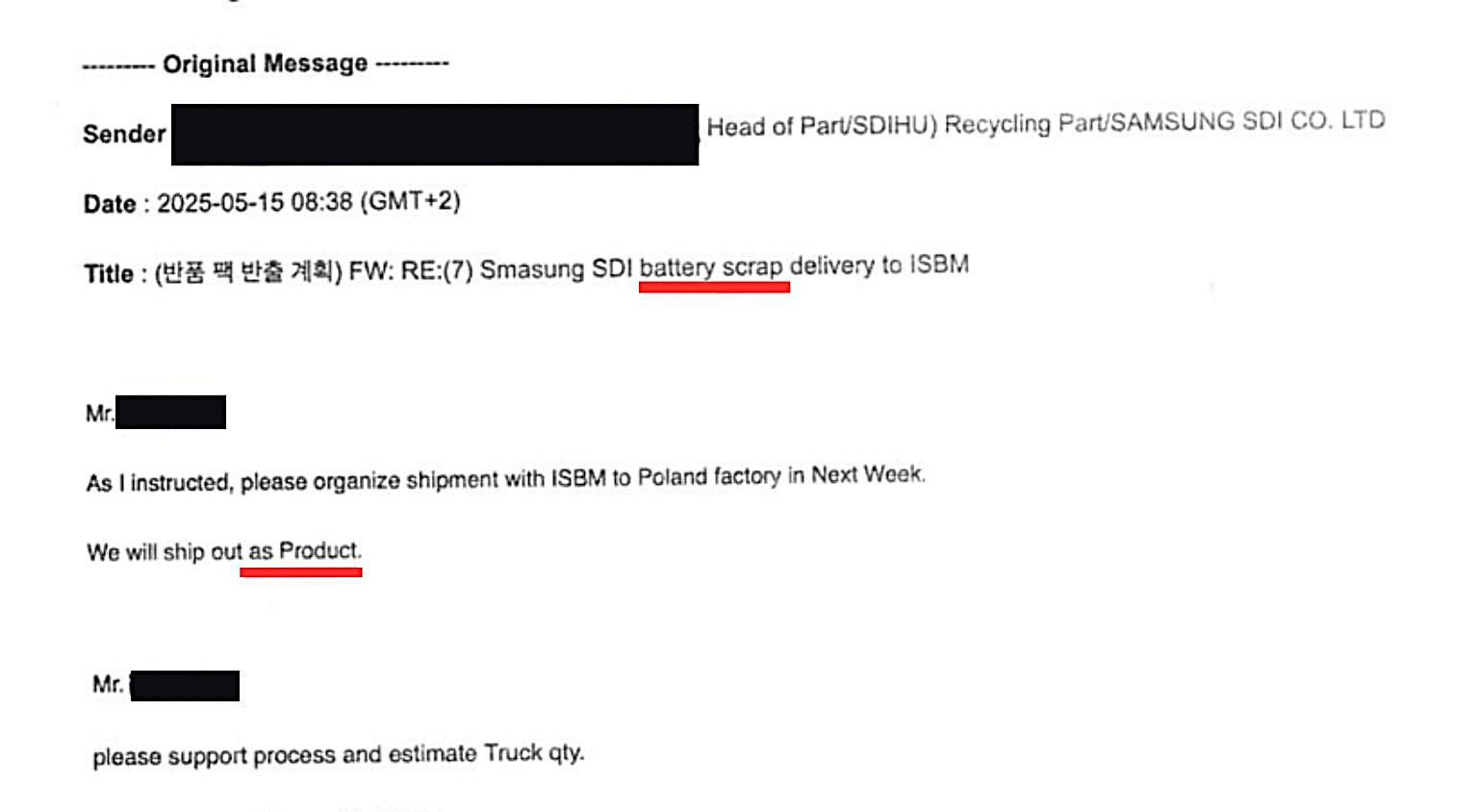
Letter excerpt about transporting waste as a product, company provided by Opten Kft .information
Battery Waste is Being Stored Illegally in Logistics Halls
We learned about the individual steps of this operation from correspondence and other documents we’ve obtained. A letter from May 2025, for example, states that Samsung orders ISBM Kft. to arrange the transport of waste to Poland, but instructs that the goods must be shipped as product.
“After every shipment, we have to ask the factory contact person to send us the data for that day’s delivery, which must be recorded in an Excel file called the ‘ISBM scrap file.’ This file must be sent to Mr. L. at the end of every month” — one of our sources, who requested anonymity, said, describing how the Korean side must be informed monthly about shipments carried out in this manner.
The waste disguised as product leaving the Göd battery factory is mostly transported to the FSK L&S CT Park logistics warehouse in Biatorbágy by trucks bearing no markings indicating hazardous waste.
In the next step of the operation, ISBM Kft. coordinates with the Polish warehousing company Withes Poland Sp. z o.o.— also Korean-owned — regarding the expected delivery and storage of the “batteries.”
In Poland, the Batteries Become Hazardous Waste Again
The goods are ultimately taken to the Polish processing plant of Korean company BTS Technology, where the battery “products” — in a staged quality control procedure — are reclassified again, this time back to being hazardous waste.
In a 2025 article, the Korean news outlet The Guru reported on the relationship between the Göd Samsung factory and the Polish recycling company. According to this report, BTS Technology — a subsidiary of IS Eco Solution, a Korean battery recycling company — “receives battery waste from Samsung SDI’s Hungarian factory and uses it in its recycling business,” the Korean outlet wrote. The article was accompanied by a photograph showing a worker dismantling and cutting up defective battery cells and modules containing hazardous materials, wearing no appropriate protective equipment — just a short-sleeved shirt.
In addition to its work in Poland, BTS Technology also operates a company in Slovakia. BTS Technology s.r.o. in Slovakia is the sole owner of IS Battery Materials Kft., the company handling shipments of the Göd factory’s “products.” That company, incidentally, also delivered battery waste classified as product to locations other than Biatorbágy — including, according to the documents, to the Ecser warehouse of a Korean company called Ajin Solution EU Zrt., which is currently in liquidation.
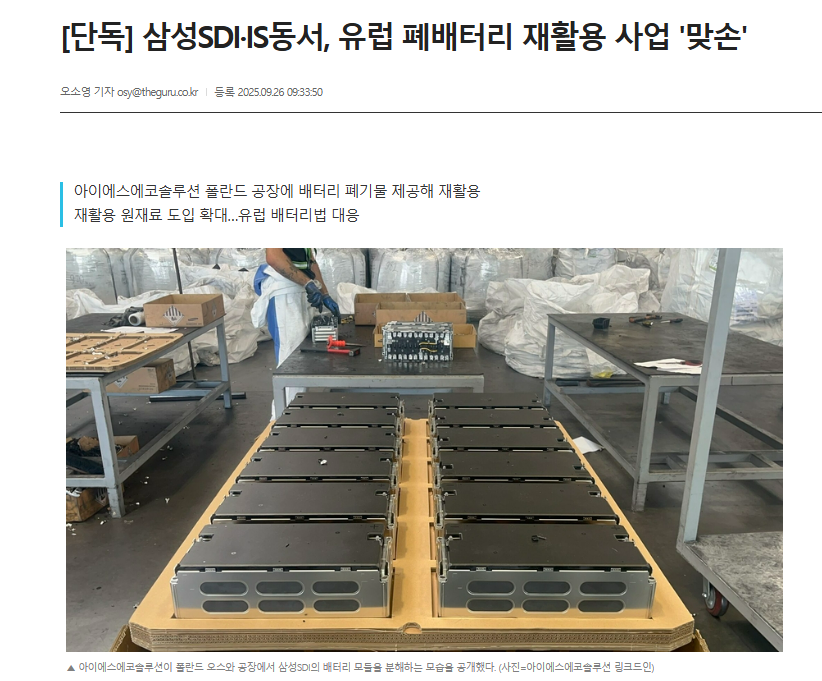
Photo from the article by The Guru news portal about the processing of battery waste from the Samsung factory in Göd in Poland.
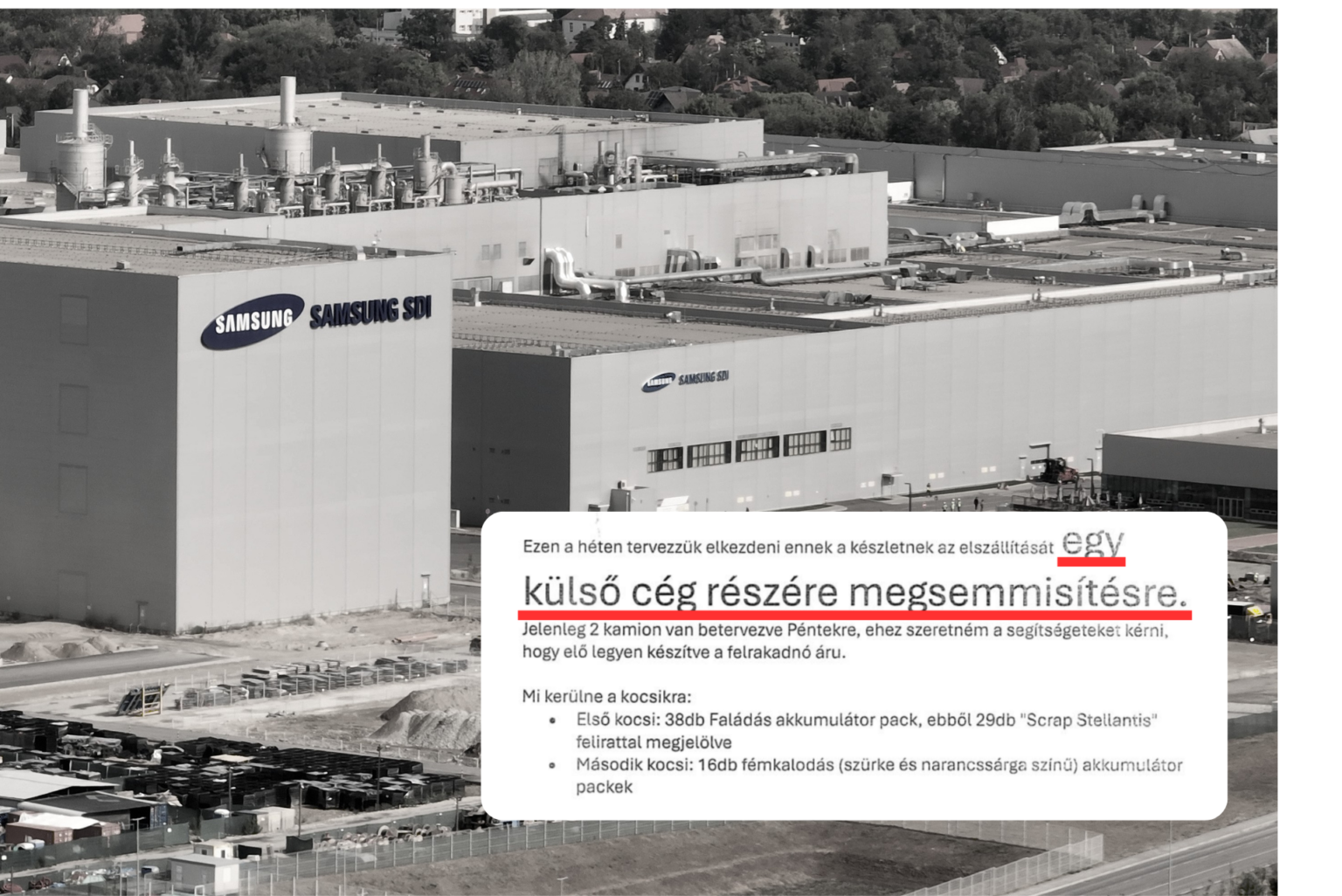
A 2025 letter further shows that the hazardous waste stored in the Ecser warehouse is to be transported to an external company for “destruction.”
According to data from the National Environmental Information System (OKIR), ISBM Kft., which carries out shipments for Samsung, has been licensed to engage in wholesale waste trading since 2018. A registration decision from 2022 that can be downloaded from OKIR lists, across 30 pages, the types of hazardous and non-hazardous waste the company is permitted to trade, up to a maximum of 10,000 tons per year.
The exact volume of waste ISBM transports from the Göd battery factory cannot be precisely determined. However, a declaration prepared during Samsung’s 2024 licensing procedure in response to a regulatory request for supplementary information may help:. According to this document, in the first quarter of 2024, ISBM Kft. transported 286 + 621 tonnes — i.e. 907 tons — of waste, suggesting that the total volume for the full year could have reached several thousand tons.
The company’s registered office is at Városliget fasor 24, ground floor, door 1, with no other operating sites; according to Opten’s corporate data, it has only five employees. Its annual financial filings, however, tell a different story: in 2024, its revenue was HUF 4,301,657,000 (approximately €11.3 million, based on 2024 average exchange rates), with a profit of HUF 217,205,000 (approximately €570,000).
We contacted Samsung SDI Zrt. and ISBM Kft. to find out whether battery waste had been transported as product from the Göd factory to various Hungarian warehouses and a Polish processing plant, and if so, in what quantities. We received no response from either company.
This story was originally published in Hungarian on Átlátszó.
Subscribe to Goulash, our original VSquare newsletter that delivers the best investigative journalism from Central Europe straight to your inbox!