







Why Is Poland Hosting a Russian-Linked Logistics Network?
Andreas Tun Hedfors, Maria Lapenkova (SVT)
Alexander Yarashevich (Buro Media)
Collaboration: Berenika Serwatka, Alicja Pawłowska (FRONTSTORY.pl)
Michael Suntinger (Paper Trail Media)
Illustration: Iwo Dziórzyński 2026-06-16


Andreas Tun Hedfors, Maria Lapenkova (SVT)
Alexander Yarashevich (Buro Media)
Collaboration: Berenika Serwatka, Alicja Pawłowska (FRONTSTORY.pl)
Michael Suntinger (Paper Trail Media)
Illustration: Iwo Dziórzyński 2026-06-16
- After over four years of full-scale Russian aggression against Ukraine and numerous rounds of sanctions, companies effectively controlled by individuals and entities from Russia and Belarus continue to operate in Poland and across Europe.
- Wealthy Russians with ties to Sberbank are conducting business as usual in the heart of Europe. What are the Polish authorities doing about it?
- The key figure is Vasily Smetanin, a Russian millionaire. Polish-registered companies are helping him.
A violent snowstorm blankets the roads, plastering houses and cars in white. In the depths of winter in central Sweden, weather like this surprises no one. On January 14, in heavy snow near Södertälje just outside Stockholm, a lorry collides with a car from a driving course car. The instructor is killed. The police open an investigation; brief reports appear in the media.
For us, that is where an entirely different story begins.
A truck accident on the outskirts of Stockholm led us to a network of transport companies evading sanctions across Europe on a massive scale.

Accident in Södertälje, Sweden, 14 January 2026 | Photo: Blåljusbilder
Medicine: From Sweden Through Poland to Russia
The truck from the accident is a curious hybrid: Polish licence plates, the logo of a Belarusian company called Jenty Spedition, and a trailer officially registered in Kazakhstan.
Reporters from Sweden’s public broadcaster SVT manage to reach the Polish branch of a company called DSPL — the registered owner of the vehicle — in Belarus. They establish that the driver has been transporting medicine from a local AstraZeneca facility to Poland, from where it was destined for Russia. The office in Minsk, where we track down the manager responsible for the transport on the day of the accident, is merely a branch; the headquarters are in Warsaw.
Just over a month after the crash, on February 26, the accident inquiry is closed. The lorry driver leaves Sweden without any charges.
The police, however, are unsatisfied. During the investigation they send an email to one Swedish government agency, flagging the fact that although the truck was registered to a Polish company, it was hauling a trailer registered in Kazakhstan. A first shadow of doubt appears in the message: “It is unclear whether it belongs to the same Polish freight company.”
Where the police investigation ends, ours begins.
SVT reporters contact AstraZeneca, the pharmaceutical giant whose medicine was on board, to establish whether transporting drugs from Sweden through Poland to Russia is lawful. AstraZeneca responds that it carried out an internal review and found everything in order, noting that the export of medicine is exempt from sanctions.
AstraZeneca adds a significant detail: the Belarusian company Jenty had been engaged as a subcontractor by the Polish firm DSPL, which “hired them.”
Since April 2022, sanctions have prohibited Belarusian and Russian carriers from operating within the EU (Belarus introduced equivalent retaliatory measures against European firms). The result: transports between Belarus and the EU are conducted via transshipment or trailer-swapping. A typical arrangement: a truck with Polish plates drives to a logistics hub near the border, where the load is picked up by a vehicle bearing Belarusian or Russian plates, which then continues into Belarus and onward to Russia.
Marcin Potapczuk, president of the Polish National Association of Carriers, tells us the crisis in the transport sector “has affected members very deeply.”
“Many carriers affiliated with us were forced to abandon eastern routes entirely. Most of the goods they had previously transported ended up on the rolling lists of successive sanctions packages — meaning these operators lost their jobs and their markets from one day to the next,” he says.
Belarusians? We Wouldn’t Know
Sanctions fall into three categories: standard, (targeting individuals and companies; related sanctions, against firms connected to those already listed; and economic sanctions. Exemptions from transport sanctions may be sought where goods serve medical or humanitarian purposes.
Kommerskollegium, the Swedish body overseeing sanctions exemptions, concluded that medicine does not fall under sanctions. In doing so, it overlooked that the issue is not just what’s being transported, but how: under EU rules any transport company founded in Belarus — or in which Belarusian or Russian nationals hold at least 25 per cent of shares — has no right to operate on EU territory.
We call Jenty to ask about its ownership structure, but after confirming that they received our questions, the company stops responding. The same happens with Polish DSPL, which offers only that it knows nothing about Jenty Spedition.
That is the last message we receive from that company.
DSPL, headquartered near Warsaw, has been operating for five years. It was founded by Anastasia Bulavina from Moscow, a representative of the Austrian firm Eastin Forwarding Holding, which is owned by Belarusian-Russian millionaire Vasily Smetanin.
Smetanin simultaneously owns the Belarusian Jenty Spedition and the Russian SDS Holding, which controls more than 20 companies across Russia. Bulavina is a manager at Jenty — and Smetanin’s stepdaughter.

Russian businessman Vasily Smetanin, owner of the JENTY and SDS-Trans holding companies | Source: belmarket.by
Today, the official co-owner of Polish DSPL is a Georgian national, Nikoloz Geguchadze — a wealthy businessman and co-owner of Dreamland Oasis, an exclusive resort in the Georgian Black Sea town of Kobuleti.
What role does he play in the Warsaw-registered company, which is formally managed by a former Jenty employee? Why was a Swedish consignment destined for Russia transported in a Polish vehicle driven by a Belarusian driver? Who owned the trailer? What lies behind this corporate labyrinth?
We try to reach Geguchadze on several occasions. He eventually replies by email through a reservation manager, stating that “it should not be regarded as unusual that vehicles, trailers, or cargo units involved in a specific transportation assignment may display various commercial names, customer references, logistics partner markings, freight forwarder identifiers, or other operational branding connected with a particular shipment or commercial arrangement. Accordingly, the existence of any such marking, even if assumed for the sake of argument, would not by itself establish ownership, control, liability, or any specific legal or corporate relationship between companies.”
In short: everything is legal. But is it?
The Stepdaughter and the Kazakh Loan
We look more closely at DSPL. We want to understand how it broke into an exceptionally competitive market — and in Poland, a fiercely crowded one — for international haulage.
Bulavina, the Moscow native, sells her shares shortly after registration of DSPL to four of Smetanin’s business partners — the same individuals who also have a stake in Jenty Spedition. In the company’s documents we find, as detailed in one 2022 DSPL financial report, a loan “for an amount below €1 million” from a Kazakh company called Technobel LLP (later revised to “an amount below €8 million”). Are inter-company loans between firms located in different countries, with no shared corporate group, a standard business arrangement — especially when one of them has barely started trading? And why does Kazakhstan feature in a venture being set up by Russians and Belarusians?
We examine Technobel LLP, the Kazakh lender. Little is publicly known: officially, the firm operates in international transport. Its office address in Almaty turns out to be the same as Jenty’s Kazakh address. The two companies share the same phone number. At the time of writing, Vasily Smetanin is listed among Technobel’s shareholders.
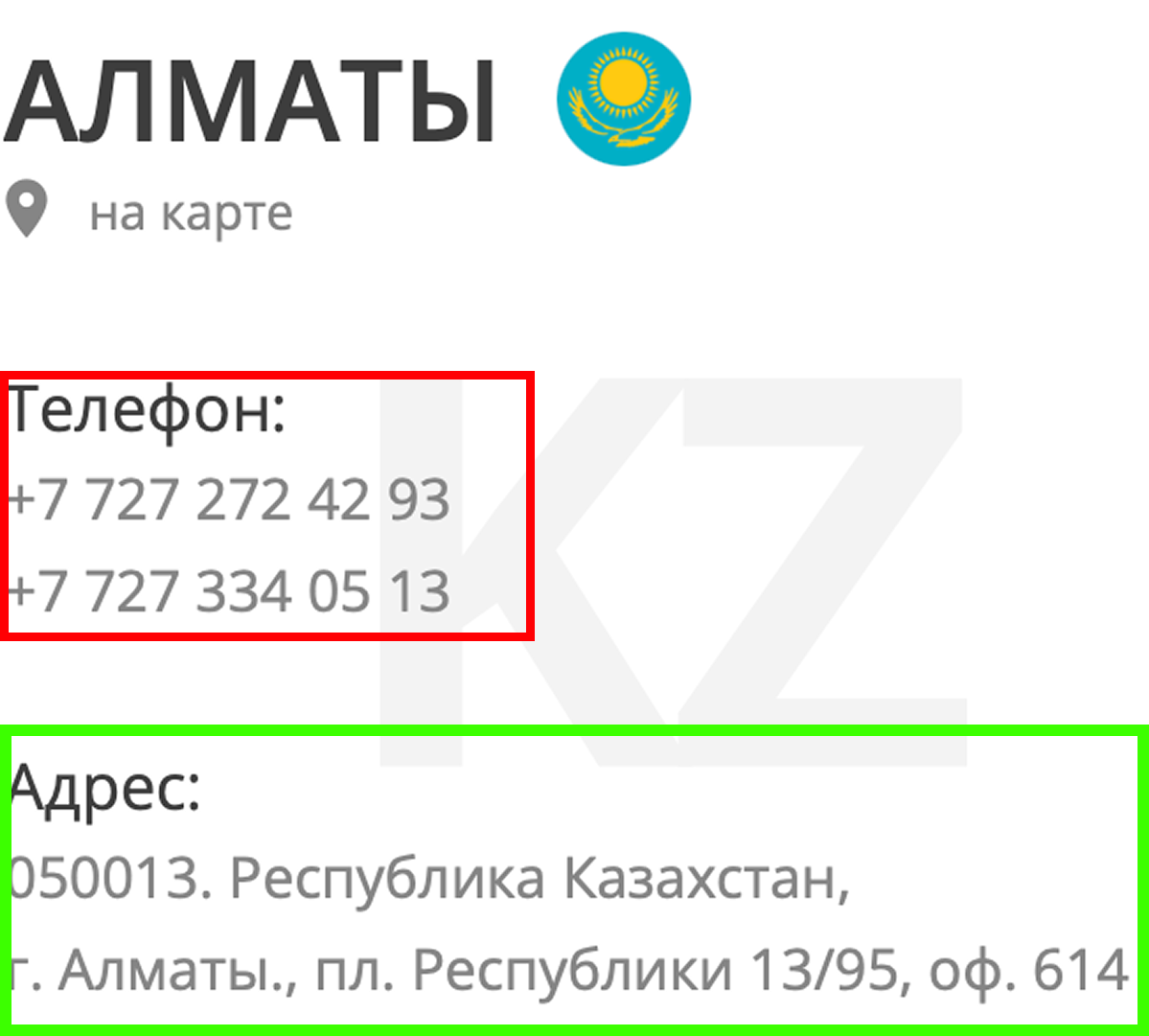
The Kazakh branch of JENTA and Technobel LLP, with identical contact details | sources: the company’s website

The Kazakh branch of JENTA and Technobel LLP, with identical contact details | Sources: the company’s website
We asked Alexandre Prezanti, partner at Global Diligence LLP and a lawyer specializing in international criminal law, to help analyze the ties between DSPL and Jenty. “Not only breaching, but evading sanctions has been illegal since last year,” he says. “Because the Kazakh firm Technobel LLP has the same owners as the Belarusian Jenty, this structure should be considered unlawful .” In other words, what was once seen as a legal grey zone is now understood as decidedly breaking the law.
Supported by millions from Kazakhstan, DSPL rapidly becomes one of the more significant players on the Polish market. In its first year of operation, it purchases 68 tractor units and 28 trailers and employs 84 people. Founded in 2021, the company boasts “26 years of experience in logistics and 800 trucks in operation,” and claims to handle more than 15,000 deliveries annually.
In the EU, international road haulage requires a Road Transport Undertaking (RTU) status. Details of such carriers are entered into the Electronic Register of Road Transport Undertakings (ERRU), which helps verify whether companies are operating lawfully. We check: in its official documents, DSPL lists only 15 vehicles.
How is that possible?
Russia and Belarus Behind the Network
The first clue towards solving this transport puzzle comes from a DSPL manager we spoke to shortly after the accident in Södertälje. He states that he worked for the Polish company remotely, from Belarus. Not impossible — but highly unlikely, unless other factors are at play. Such as: having a different employer than DSPL.
The bulk of DSPL’s revenue derives from “services provided by other companies.” The scale is striking: in its first year of operation, DSPL records revenues exceeding PLN 100 million. But because “third-party services” generate almost equivalent costs, the company’s profit is negligible — just PLN 170,000.
In year two, revenues surge to PLN 235 million, with profit rising to nearly PLN 3 million. Within three years, DSPL has transformed itself from a dynamic new company to a major carrier operator.
We found indications that the Warsaw firm is, in reality, controlled by the ownership circles of the Belarusian Jenty and the Russian SDS-Transport. Is it a front — a smokescreen for businesses from sanctions-hit countries that cannot accept being cut off from European markets?
The evidence: we identified employees working at both companies, as well as recruitment advertisements published by Jenty — including one from 2022 — through which Jenty recruited staff specifically for DSPL. We also obtained footage filmed by DSPL drivers in which they state they are transporting goods for Jenty.
DSPL and Jenty share something else: the same shareholders — Vasily Smetanin and his family; Tatiana Braouzovskaya and her husband, Barys Klimas; Igor Degterjonok; Dmitry Budovoy; and Vitaly Pushkin. All are Smetanin’s associates and business partners. Geguchadze, the Georgian, joins this chain only at the very end — having taken control of the Polish firm last year.
We Do Nothing, We Say Nothing
Geguchadze’s business portfolio also includes four other Polish transport companies: Azonik, BIRC Transport, Rezon Trans, and Starprim. He acquired a stake in each of them from individuals directly connected to Jenty.
That Belarusian connection is significant, because under sanctions Belarusian and Russian enterprises cannot freely operate in the EU.
We ask sanctions experts at the British think tank Royal United Services Institute (RUSI) about the Jenty-DSPL relationship . They note that sanctions rules do not apply to persons with dual citizenship — but that that scenario covers at most a handful of the individuals connected to the Polish entities in the network.
We examine Geguchadze’s five Polish companies. At the Azonik transport base near the Polish city of Białystok, we find a trailer on Kazakh plates bearing the Jenty logo — though different from the one on the company’s website. Azonik was founded by the Belarusian firm Autopromsnab-Spedition, and its ownership history mirrors that of the other companies in the Georgian’s portfolio. Just as with DSPL’s founding company, Autopromsnab belongs to Smetanin.
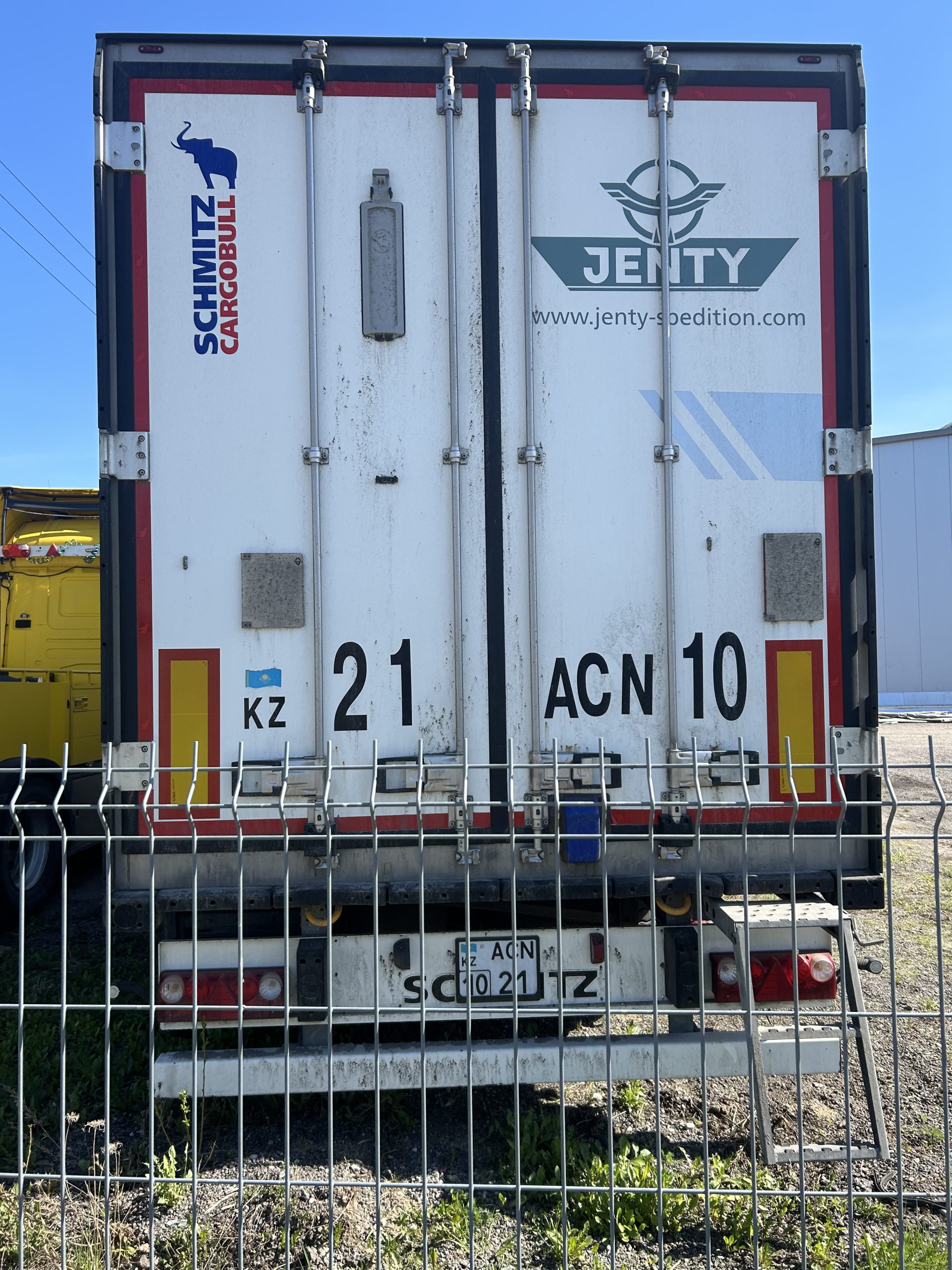
A JENTY trailer with Kazakh registration at the AZONIK transport depot in Kuriany | Photo: own materials
Initially, Azonik was controlled by the Austrian company Eastin Forwarding Holding, with management remaining linked to Smetanin and the Jenty circle. When the Austrian company withdrew, Geguchadze became the main shareholder — at the same time as he took control of DSPL and BIRC Transport.
The second of Geguchadze’s Polish firms operates as an intermediary for the Russian group APS-Solver; it is APS’s logo we find on trailers at a workshop belonging to Azonik and on the door of the company’s office in Białystok. Within the APS group there operates a Belarusian firm controlled by Smetanin — Autopromsnab, the very same company that founded Azonik.
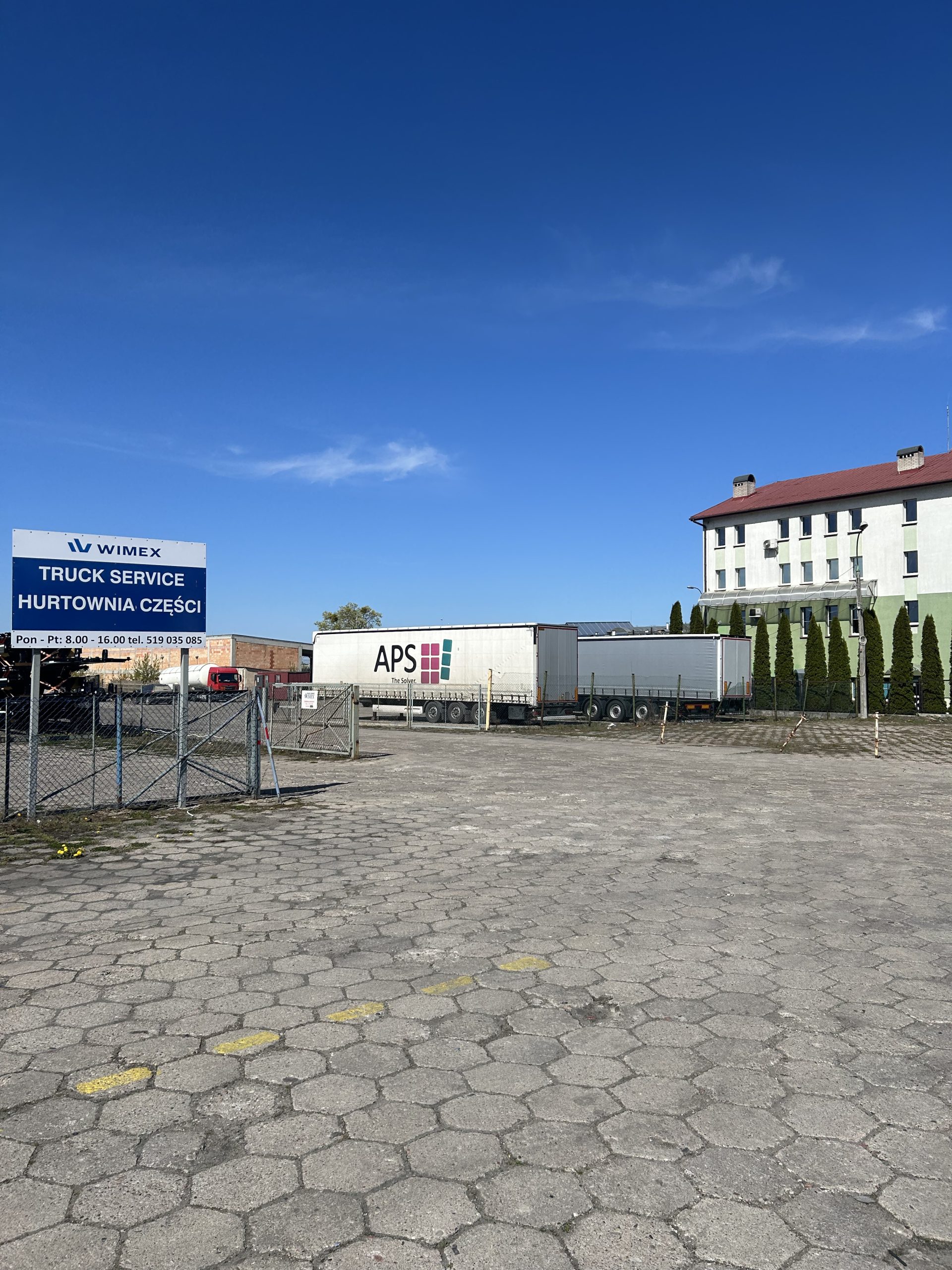
The APS-Solver Group logo on AZONIK trailers in Warsaw, owned by a company in Białystok | Photo: own materials
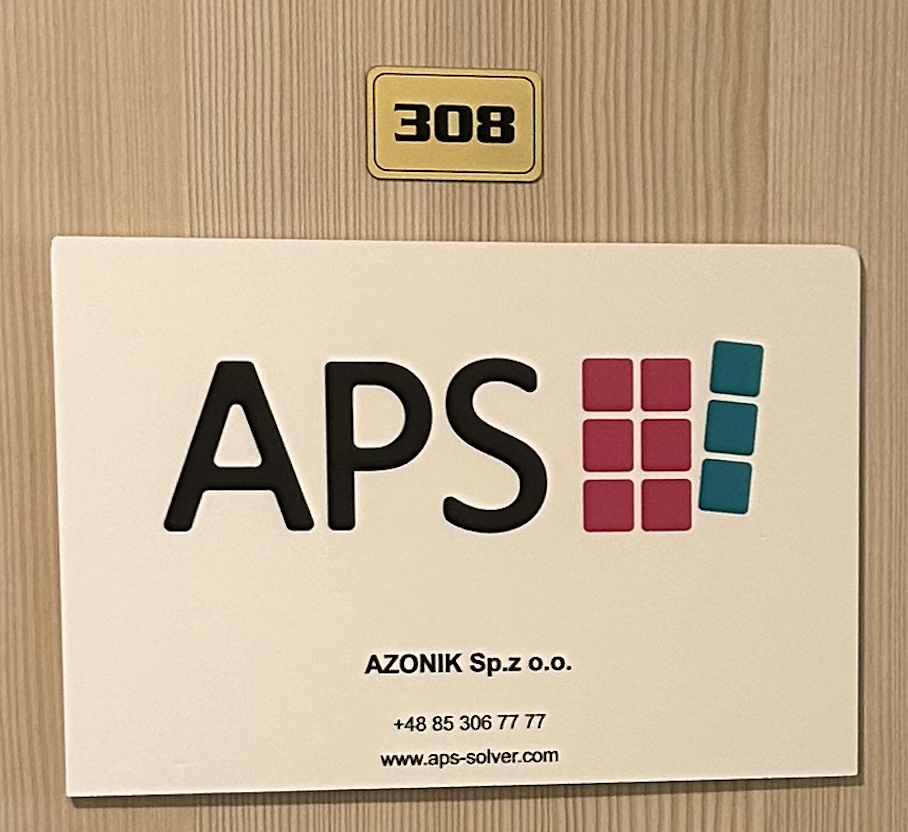
The APS-Solver group logo on the door of the AZONIK office in Białystok | Photo: our own
All of this may explain a curious coincidence: in 2022 — a year in which other Polish carriers were battling the enormous crisis triggered by the war and sanctions — Azonik posted revenues 10 times higher than in the previous year, before the full-scale invasion and the paralysis of the sector.
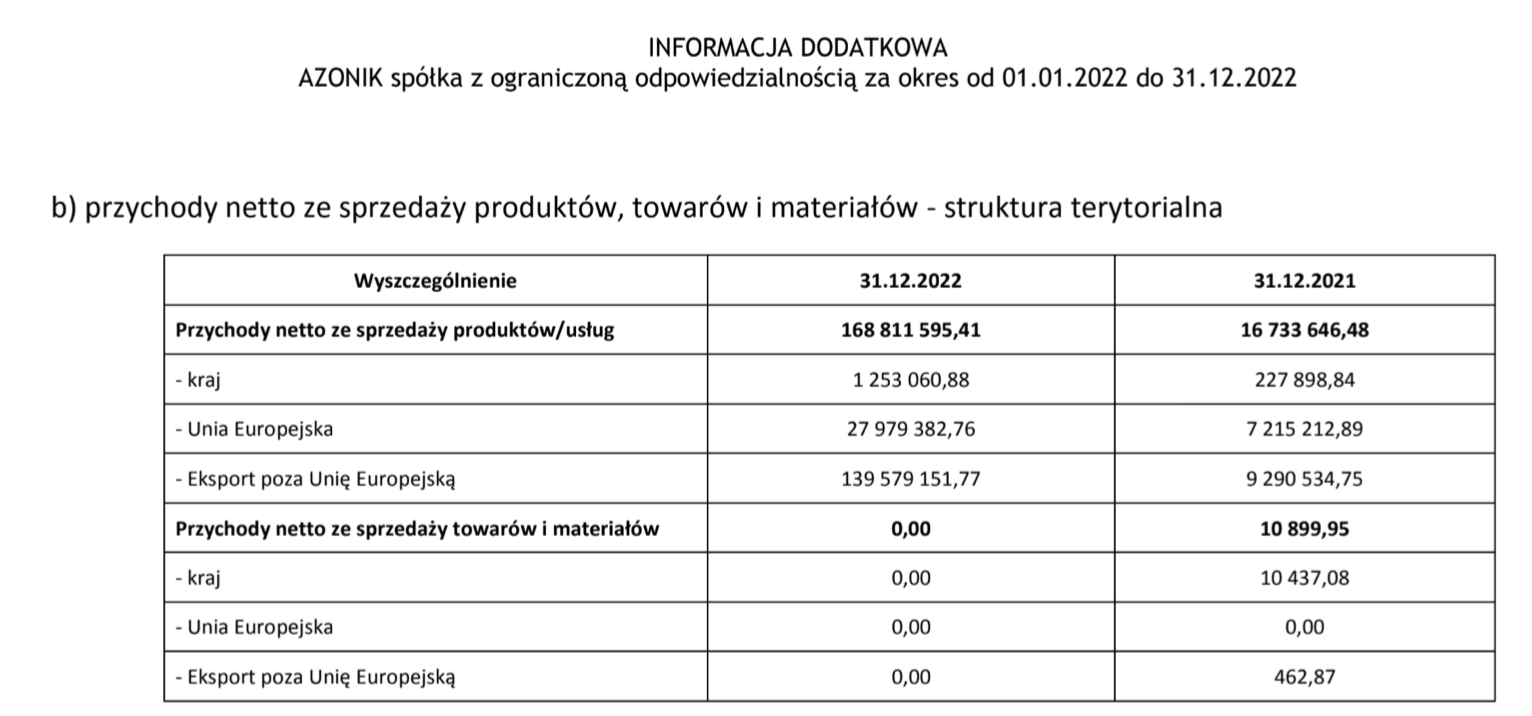
The increase in revenue for the Polish Smetanina companies coincides with a crisis in the sector | Source: AZONIK Sp. z o.o.’s 2022 financial statements
A Woman from Sberbank Goes Into Transport
Another of the Georgian’s Polish companies — BIRC Transport — was established in Poland by a firm called WIP-TRANSPORT. Its address? Minsk, Belarus. Contact details? A Jenty email address. Its ownership history features the same individuals and the same dates of ownership changes as the documents for DSPL and Azonik. On one website, BIRC is described outright as “a Jenty subsidiary.” Valery Korsunskiy, the company’s president, is less forthcoming: “You’d be better off writing about how the Polish state destroyed a company with 60 trucks that employed over 120 people. But the best thing you can do is drop the whole thing,” he says, concluding with a note of friendly advice.
Officially the firm owns no vehicles, yet a job advertisement lists “a fleet of more than 260 modern tractor units.” That is possibly because it operates openly under the brand of the Kapitan group, which includes the Russian transport firms Rusant and LideravtoGruz — both founded in Russia and both belonging to Smetanin’s SDS Holding. The Belarusian address for Kapitan is also the registered seat of the Jenty holding.

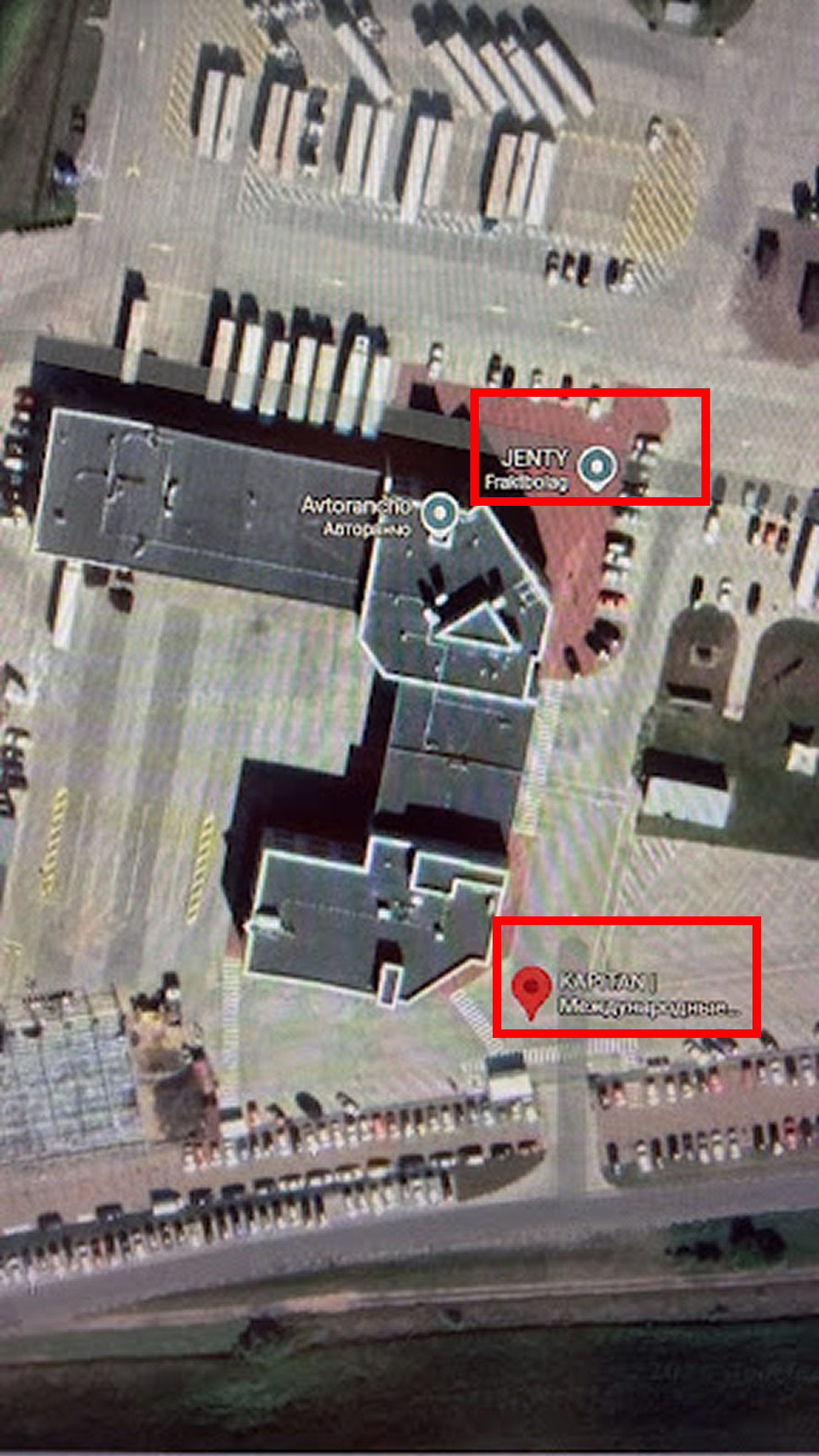
The offices of JENTA and Kapitan are located at the same address | source: Google Maps
The offices of JENTA and Kapitan are located at the same address | Source: Google MapsAnother Polish company, Rezon Trans, was created thanks to a €50 million loan from a Russian company.
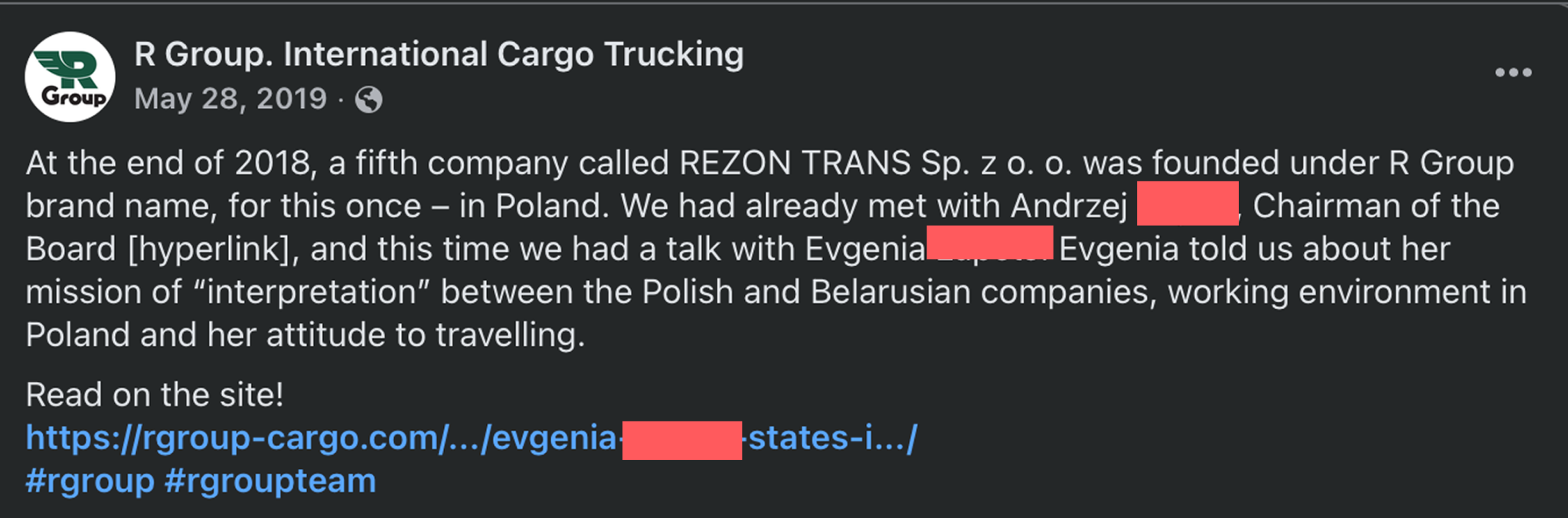
Links between Rezon-Trans and the Russian R Group | Source: Facebook.com
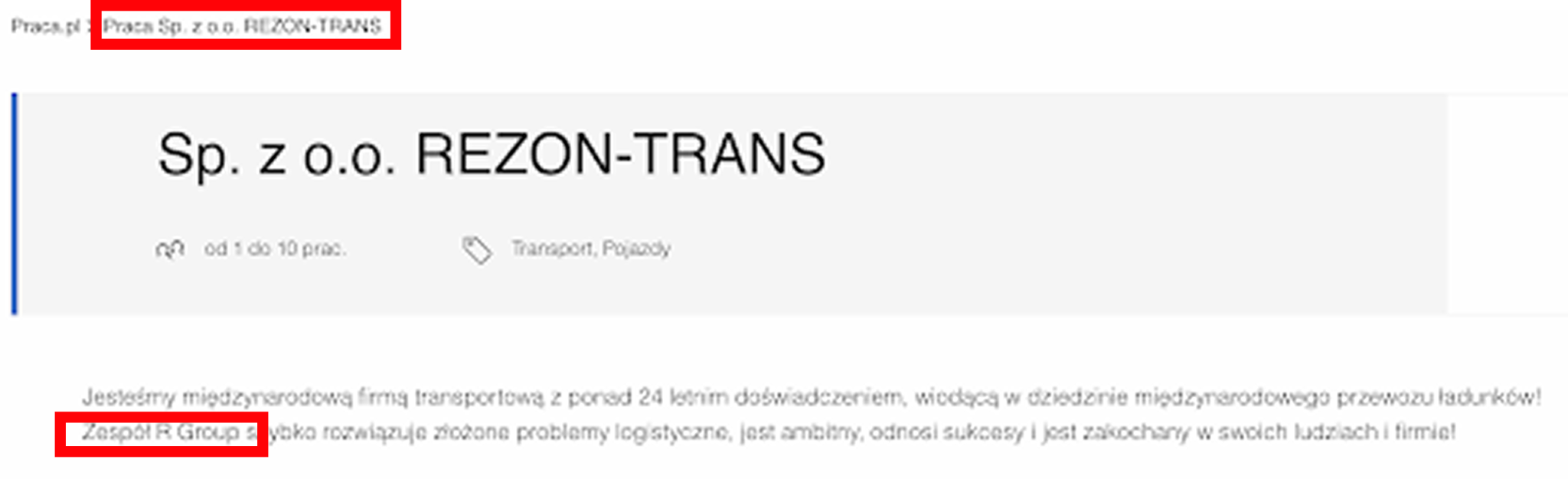
Links between Rezon-Trans and the Russian R Group | Source: pracuj.pl
Over the past two years, Poland’s Chief Road Transport Inspectorate (GITD) has examined well over 11,000 companies. It was looking, among other things, for firms in which Russian or Belarusian nationals hold more than 25 percent of shares — and initiated proceedings to revoke the licences of 453 entities.
We did not receive confirmation as to whether GITD had examined DSPL, Azonik, or BIRC Transport. Officially, GITD does not provide information on individual entities, on the grounds that “requests for information on a specific entity, including inspections carried out in a given company and their findings, do not constitute public information.”
Logistics, Austrian Style
At the centre of the dense web of business connections between Poland, Belarus, and Russia sits Albereta GmbH, an Austrian holding company founded in 2004 by Vasily Smetanin and Julia Chechet. Chechet is no ordinary figure: she is a former member of the Public Council of Russia’s Ministry of Health, a former director of the foundation of Russia’s largest state-owned bank, Sberbank, and a former senior manager within Sberbank itself. She left Sberbank in March 2022.
Chechet, formally a Russian citizen, has since reinvented herself as a businesswoman. She owns a British company (in the documents of another British company where she serves as director, she appears as an Israeli citizen); one French company; two German companies; and has a stake in firms in Cyprus and Luxembourg. She is a business partner not only of Smetanin but also of Vladislav Mangutov — a Russian oligarch sanctioned by Ukraine.
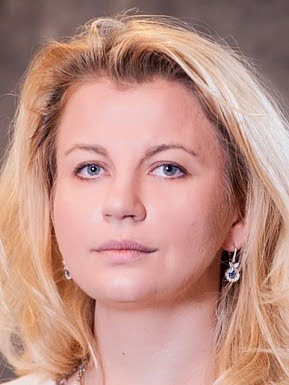
Russian Julia Chechet | Source: TAdviser.com
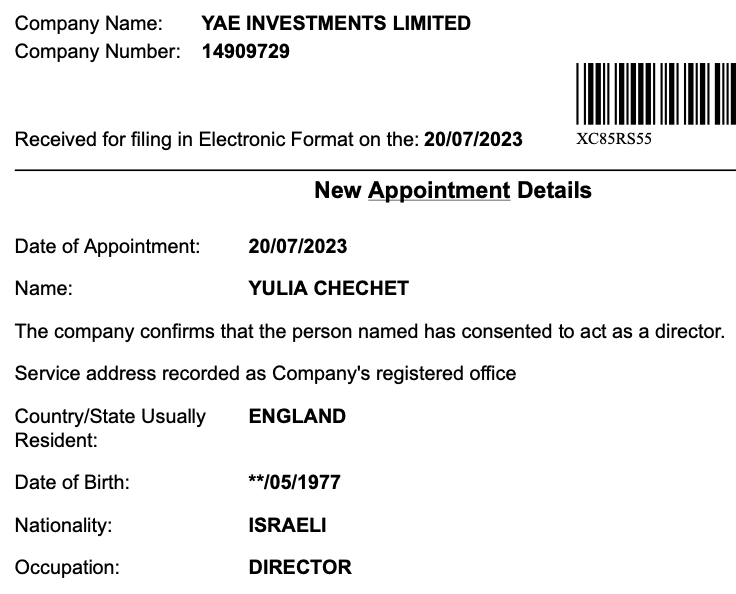
Documents from a British company indicating that Chechet is an Israeli citizen | Source: gov.uk
The firm Smetanin and Chechet created was used to establish Eastin Forwarding Holding in Austria. Although controlled by Smetanin, its official director is a well-known Austrian financier, Florian Koschat. The holding may function purely as a legal instrument, allowing Smetanin to buy and sell stakes within the EU — something he could not freely do without such a structure.
Trucks, Trailers and Penalties
Within the circle of firms connected to Jenty, we find a lawyer employed by the Belarusian holding itself — Hanna Shynkevich — whose name appears in connection with ownership transfers, company formations, and the movement of assets. She acts as a representative not only for Smetanin himself and his Austrian firm but also for Geguchadze, the current owner of the Polish front companies.
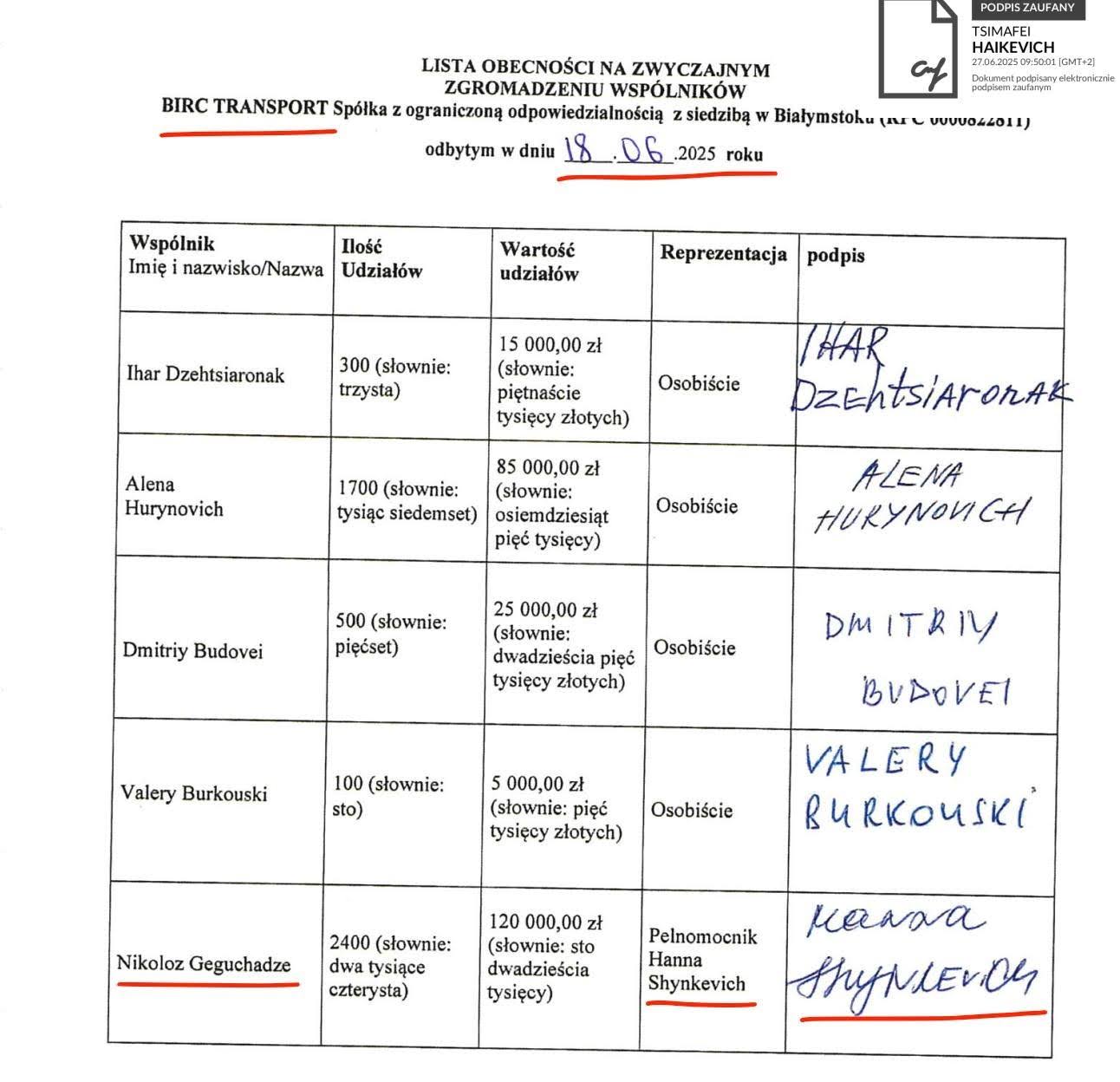
Lawyer Hanna Szynkiewicz acts as legal representative for Smetanin and Geguchadze | Source: rejestr.io
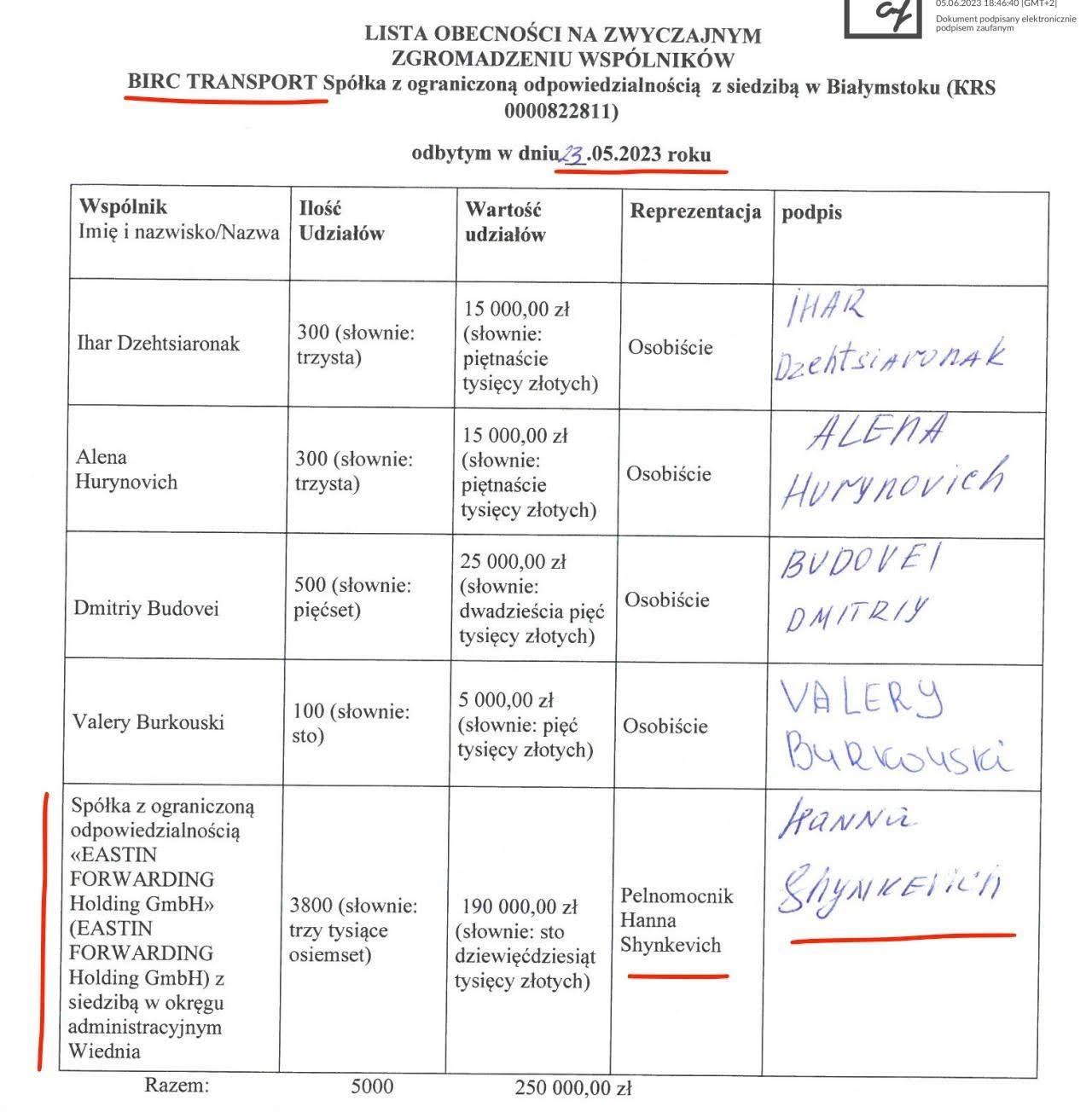
Lawyer Hanna Szynkiewicz acts as legal representative for Smetanin and Geguchadze | Source: rejestr.io
Of the five companies connected to Smetanin, four are legally authorized to carry out international haulage in the EU: DSPL, Azonik, Rezon Trans, and BIRC Transport. Two others — one Austrian, one German — operate in Błonie, near Warsaw. All are interconnected, forming a network that allows Jenty to exploit legal loopholes without any visible breach of sanctions.
The five Polish front companies recorded combined revenues of over PLN 200 million last year. Beyond them, the network also includes two German entities: Jenty Internationale Logistik and Advice Logistics.
After over four years of full-scale Russian aggression against Ukraine and numerous rounds of sanctions, a network of companies effectively controlled by individuals and entities from Russia and Belarus continues to operate openly in Poland and across Europe. Their ingenious ownership architecture — control exercised through an Austrian financial holding, creative accounting, and cooperation with related entities — allows them to circumvent sanctions. Furthermore, Azonik, BIRC, and Rezon Trans should never have been granted RTU status in the first place, since they were founded and remain more than 25 percent controlled by Belarusian and Russian entities.
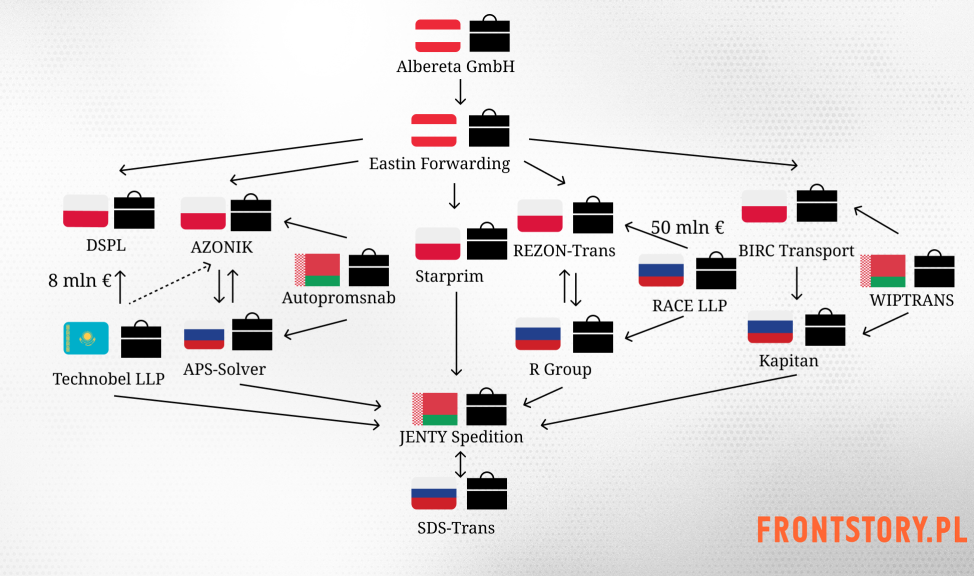
The structure of the network of companies associated with the JENTY holding company | Author: M. Możański
Process Versus Procedures
What do the Polish authorities have to say? The Ministry of Finance states that “matters concerning sanctions fall outside its remit.” The Ministry of Infrastructure refers us to the Chief Road Transport Inspectorate. The Inspectorate replies that it monitors companies whose owners or shareholders are Russian or Belarusian citizens — and leaves it at that.
And Vasily Smetanin himself? The Austrian interior ministry declined to provide any information on Smetanin’s residential status. We asked the DSN, Austria’s domestic intelligence service, whether any investigations into his companies for sanctions violations were under way. We received no reply.
We attempted to contact Smetanin and the other owners of the companies described in this article. Only a representative for Geguchadze responded — to say he was not breaching sanctions. Florian Koschat, Smetanin himself, and the directors of the Polish companies did not reply to our requests for comment or interviews.
Lawyer Alex Prezanti, who specializes in international criminal law, anti-corruption, and sanctions, offers a reminder: since 2025, even schemes to evade sanctions — not just outright violations — should be treated as unlawful in all EU member states.
Robert Socha, a sanctions policy expert at Open Intelligence Group, puts it plainly: “Due diligence should go far beyond checking entities against sanctions lists — that is the absolute minimum. You need to verify the entire ownership structure, not just what is on the surface — not just the company name and registration number, but also the shareholders, the beneficial owners, the board members, and the address. You may find that the company itself is clean, but at that same address sits another company that is on the sanctions list. Many companies are absent from sanctions lists yet should still be treated as sanctioned and subjected to restrictions.”
Right after publication of our findings by SVT in Sweden, Buro Media (Belarusian independent outlet) and FRONTSTORY.pl in Poland, AstraZeneca (which previously ignored most of our questions) stated that they will stop using DSPL and Technobel.
***
At the end of May, the Regional Prosecutor’s Office in Lublin (Eastern Poland) announced the detention of six individuals suspected of membership in a criminal gang. The group had been smuggling sanctioned goods into Belarus; among those detained was a customs officer, as well as owners of customs agencies and transport companies.
According to the Prosecutor’s Office, an investigation into activity at the border crossings in Terespol, Kukuryki, and Koroszczyn is ongoing.
While we wait for its results, trucks continue to pass us on the road from the eastern border. On several of them — bearing Polish plates — we spot trailers carrying the Jenty logo.
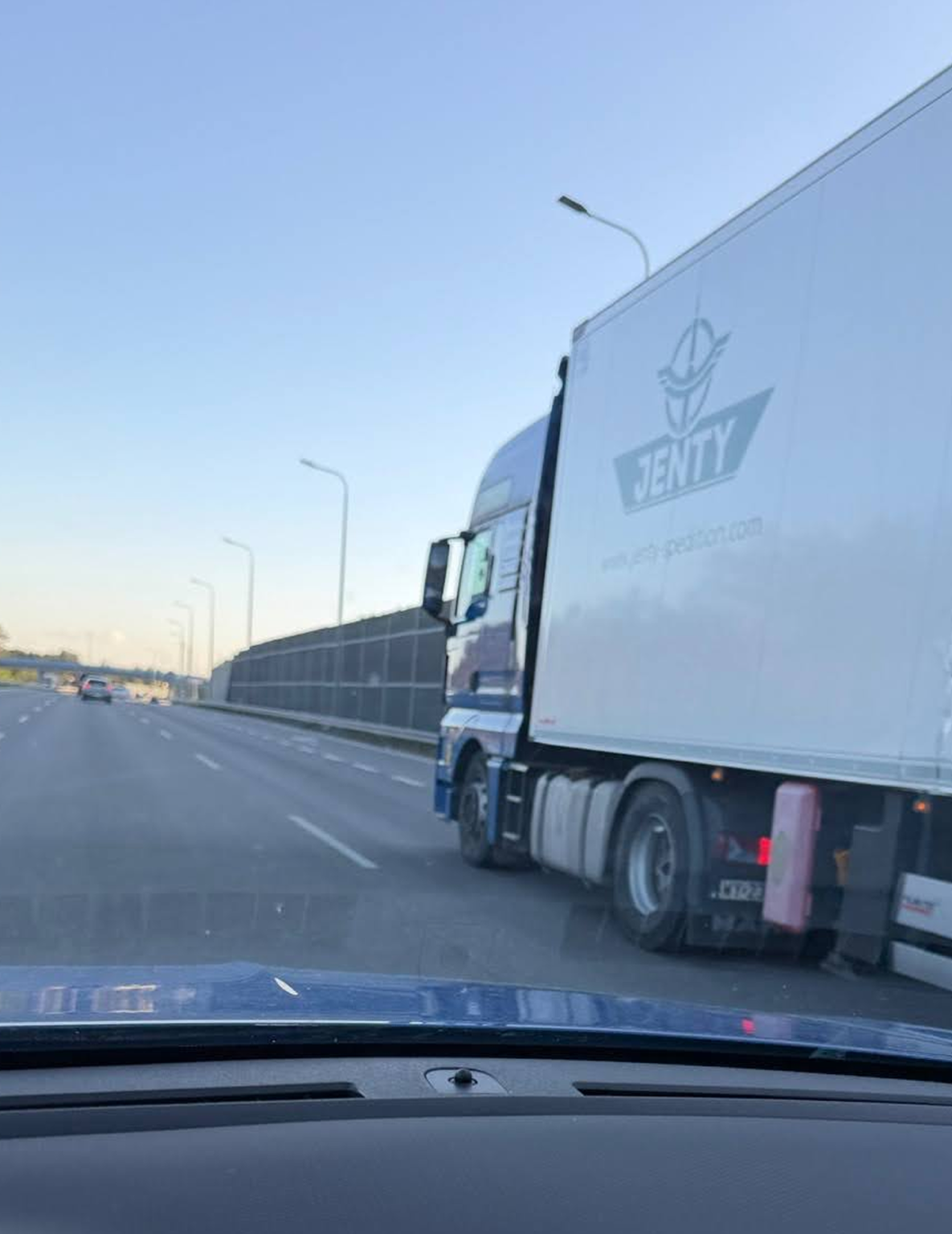
A TIR lorry with a JENTY semi-trailer on the Terespol–Warsaw route, 28 May 2026 | source: own materials
This investigation was originally published in Polish on FRONTSTORY.PL and would not have been possible without access to the NorthData and YouControl databases.
Subscribe to Goulash, our original VSquare newsletter that delivers the best investigative journalism from Central Europe straight to your inbox!