




Blackmail Allegations and a Million Signatures: Babiš’s Government Already Under Fire


Not even two months into office, Andrej Babiš’s coalition government — made up of ANO, SPD, and the Motorists party — is already facing a wave of protests. Demonstrations are directed not only against the coalition’s decisions, but also in support of President Petr Pavel. Babiš is juggling his own scandals alongside growing tensions between the president and several ministers, all while the Czech Republic’s foreign policy appears increasingly inconsistent and improvised.
The protest movement Million Moments (Milion chvilek), which gained national prominence during the 2018–2019 demonstrations against Babiš, is experiencing a revival. Organizers are trying to collect one million signatures in support of President Pavel and are mobilizing demonstrations across the country.
Public anger has been fueled above all by a series of text messages Pavel received — via one of his advisers — from Foreign Minister Petr Macinka. The messages reportedly pressured Pavel to appoint Motorists chairman Filip Turek as minister of the environment after Pavel repeatedly refused to do so. Pavel decided to publish the messages, and they are now the subject of a police and legal investigation to determine whether the exchange could qualify as blackmail.
At the time of writing, the pro-Pavel petition had already gathered more than 680,000 signatures. A demonstration in Prague, stretching over two main squares in the center, drew around 90,000 people — less than two months after the new government took office.
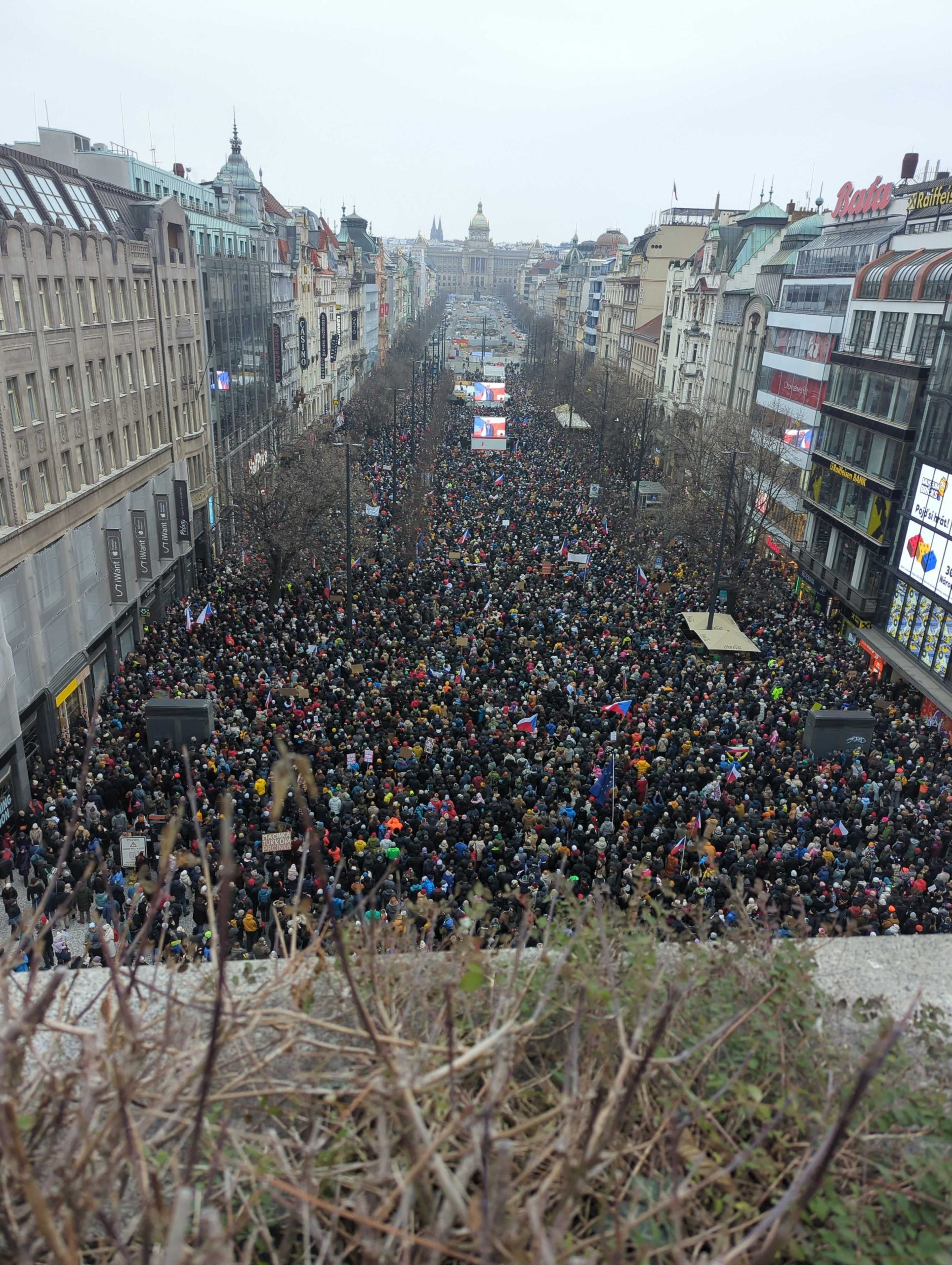
Wenceslas Square (Václavské naměstí), streaming the speaker’s stage from the main location of the demonstration, Old Town Square (Staroměstské náměstí), Source: Veronika Divišová, Investigace.cz
Disagreements From the Very Start
On January 15, Babiš’s coalition won a vote of confidence in the Chamber of Deputies following a record 26-hour debate. ANO, SPD, and Motorists backed the government formation, while the opposition condemned it and warned about its economic plans and foreign policy direction.
Soon after the start of 2026, conflict erupted between President Pavel and Filip Turek, the Motorists’ nominee for environment minister. Turek first drew major media attention in October, when Deník N uncovered deleted racist, homophobic, and sexist Facebook posts. Pavel refused to appoint him, laying out his arguments in a letter and citing Turek’s lack of respect for the Czech legal system. Until the dispute is resolved, Foreign Minister Petr Macinka has a double role, taking care of the Ministry of Environment as well.
“The biggest surprise isn’t the direction itself, but the degree of chaos and haste in the government’s decisions,” said Veronika Víchová of the Center for an Informed Society. “Already in the first weeks it has become clear that ANO, SPD, and Motorists have fundamentally conflicting lines on foreign and security policy, and publicly it looks like a permanent dispute. The personnel purges and dismantling of established security and communications teams at state institutions are a warning sign. In the short term this paralyzes the functioning of the state; in the long term it erodes institutional memory. Ill-considered changes and contradictory symbolic gestures damage the Czech Republic’s reputation and security.”
Macinka’s Late-Night Text Messages
Just over a month after the government was appointed, Macinka became directly involved in pushing for Turek’s appointment.
“The published messages and public threats like ‘I’ll burn bridges’ take the dispute to a whole new level,” Víchová said. “The president has described it as an attempt at blackmail, and the police — the National Center against Organized Crime — are investigating, which only raises tensions further. But I don’t think it’s in the prime minister’s or the state’s interest for this to turn into a trench war between officials. I expect pressure to calm things down and attempts to downplay it. At the same time, Macinka is already using the conflict as leverage, so it won’t be easy to defuse completely.”
Babiš has tried to contain the crisis, prioritizing government stability. He invited Pavel and Macinka to a joint meeting, but Pavel insisted that the prime minister was responsible for his ministers and said he would deal with Babiš alone.
During a press conference on the dispute, Deník N journalist Zdislava Pokorná was barred from entering — a ban later extended to the entire outlet by Macinka, delivered by the spokesperson of the Foreign Ministry. A group of journalists sent Macinka an open letter, and he was confronted about the incident during a Brussels trip.
“I have to admit there’s something to what they wrote,” Macinka told reporters. “So if Ms. Pokorná was offended in any way, I’ll take her somewhere with me as part of some psychosocial support.”
As referenced in the messages, Macinka did travel to Brussels, where he met NATO Secretary General Mark Rutte, top EU diplomat Kaja Kallas, and attended an EU foreign ministers’ meeting. He ultimately did not raise the sensitive issue of who will lead the Czech delegation to the summer NATO summit — a role he does not see Pavel as suited for. After meeting Rutte, Macinka said they had “more important things to discuss.”
Pavel invited Babiš to meet at the Prague castle in order to discuss the situation with Macinka, and Babiš reiterated that his goal is to have a stable relationship with the president, and that Macinka promised to tone down his communication style. Babiš also made an announcement that he’s giving up on Turek as a minister and accepted that the president will not name him.
Ambassadors Frozen, Democracy Promotion Cut
At the foreign ministry, Macinka has framed his agenda as putting “national interests” back at the center of diplomacy.
“Macinka presents this as returning the national interest to the core of diplomacy — defined through security, prosperity, and citizens’ freedom,” Víchová said. “In practice, I think it means a shift toward a more transactional foreign policy: less values-based politics and more emphasis on profit. There is a strong focus on the US, while at the same time there are signs of convergence with part of the Central European / conservative line inside the EU.”
Another major shock came when the coalition canceled an ambassador rotation plan approved by Petr Fiala’s previous government, arguing it reflected the old cabinet’s agenda and priorities. The decision signals yet another point of friction between the government and the president. One crucial appointment will be the next Czech ambassador to the United States: Fiala’s pick was Jan Havránek, but he may be replaced by a career diplomat and the current Deputy Foreign Minister Marie Chatardová.
Normally, ambassadorial appointments require presidential approval. Diplomats have raised the possibility of a “Polish scenario,” in which embassies are led by chargés d’affaires rather than ambassadors, avoiding the president’s signature. Formally these are temporary postings, but in practice, in some countries this situation could amount to diplomatic stalling and isolation for the Czech Republic.
“This is an extremely unusual step and looks like the politicization of professional diplomacy,” Víchová said. “The impact is primarily practical: uncertainty inside the foreign service, lost time, weakened continuity in relations with key partners. And reputationally it looks bad abroad, because our partners are watching whether we remain predictable.”
Around the same time, Macinka announced a freeze on funding for democracy-support projects launched under the former foreign minister Jan Lipavský. Macinka published a list of projects and organizations that will lose support, including People in Need, an NGO offering humanitarian help to people facing social challenges, environmental education initiatives, and teaching programs in Ukraine — funding worth tens of millions of Czech crowns (hundred thousands of euros), according to Macinka.
Despite EU sanctions on Russia, Macinka also loosened the rules for Russian diplomats traveling within the Schengen area. Under the previous government, Russian diplomats could enter the country only with prior approval from the foreign ministry. Under the new rules, they simply have to notify Czech authorities of their arrival.
Confusing Signals on Ukraine
Another dispute erupted over the potential transfer of four L-159 aircraft to Ukraine. Babiš sees no reason to argue about the jets, and considers the case closed. He refuses to sell the jets to Kyiv, accusing Pavel of turning the issue into premature political campaigning. The core question is whether the Czech military still needs the aircraft.
Defense Minister Jaromír Zůna, delegated by the SPD party, said the planes cannot be sold because they remain part of the country’s active military inventory. However, the Czech Army’s chief of the general staff countered that military aid is ultimately a political decision, and gifting the aircraft to Ukraine would not pose a security risk.
The Czech Army currently has 24 L-159 planes (16 operational and eight training), with modernization planned from this year through 2029.
“I see this mainly as inconsistency driven by SPD’s political interests,” Víchová said. “Zůna repeatedly said Russia is the aggressor and that the attacked country has a right to support — but after pressure from SPD he walked back part of his communication and even canceled his trip to Ukraine. At the same time, the government refused to sell or deliver the L-159s to Ukraine. Zůna personally seems more rational than some of his colleagues, but the government line is shifting toward more cautious, less ambitious support for Ukraine.”
After refusing Zůna’s invitation to Ukraine during a press conference, Chamber of Deputies Speaker Tomio Okamura said the purchase of American F-35 fighter jets is inappropriate and too expensive, and suggested he would consider withdrawing from the deal, which was signed in 2024. Babiš said the project is already in an irreversible phase, but added that he wants to renegotiate better terms.
Meanwhile, the foreign ministry pledged 10 million Czech crowns (around 400,000 euros) to buy electrical generators for Ukraine. The ammunition initiative — which Babiš initially wanted to cancel entirely — will continue, but the government will not finance it from the state budget and will limit itself to coordination and logistics. Separately, the grassroots initiative Gift for Putin, which began with collecting money in 2022, and has since sent equipment for more than a billion Czech crowns (more than 41 million euros), raised more than €5 million in just five days to deliver mobile generators during blackouts in Ukraine.
Babiš and His Own Scandals
Beyond the standoff between his ministers and the president, Babiš entered office with scandals already hanging over him — most notably the conflict of interest tied to his ownership of Agrofert, the biggest agricultural and food industry group in Czech republic and Slovakia . He addressed it by formally stepping down from management and transferring the company into a trust. For now, however, Babiš is still listed as Agrofert’s sole shareholder on the company website, pending public approvals from three countries. This is to comply with rules of some countries where Agrofert operates, in which approvals by the government or some institution are necessary when a major company changes ownership.Another long-running controversy is the Stork’s Nest (Čapí hnízdo) case. The investigation into alleged subsidy fraud and misuse of public funds for a conference and wellness complex began in 2015. The case has repeatedly stalled and restarted over the years, including during Babiš’s 2018 election victory, which granted him parliamentary immunity. Parliament has voted to lift his immunity three times; at present, the prosecution is paused.
Babiš has said he will not allow the Chamber of Deputies to vote on his extradition for criminal prosecution in the case and has publicly questioned whether judges are politically motivated.
“SPD and Motorists have already publicly announced they won’t vote for extradition, and the coalition holds a comfortable majority,” Víchová said. “Procedurally the case will go through the immunity committee, which is expected to meet in mid-February, and the plenary will vote in the first half of March. If, by some miracle, he were extradited, it would immediately trigger a major political crisis and undermine the government’s stability — but given the current makeup of parliament, I don’t consider it likely.”
Subscribe to “Goulash”, our newsletter with original scoops and the best investigative journalism from Central Europe, written by Szabolcs Panyi. Get it in your inbox every second Thursday!

Tamara is a journalist from Slovakia, currently based in the Netherlands. Besides VSquare, she writes for The European Correspondent.