




How Chinese Surveillance Cameras Penetrated Czech Critical Infrastructure
Illustration: Investigace.cz 2026-05-28


Illustration: Investigace.cz 2026-05-28
Cybersecurity experts consider Chinese security cameras to be a risk. This has not deterred Czech institutions from purchasing these cameras again this year. They can be found in military facilities and on the facade of the Prague headquarters of the very cyber agency that warns against them. Investigace.cz has mapped out how Chinese cameras are monitoring the Czech Republic.
Cameras from Chinese state-owned companies are monitoring the entire Czech Republic. They can be found on the building of the General Staff of the Czech Army, at stations along the Czech railways, at the airport in Karlovy Vary, on Czech Post buildings, at regional police stations, on the buildings of the Ministries of Defense and the Interior, at the Supreme Court, and even in the courtrooms of the District Court in Teplice.
Investigace.cz also found cameras from Chinese brands Dahua and Hikvision in military weapons depots and on military bases, as well as on the building of the Prague headquarters of the National Cyber and Information Security Agency, which itself warned against the use of these cameras last August. In fact, according to Investigace.cz’s findings, numerous Czech institutions classified as critical infrastructure have continued to purchase Chinese cameras this year despite the cyber agency’s warnings.
Chinese Cameras Film Those who Warn Against Them
You can’t avoid them from the moment you first set foot in the Czech Republic. A camera from the Chinese brand Dahua is even on the trolleybus that takes passengers from Václav Havel Airport to Prague.
We found the same type of camera at a Czech Post branch in Prague’s Žižkov district, which also houses the Prague headquarters of the National Cyber and Information Security Agency (NÚKIB). Last August, NÚKIB issued a warning specifically against the use of Chinese network cameras, particularly those from Hikvision or Dahua.
“Their products are high-risk, particularly with regard to technical, political, legal, or ethical aspects,” NÚKIB states in its warning. According to their analysis, products from Chinese companies held a one-third share of the Czech public market between 2016 and 2023, amounting to more than 13 billion crowns.
“The deployment of Chinese network cameras poses a high risk, given the combination of their technical weaknesses with non-standard Chinese legislation, Beijing’s role in the companies’ ownership structures, their cooperation with security and party agencies, and China’s past activities against Czech interests and those of its allies. It is likely that some of the cameras have been compromised to some extent by Chinese authorities,” warns the cyber agency.
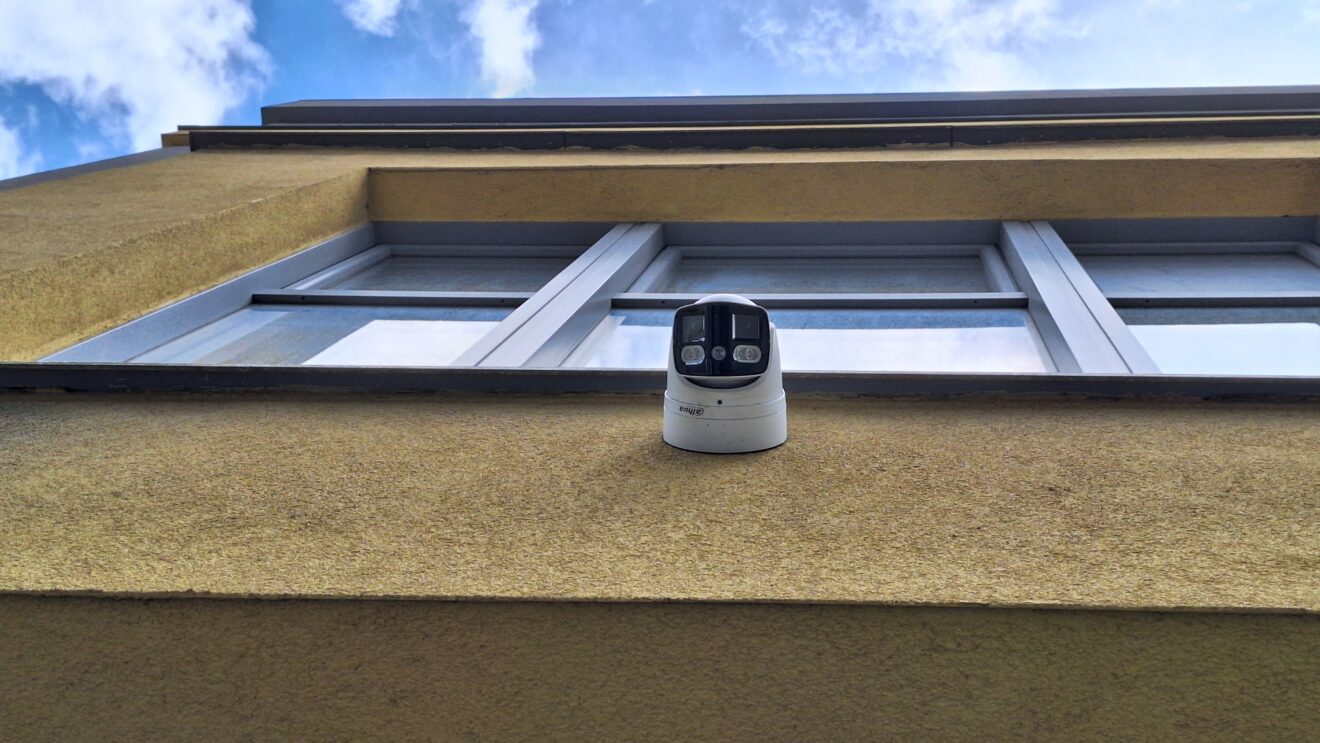
One of the numerous Dahua cameras on the Czech Post building in Prague’s Žižkov district, where NÚKIB is headquartered. Photo: investigace.cz
So what does the agency say about the fact that Dahua cameras are monitoring their entrances, vehicles, or employees?
“NÚKIB is fully aware of the risks associated with Dahua technologies. However, the building is owned by the Czech Post. NÚKIB operates here solely as a tenant with no influence whatsoever on the selection, installation, or management of the external camera system. Security systems owned and operated in the premises used by NÚKIB do not contain similarly risky elements,” says agency spokesperson Jakub Neščivera in response to a question from Investigace.
The spokesperson added that NÚKIB has long planned to purchase its own building in Prague. “By its very nature, operating a security institution in a rented space imposes certain limitations that are not optimal for an agency of our type. At present, however, the Agency has no other alternative,” says Neščivera.
Czech Post, which is also part of the state’s critical infrastructure, did not respond to the editorial team’s inquiries by the time of publication.
Chinese Technology in the Czech Army’s Weapons Depot
Chinese Hikvision cameras are also found in the most sensitive and heavily guarded locations in the Czech Republic. The editorial team at investigace.cz discovered from public sources that Hikvision cameras monitor army weapons depots, soldiers’ vehicles at bases, and even entire military units.
Examples include military units in Hradiště and Olomouc. In March, the army ordered repairs to the camera system at the military training area in Hradiště. The published contract indicates that the Hikvision cameras (the contract specifies the model DS 2CD7347G0-XS) that needed repair are located in the Czech Armed Forces’ (AČR) and military police’s weapons depot.
A similar model (Hikvision DS-2DF8A442IXG-AE) also required repair last June. The contract also specifies its location: “Camera repair—detailed view of the vehicle fleet (fuel station).” The client was also the Military Training Area in Hradiště.
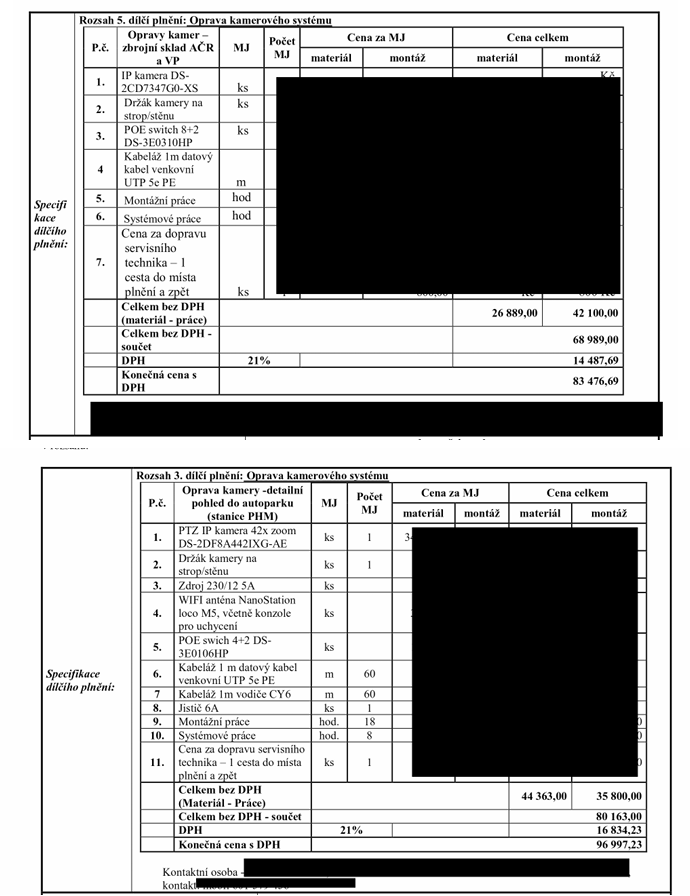
Contracts concluded by the Ministry of Defense for the repair of cameras at the Military Training Area in Hradiště. Source: investigace.cz
Last June, the Ministry of Defense signed a framework contract for the repair of cameras at a military unit in Olomouc, where the 15th Engineer Regiment is based. Although the price specification does not reveal the camera type, the order includes a spare part for a “bracket for mounting Hikvision SpeedDome cameras on a wall,” suggesting that soldiers in Olomouc are also monitored by a camera from the Chinese state-owned company.
“All Hikvision cameras used to guard Ministry of Defense facilities and buildings were purchased prior to the NÚKIB recommendation. The video feed and recordings from these cameras are transmitted and used exclusively on a secure military network, which is separate from the public internet,” Zdeňka Sobarňová Košvancová from the office of the Chief of the General Staff replied in response to questions from the editorial staff.
“The Ministry of Defense is fully aware of the potential security risks of this technology and has eliminated any data leaks from these camera systems through the measures described above. When upgrading or installing new camera systems, we follow NÚKIB’s recommendations,” the spokesperson added.
We also asked the army about the Hikvision cameras found on the General Staff building. According to the spokesperson, this was purchased based on a contract from 2019, when the bid with the lowest price won.
The cameras in question are reportedly only connected to the building’s security systems and do not have internet access. “This measure eliminates the possibility of data leaks. We are currently in the process of upgrading our physical security equipment, which includes replacing the Hikvision camera system,” the army spokesperson clarified.
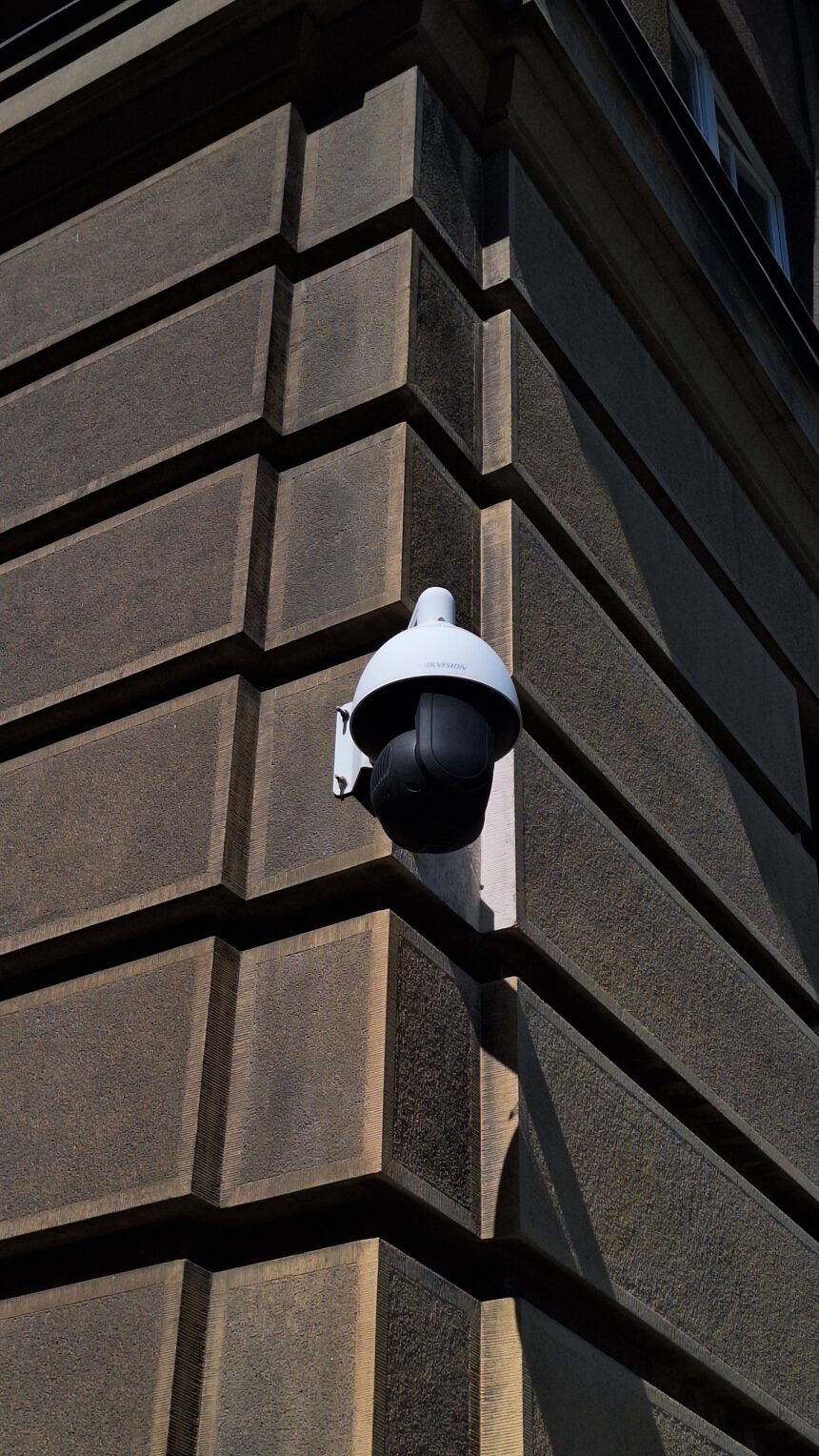
One of many Hikvision cameras on the General Staff building in Prague’s Dejvice district. Source: investigace.cz
A Camera Without Internet Access is not Automatically Secure
According to ethical hacker and cybersecurity expert Martin Haller, however, one cannot simply equate being disconnected from the internet with camera security. In his view, it is necessary to regularly verify and enforce strict measures, including disconnection from the internet.
The reality he encounters when addressing cyber incidents, he says, often does not match the original specifications. “A system may be deployed correctly at the outset, but over the years, configuration changes occur, remote management is added, connections to surveillance systems are made, service access points are established, or links to other networks are created. The result can be that a system that was supposed to be isolated is, in fact, not isolated,” he explained.
“That’s why I wouldn’t say that a camera without a direct internet connection automatically poses no security risk,” adds Haller. Czech state institutions, however, use precisely this argument to justify their actions.
Camera Purchases Even After Warnings
The use of Chinese cameras at Czech state institutions is nothing new. Journalists from many media outlets have repeatedly reported on various cases in the past. In February, the editorial team of the regional website Okraj published a report that the airport in Ostrava-Mošnov is monitored by Chinese Hikvision cameras. In March of last year, the website Page not found released an analysis of where Chinese cameras can be found.
However, most of the cameras reported on so far were purchased in the period before the cyber agency’s warning. Czech state institutions, however, did not stop purchasing them even after the warning. One example is the Czech police, which even today continues to purchase Hikvision or Dahua cameras for regional headquarters.
We contacted some of the regional police headquarters that had ordered Chinese cameras in recent months. By the time this article went to press, only the Olomouc office had responded.
“The Olomouc Regional Police Headquarters uses the aforementioned technology outside of critical infrastructure, and without the possibility of connecting to the internet; therefore, there is no risk of sensitive data leakage in this case,” Libor Hejtman, a spokesperson for the local police, replied. Hejtman did not provide further details..
The use of Chinese cameras on Railway Administration buildings may be an equally serious problem. The railway network is part of the country’s critical infrastructure, and the military also uses trains to transport its equipment, whether across the country or to deliver weapons to Ukraine.
There are countless Chinese cameras on train station buildings. Furthermore, even now, in 2026, the Railway Administration is ordering Hikvision cameras from its suppliers, which it is installing on buildings near railway tracks. An example is an order placed this past March for seven Hikvision cameras with lighting and a pole for a parking lot on Pernerova Street in Prague.
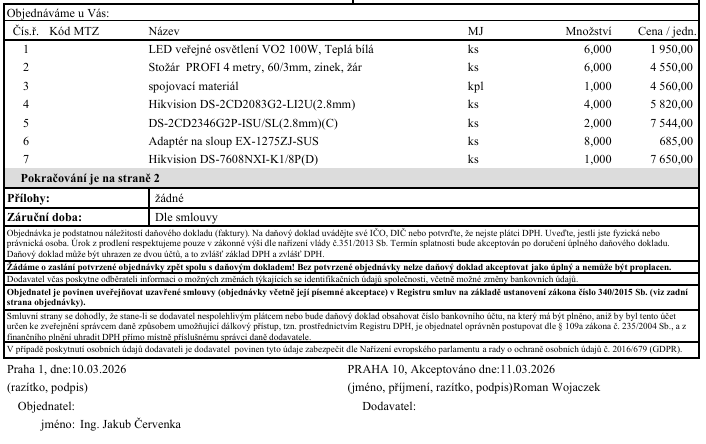
Order for new cameras to monitor a parking lot near a railway line in Prague. Source: investigace.cz
Railway Administration spokesperson Nela Eberl Friebová says the organization is following the cyber agency’s warning. “The Railway Administration’s camera systems are categorized by risk level, and we have clear rules in place for their use. In facilities and locations with the highest security requirements, we neither deploy nor operate potentially risky technologies, and in many places they are being replaced with safer solutions,” she explained in response to a query from the editorial staff.
“Our goal is to ensure that the railway infrastructure, as part of the Czech Republic’s critical infrastructure, remains secure and well-protected.”
Beijing “Sees” All the Way to the Czech Supreme Court
New cameras from the Chinese company Hikvision were also installed at the Fire Department’s headquarters and the Prague Municipal Police after a warning from NÚKIB.
“The cameras are operated as a closed system within a secure network without internet access, thereby preventing data leaks. Based on these facts, this security risk is eliminated within our operations,” wrote Jiřina Ernestová, spokesperson for the Prague Municipal Police.
A similar response comes from the Fire Department. “When selecting cameras, we primarily assessed the balance between purchase price, technical parameters, and practical use in Fire Department conditions. We also consulted directly with the Ministry of the Interior regarding the purchase of Hikvision products,” Kristýna Posekaná, spokesperson for the Fire Department’s General Directorate, told our editorial team.
She adds a similar argument to that used by representatives of other institutions: namely that the cameras are not connected to any internal network and are disconnected from the internet. “Therefore, from the perspective of image transmission security, they do not pose a cyber risk.”
The same cameras can also be found at the High Court in Prague. The court purchased the cameras back in 2021. Spokesperson Eliška Duchková told our editorial team that they proceeded based on the information and recommendations available at the time, in accordance with cybersecurity regulations.
“Any further recommendations are always taken into account in future plans for IT equipment upgrades; however, a rapid replacement of the existing equipment is not possible due to budget constraints. We are also in contact with the supplier regarding appropriate procedures for managing and operating the system,” says Duchková. According to her, it is merely a “closed-circuit monitoring system” and the cameras are not connected to the internet.
Uyghur Analytics, Missile Guidance in Ukraine
It is perhaps here worth mentioning the not-so-distant history of the Chinese brands with which various Czech authorities are cooperating. Cameras from Hikvision or Dahua are still used for mass surveillance of the Uyghur minority in China.
NÚKIB also mentions this in its warning: “Camera manufacturers such as Hikvision, Dahua, and Uniview offer so-called Uyghur analytics, through which the systems can racially/ethnically distinguish Uyghurs from other ethnic groups,” the cyber agency describes.
Rushan Abbas, chairwoman of the international organization Campaign for Uyghurs, also testified about this feature firsthand. In October 2023, she testified at a conference in the Czech Senate that “This year, Hikvision won a $6 million contract that explicitly requires their analytical software to identify Uyghurs. So they developed software specifically designed to identify the ethnic groups that are to be monitored and to suppress dissent.”
Another security risk involving Chinese cameras emerged in Ukraine. According to findings by investigative journalists from Radio Free Europe and the Hungarian website Átlátszó, Chinese cameras may have been used by the Russians to spy on Ukrainian cities or even to guide missiles toward them.
In 2023, Átlátszó reported that Russia may have done so through digital backdoors in Chinese surveillance systems. “These methods could have been used to locate Kyiv’s Patriot air defense systems during the May bombardment of the city,” according to the outlet.
In January 2024, Radio Free Europe conducted an experiment on Hikvision and Dahua cameras, demonstrating that the cameras automatically establish connections to servers leased by Chinese state-owned companies in Europe. According to experts, this then opened the possibility for Russian surveillance of Ukrainian cities.
Security is not a Priority for Them
“Overall, I get the feeling that the cybersecurity of these devices isn’t very important to the manufacturers,” comments cybersecurity expert Martin Haller. Haller says there are several risks that these incidents have highlighted.
The first is that another similar software flaw could emerge, such as the one uncovered by investigative journalists from Radio Free Europe. Moreover, Haller points out that older models may not have received the necessary security patches and therefore still contain the aforementioned issues. “Or that similar functionality could, conversely, be introduced into the device later, for example through an update,” the expert explains.
Haller says that thorough and regular checks of these devices can mitigate a large portion of the risks by enforcing restrictions on access to the internet, the cloud, remote management, and other parts of the infrastructure.
He notes, however, that institutions must consider whether the risk they are dealing with is acceptable even with all these measures in place. “For a regular company, well-designed isolation may be an acceptable solution. For a military warehouse, a military base, or a critical infrastructure facility, it’s hard to say,” he says.
International Sponsors of the War
Hikvision and Dahua are subject to sanctions, and cooperation with them is prohibited in many Western countries.
Hikvision faces sanctions in the US due to its ownership—it is 100% controlled by the Chinese state apparatus. Dahua, in turn, cannot operate in the US due to its inclusion on the list of Chinese military companies. Both companies are also sanctioned in Ukraine for aiding the Russian war machine. Since 2023, Ukraine’s anti-corruption agency has included them on the list of “international sponsors of war.”
According to the independent US security institute IPVM, Lithuania and the United Kingdom have banned government agencies from purchasing these brands. Other countries are currently only following recommendations. Denmark, for example, began gradually removing the technology from various key locations across the country based on recommendations not to use these cameras in public spaces and around critical institutions.
However, no such ban currently exists in the European Union. In 2022, the European Parliament issued a resolution condemning brands including Hikvision and Dahua for their complicity in the genocide of the Uyghurs in Xinjiang Province.
This article was originally published in Czech on Investigace.cz.
Subscribe to Goulash, our original VSquare newsletter that delivers the best investigative journalism from Central Europe straight to your inbox!