





How Romanians Helped Conservative Brothers in Poland Win Elections
Mihaela Tanase, Attila Biro (Context.ro)
Illustration: Diana Dupu (Context.ro) 2025-12-18


Mihaela Tanase, Attila Biro (Context.ro)
Illustration: Diana Dupu (Context.ro) 2025-12-18
- Romanian social media experts quietly helped Karol Nawrocki’s Polish presidential campaign on Facebook.
- They also work for Law and Justice (PiS) MEP Patryk Jaki.
- PiS’s most important Romanian link is George Simion, an anti-Ukrainian politician banned from entering Moldova and Ukraine.
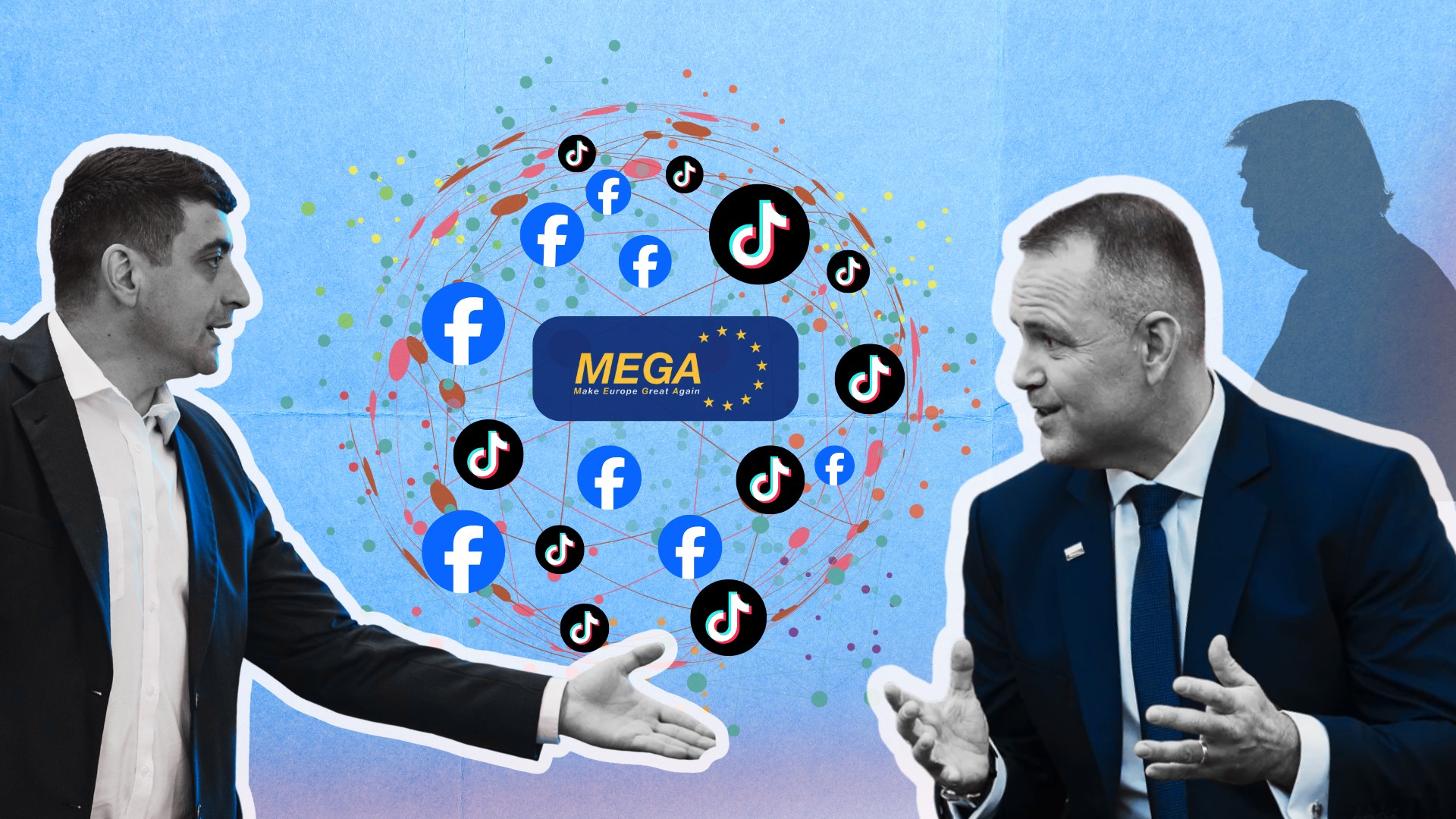
- Our investigation goes behind the scenes of the “Make Europe Great Again” (MEGA) movement and reveal European Trumpists’ connections between Bucharest and Warsaw,
George Simion, leader of the Romanian party Alliance for the Unity of Romanians (AUR), a nationalist with a hooligan past, lost the presidential election this year, but he learned an important lesson from it. The lesson is: it pays to cross borders.
In the spring, at a rally for candidate Karol Nawrocki in Zabrze, Simion declares from the stage in an emotional voice (in English, with a strong accent): “We will resist the anti-American policy of the European Union! The most powerful man in the world, Donald Trump, supports Nawrocki! Donald Trump!” The Polish crowd repeats the name of the American president.
The former Romanian presidential candidate is also one of the leaders of the MEGA (“Make Europe Great Again”) movement. He has visited Poland more than 20 times, and was during the presidential campaign at least several times. He appeared in Rzeszów at the CPAC conference, a congress of right-wingers. “In Romania, we were against everyone: Soros, the Deep State, NGOs, Open Society, the European Commission… You have to oppose fake news, mainstream media… Together, we must stand together against EU bureaucrats, the globalist puppets of this continent!,” he urged at a campaign rally.
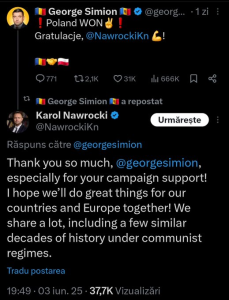
Simion lost the election in Romania to Nicusor Dan. But in Poland, Karol Nawrocki, whom he supported, defeated Rafał Trzaskowski and became president.
Simion visited Poland again to celebrate Trzaskowski’s victory at an election night party surrounded by the PiS leadership. He had played his part in their success.
MEGA Supports and Wins
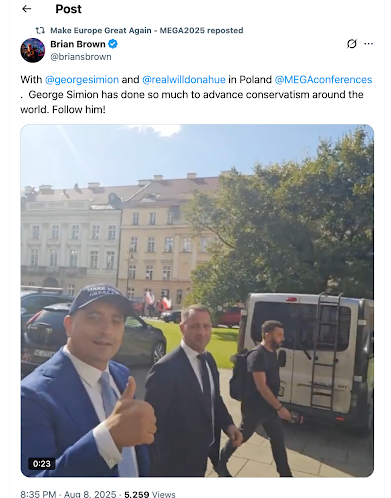
On August 6, a crowd wearing red and blue baseball caps parades down Krakowskie Przedmieście Street. The red caps bear the inscription MAGA (Make America Great Again), while the blue ones say MEGA (Make Europe Great Again).
-
- Source: X
-

- Source: X
The leaders of the MEGA movement are triumphant: Nawrocki, whom they supported, is about to be sworn in as president. To mark the occasion, MEGA is organizing an event at the Bellotto Hotel in Warsaw, simply titled “MEGA conference.”
George Simion boasted: “We are available to all our friends that have elections. We will have elections soon in the Republic of Moldova, in the Czech Republic, in the Netherlands… Next year in Hungary, Cyprus, and Slovenia … My party is very good at [working] online. And we supported Karol Nawrocki with the online instruments we had in order to get the young people out to vote. And the young people were decisive in this battle. … We didn’t ask anything in return because we are not political consultants. We are conservative brothers.”
Source: x.com/WolfgangSchuett/
What online tools is Simion, a politician banned from Moldova and Ukraine, talking about? What did his online support for Nawrocki consist of?
Together with the Romanian investigative journalism center Context.ro, and Polish outlet FRONTSTORY, we analyzed documents from open sources and social media, and conducted dozens of interviews with politicians and experts. We took a look behind the scenes of the MEGA movement, which is centered in Bucharest and Warsaw and coordinated by Simion.
Source: X
Nicu, Simion’s Facebook Specialist
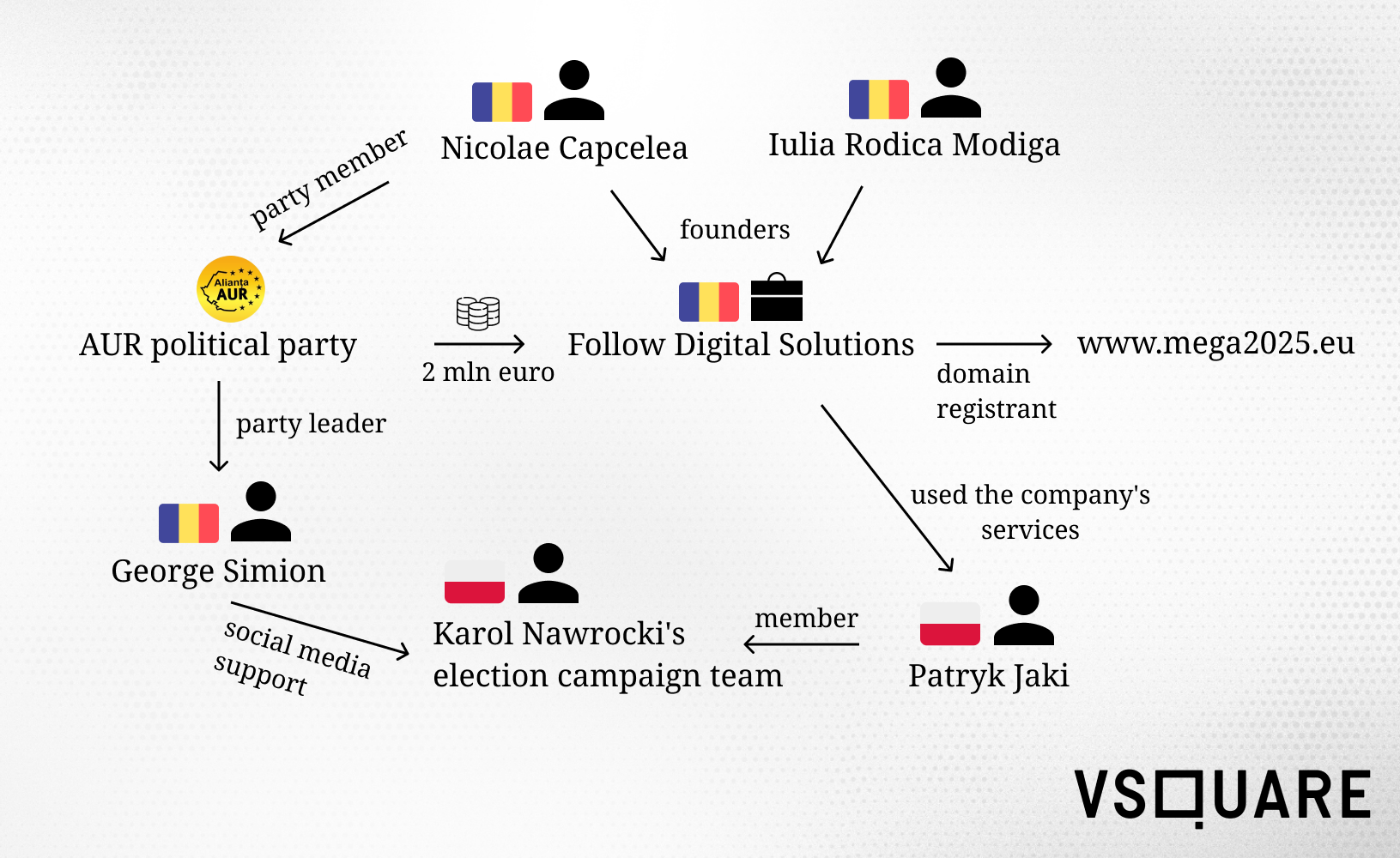
There is not much publicly available information about Nicolae Capcelea. It is known that he is a co-owner of Follow Digital Solutions, a company registered in Bucharest. The Romanian party AUR paid this company over €2 million for online promotion in 2024-2025 over the course of the parliamentary campaign and the two presidential campaigns (one of which was canceled) held in that time in Romania. Capcelea is a Moldovan citizen and a member of AUR (according to snoop.ro). Since at least 2020, he has been seen in photos of Simion’s speeches.
In addition to Capcelea, Iulia Rodica Modiga, former editor-in-chief of Info-Prut and vice president of the Unionist Platform Action 2012, was also a partner in Follow Digital Solutions. Both Rodica and Capcelea publish Facebook posts calling for the unification of Romania and Moldova. The main proponent of unification is Simion. For this reason, the AUR leader has been banned from entering Chișinău for several years.
Outside Moldova, Simion is also persona non grata in Ukraine, which is a result of his anti-Ukrainian activities. According to the Ukrainian SBU statement, “the decision [to ban entry – ed.] was made based on the available information on systematic anti-Ukrainian activities of this politician that are contrary to the national interests of Ukraine and encroach on its state sovereignty and territorial integrity.”
on the basis of information about this politician’s systematic anti-Ukrainian activities, which are contrary to Ukraine’s national interests and violate its state sovereignty and territorial integrity.”
According to former Moldovan Defense Minister Anatol Salaru, Moldovan and Ukrainian services have evidence of Simion’s meetings with people associated with Russian intelligence. Simion himself denies this and has sued Salaru for defamation (though he has lost in two instances so far). In an interview with Context.ro, Salaru claims that the Moldovan services provided him with information about Simion’s meeting in 2011 with an FSB resident in Chernihiv.
Nicolae Capcelea and his company Follow Digital Solutions do not only work for AUR and Simion. Since 2023, they have also been providing services to Patryk Jaki, a PiS (formerly Suwerenna Polska) MEP and co-chair of the ECR group in the European Parliament.
Capcelea’s company is listed as one of the service providers on Jaki’s website. EU regulations allow MEPs to spend a maximum of €6,154 per month on such services.
What exact services does the company working for Simion and Jaki provide? Its website states that it help “establish politicians and ambitious new-comers in building their audience of likely-voters, and keeping their electorate engaged by building long-lasting, emotionally-driven personal connections.” The company boasts measurable successes: “In the past year we generated politically-savvy audiences of over 5 million people and over 1,5 million new votes at the ballot.”
Patryk Jaki is one of the most popular Polish politicians on the internet. On Facebook alone, he has over 830,000 followers. “Patryk has an army of followers on Facebook, largely thanks to Simion’s people,” a PiS politician who wants to stay anonymous says.
Jaki confirms the fact that FDS manages his social media. “The company is responsible for analysis and consulting in the field of communication, especially in modern media, regarding my activity as an MEP. … It is one of the best in the EU in the industry,” he says in response to our email.
Among the listed administrators of Jaki’s Facebook account, several accounts come from Romania. Romanian administrators can also be seen on the official Facebook accounts of Suwerenna Polska (Sovereign Poland), ECR party leader Mateusz Morawiecki, and Karol Nawrocki. Neither SP, the President’s Office, nor the former prime minister responded to our questions about the Romanians managing their social media accounts. Meanwhile, the President’s Office also assured that it “did not hire any external entities to manage its social media accounts.”
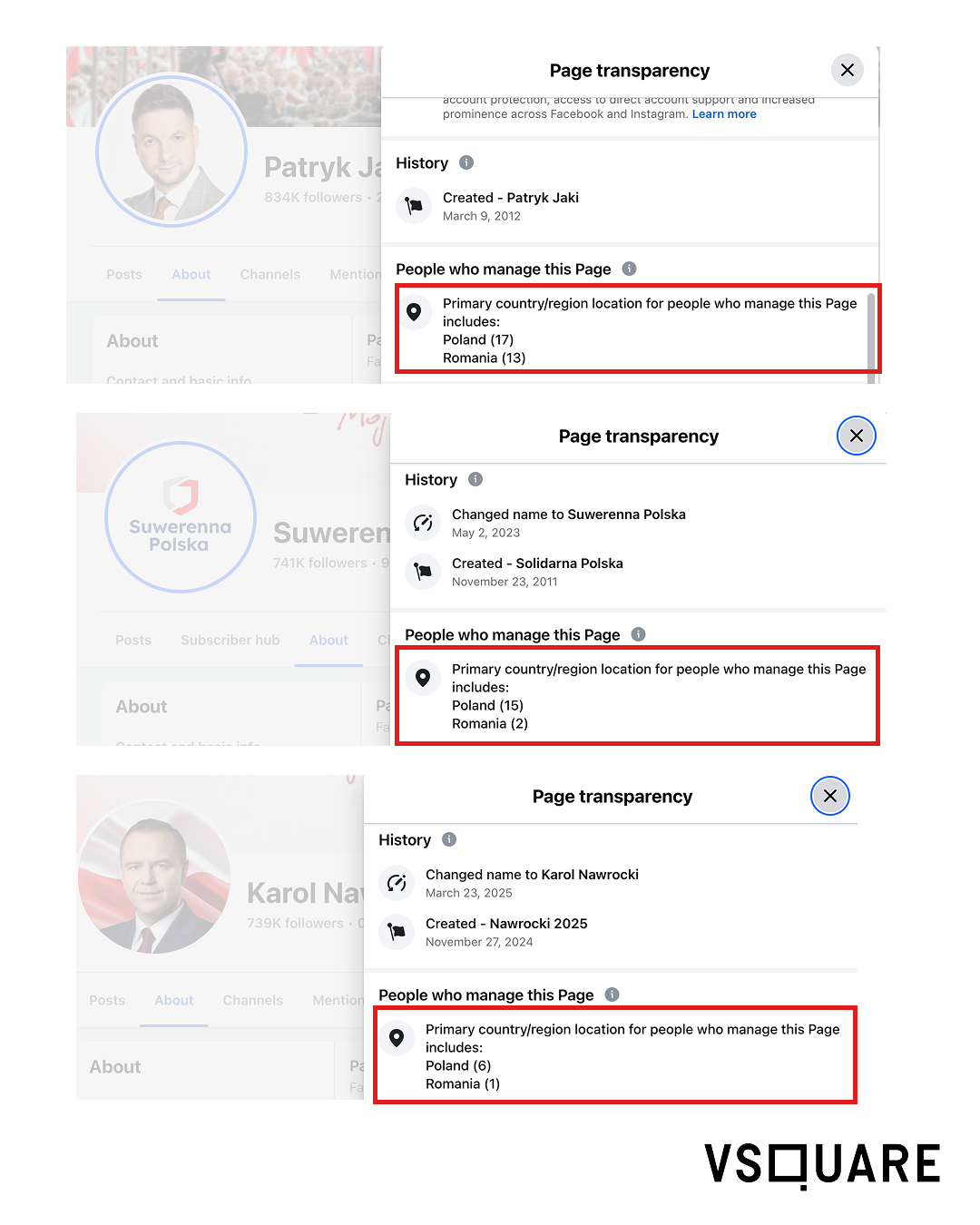
Romanians? I Don’t Know Them
On Nawrocki’s team, led by Paweł Szefernaker, Adam Andruszkiewicz was the man responsible for the campaign’s online component. According to our sources, MEP Jaki was also involved in the social media team.
One of the PiS politicians familiar with the behind-the-scenes happenings of the campaign said: “Simion gave Nawrocki people from social media. Those were the same people who have been working on Jaki’s social media. Nicu, he knew Facebook very well.”
But Jaki denies this version of events: “My cooperation with Follow Digital Solutions in the European Parliament has nothing to do with the presidential campaign,” he responds via email. However, he admits that AUR politicians “are great at modern communication, so of course the whole group in the EP is in constant dialogue with them and benefits from their knowledge and experience in this area.”
Nicolaeu Capcelea from FDS did not respond to our questions about whether he was involved in Nawrocki’s campaign. When Context.ro journalists visited his office near Bucharest, they found only a consulting company there, which provided Capcelea’s contact details (the same ones we sent our questions to).
According to our sources, Romanian specialists appeared in Nawrocki’s campaign a few months before the first round of elections. “They had tools for Facebook, including an automated system: when someone reacted to a post, it was possible to write to them directly and interact with them. They helped set this up,” says a PiS politician familiar with the workings of the campaign.
One of the tools used by Simion’s specialists is Manychat, a special “plugin” used in marketing to expand the audience base and interact with new users.
The company’s website states: “Manychat built Follow to DM … an automation that sends a direct message the instant someone follows you: no manual greetings, no awkward copy-paste jobs, no missed moments. You and your future devotees get an instant conversation starter that triggers at the perfect time — right when curiosity is fresh. This is a front-door moment for your brand. It’s a way to say, “Hey, I see you, and you matter to me.” And if you use it right, it’s how followers turn into fans — and fans into paying customers.”
In his speech at the MEGA movement event in Warsaw, Simion emphasizes that his people helped Nawrocki’s campaign as part of a fraternal cooperation “without expecting anything in return.” And indeed, there is no trace of cooperation between Nawrocki’s committee and Nicu Capcelea’i’s company or other Romanian companies in the Polish State Election Commission.
Tomasz Bartczak, financial representative of Nawrocki’s committee, in response to questions from FRONTSTORY, offers assurances that the committee “did not commission any services from entities based in Romania.”
Campaign Assistance: Illegal?
However, if Simion and his colleagues helped Nawrocki’s campaign team for free, they might have done it illegally. The Polish Electoral Code prohibits “accepting non-monetary benefits“ by election committees with a few exceptions. These exceptions include distributing leaflets, assisting with office work, and lending a car. Online campaigns are not included in this list. In addition, support from foreigners is illegal. Violating this prohibition might be punishable by a fine — both for the person receiving the support and the person providing it.
In the National Electoral Commission, we only find several invoices for the operation of the Manychat platform for a total of PLN 11,100 (approx 2,5K euro). These were handled by Grzegorz Izbicki, a PiS councilor from Suwałki associated with Adam Andruszkiewicz from the President’s Office.
We asked Izbicki whether he had collaborated with Romanian citizens while managing Manychat. He denied it .
We also found invoices issued by Krzysztof Pacuk, a PiS councilor from Suwałki and a colleague of Izbicki’s. He received almost PLN 1.4 million from Nawrocki’s committee for “online advertising” and “developing graphic materials.” He assures us that he never used Manychat and did not cooperate with any Romanians.
Krzysztof Izdebski, a legal and policy expert at the Batory Foundation, says of Simion’s fraternal assistance, “We are probably dealing here with the acceptance of a non-monetary benefit that is not clearly reflected in the Polish committee’s financial documents. In my opinion, this requires a broad and thorough investigation by the prosecutor’s office. If Nawrocki’s campaign team defends itself by saying that the service was performed by a Polish company, the police could check whether it actually performed the service, whether it did so on its own, and if it had subcontractors, investigate whether their prices were underestimated.”
We asked the President’s Office what the online assistance Simion referred to consisted of and whether it was paid for. Did it include services of Follow Digital Solutions to Nawrocki’s campaign team?
The Presidential Office replied that the questions were “beyond its competence.” We also asked members of the campaign team and representatives of Nawrocki’s committee, as well as Simion and Capceala.
We did not receive a response.
Simon’s Friend Czarnecki
No one has strengthened cooperation between AUR and the Polish right-wing on the MEGA movement as much as former PiS MEP Ryszard Czarnecki (who faces charges for, among other things, fraud against the European Parliament). Czarnecki was one of the first politicians to support Simion in Romania. “He was already backing Simion during the previous term of the European Parliament, he was then involved in his campaign, he visited Bucharest often, and he stood behind Simion on election night in 2024,” one PiS politician recalls.
“I think I was the only one who accepted the AUR delegation, which came to Brussels as a small opposition party. They joined the ECR and participated in Independence Marches in Poland,” Czarnecki himself recalls.
During the presidential campaign in Romania, Czarnecki established a cross-party committee in Poland to support Simion and was pleased that it included not only PiS politicians, including Patryk Jaki, Dominik Tarczyński, Antoni Macierewicz, and Janusz Kowalski, but also members of the far-right National Movement, such as its former leader Robert Winnicki.
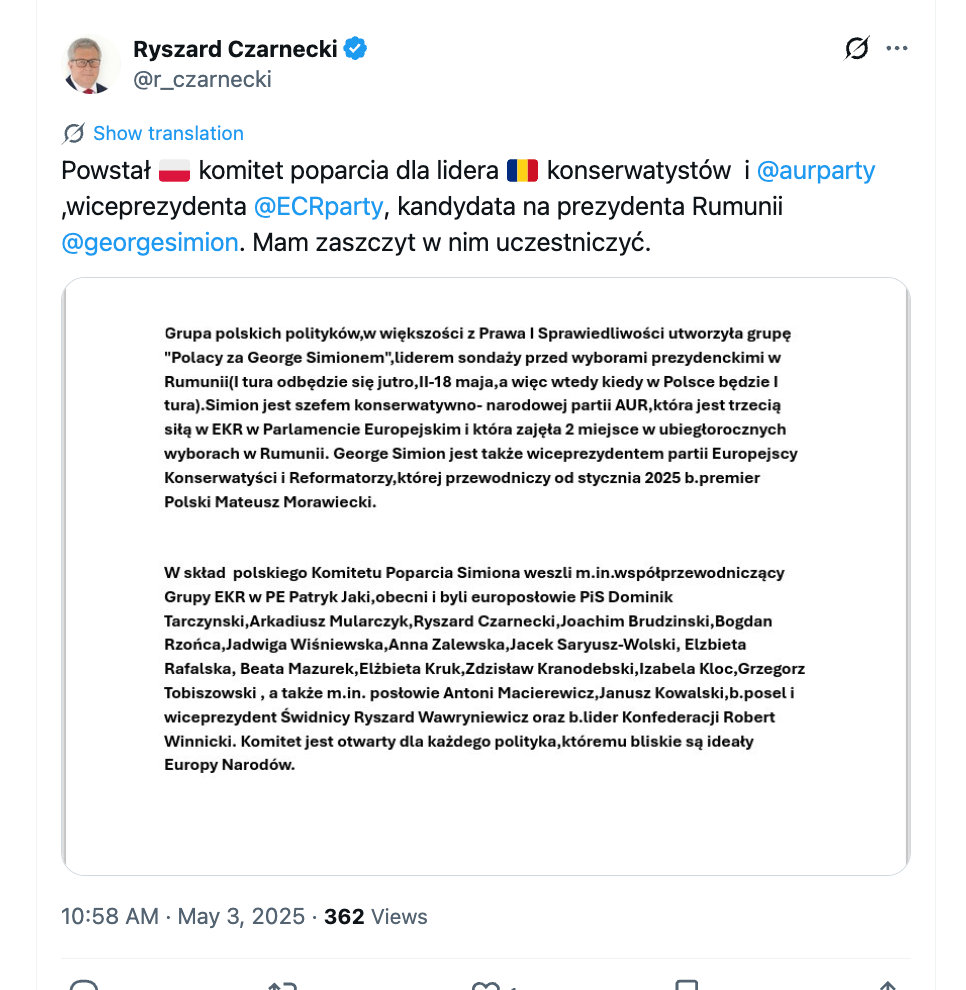
Source: X
When asked about Simion’s internet specialists, Czarnecki stiffens. He has no memory for faces. He does not recognize Nicu from Follow Digital Solutions.
MEGA on Tour
MEGA politicians’ international activity has been expanding for at least a year. These figures have been touring Europe with an international right-wing MEGA conference, supporting local far-right and extreme politicians and anti-EU narratives online. The same individuals, companies, and methods are behind the European Trumpists — from Warsaw to Brussels, Bucharest, Chisinau, Dubrovnik, and Thessaloniki.
One of these figures is Nicolae Capcelea, Simion’s Facebook specialist.
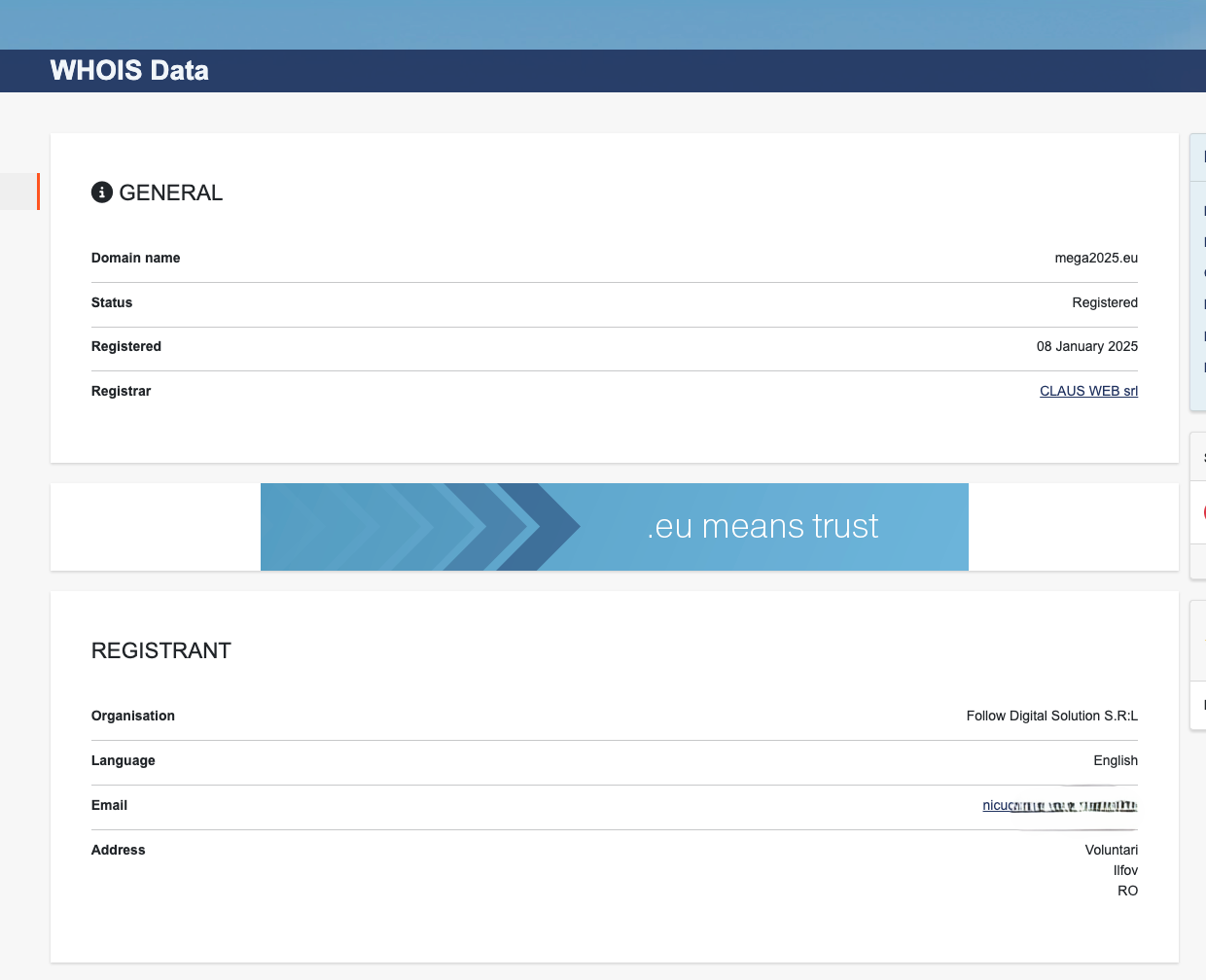
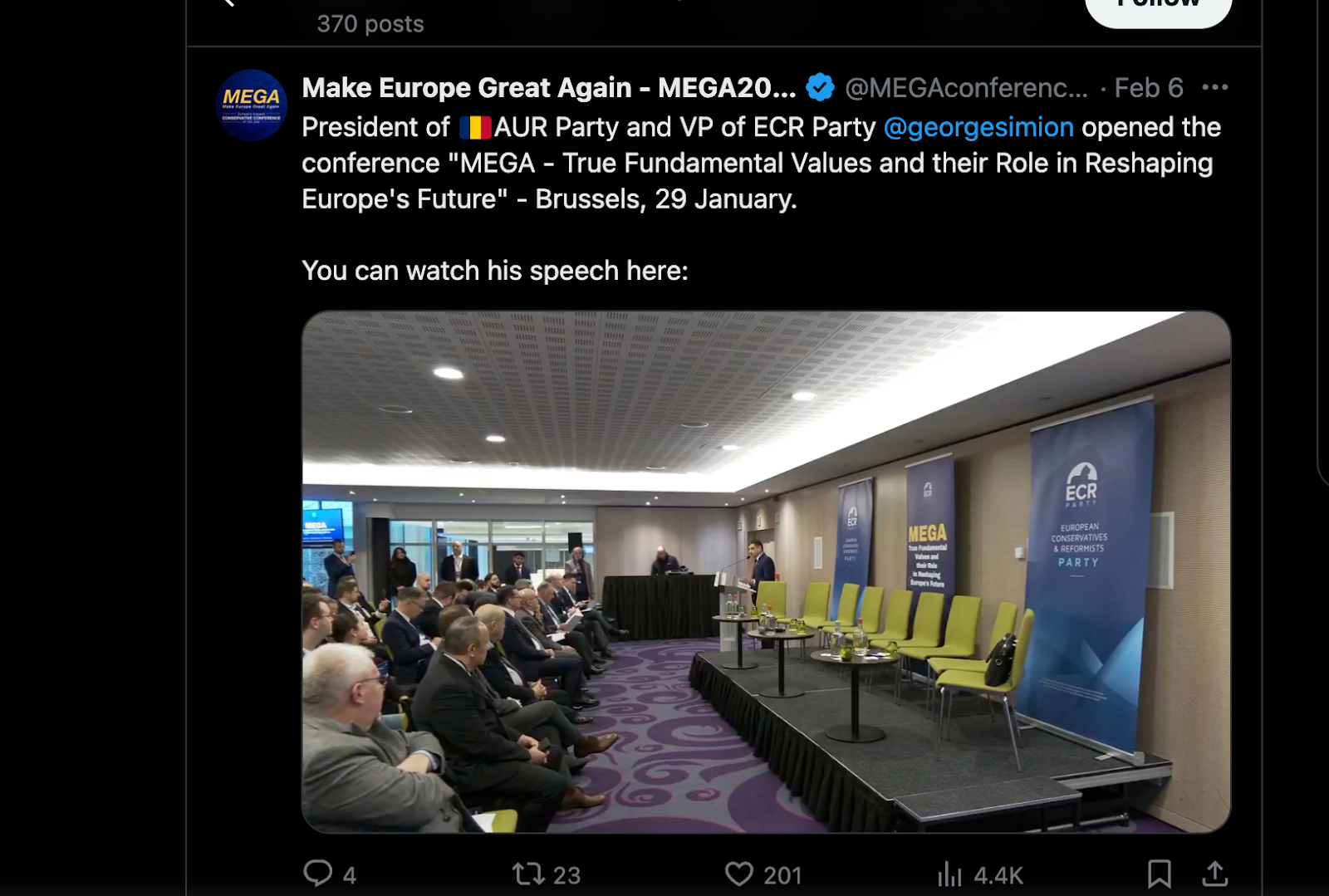
In January 2025, the domain mega2025.eu was created. Initially, it was registered by Modern Art Design, a company from Romania. Its owner admits in an interview with Context.ro that he registered the domain for AUR. At the moment, the Eurid registry lists Follow Digital Solutions and Nicu Capcelea’s email address as the registrant.
The website appeared a few weeks before the MEGA conference in Brussels, organized by ECR, the European Conservatives and Reformists Party. “The victory of MAGA’s is an example for us in Europe. We should start thinking and deciding what we should to this year, when the Trumpist wave is hitting Europe,” Simion says at the time.
Source: X
These decisions appear to be made quickly, as the movement’s leaders go on to meet several more times. It is not known who organized or financed the other five conferences — this information cannot be found on the movement’s website. No one responded to the questions we sent to the addresses provided on the MEGA2025 website and Facebook page.
At the end of July, MEGA organizes its event in Moldova during parliamentary elections, with independence from Russia’s sphere of influence at stake.
Pro-Russian politicians appeared, including Victoria Furtună, whose party was banned from the elections for its ties to Russia.
Was AUR also behind the conference in Moldova? Politicians of the Romanian party make contradictory statements on this matter. However, in the photos from the event that we found, at least one AUR politician is wearing a conference organizer badge.
Another leader of the MEGA movement, American Brian S. Brown, is crystal clear when he thanks Simion on X for organizing the rally in Chișinău. He travels to the event in Moldova capital, but is initially banned from entering the country for the MEGA conference. According to the Moldovan secret services, it was the event “with obscure organizers, without transparency of financing and with dubious connections to the Shor criminal group (editor’s note: Ian Shor is a pro-Russian Moldovan oligarch). Based on the information, some participants and organizers aim to promote an extremist agenda, to undermine the territorial integrity and democracy of the Republic of Moldova.” The Moldovan secret services didn’t agree for an interview and to reply to our questions about the event, saying that any information is classified.
It is not clear what was the reasoning behind the temporary ban for Brown. According to Brown himself, he ultimately manages to appear at the conference after an intervention by the US embassy.
Brown is the leader of the American organization International Organization for the Family (IOF) and an acquaintance of Alexei Komov (representative of the World Congress of Families, which brings together ultra-conservative organizations and is organized by the IOF). Komov is currently on the US sanctions list.
Brown has long been considered one of the key figures in international far-right cooperation. In addition to heading the IOF, he oversees the radical right-wing movement CitizenGO (together with Komov).
We sent a list of detailed questions to Brian S. Brown to which he replied: You guys crack me up! Could you be any more biased?
Straight from the Chisinau MEGA conference, Brown flies to Warsaw to celebrate Nawrocki’s victory along with Simion. “We were originally denied entry into Moldova, but we were welcome into Poland for the presidential inauguration” he rejoices.
We asked the Polish authorities and the Ministry of Foreign Affairs if they had any reservations about Brown’s visit. We received an enigmatic response from the Internal Security Agency (ABW): “The Agency conducts ongoing reconnaissance of events and individuals that may pose a potential threat to the security of the Republic of Poland. Current regulations do not allow media representatives to be provided with information about the Agency’s interests or tasks.”
The President’s Office assures us that “no one named Brian S. Brown” was invited to the swearing-in ceremony.
How MEGA is Growing Online
MEGA replicates the narratives of the American MAGA, and American far-right influencers support European expansion with their online reach.
Context.ro has analyzed how MEGA has been growing online. This year alone, posts with the hashtags #MakeEuropeGreatAgain and #MEGA2025 generated approximately 120.7 million views and reactions. In addition to the MEGA conference, the slogan “Make Europe Great Again” was also heavily promoted by a rally organized by the Spanish party VOX, the creation of the Patriots for Europe group in the European Parliament by Viktor Orbán and Marine Le Pen, and a far-right march in London in September.
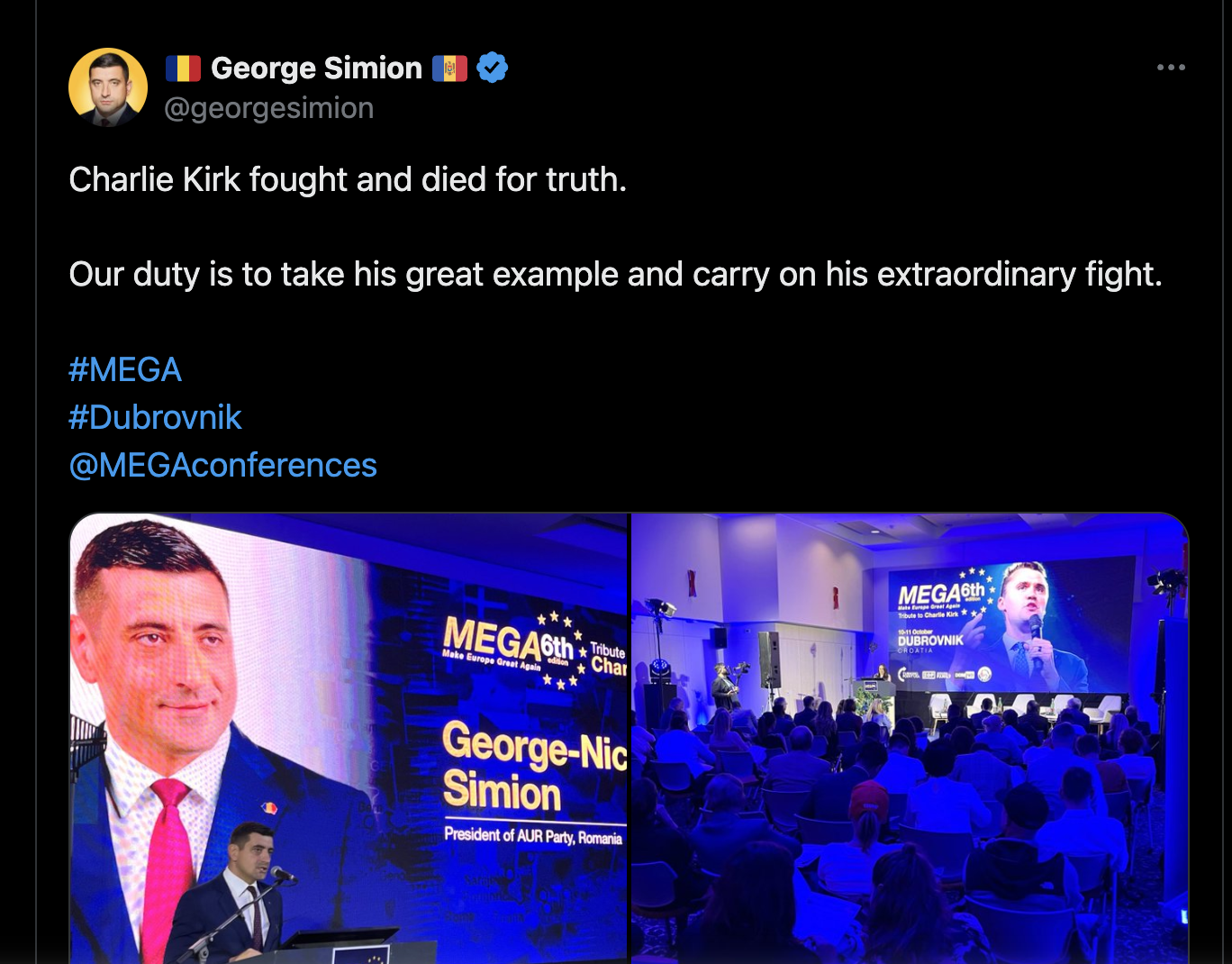
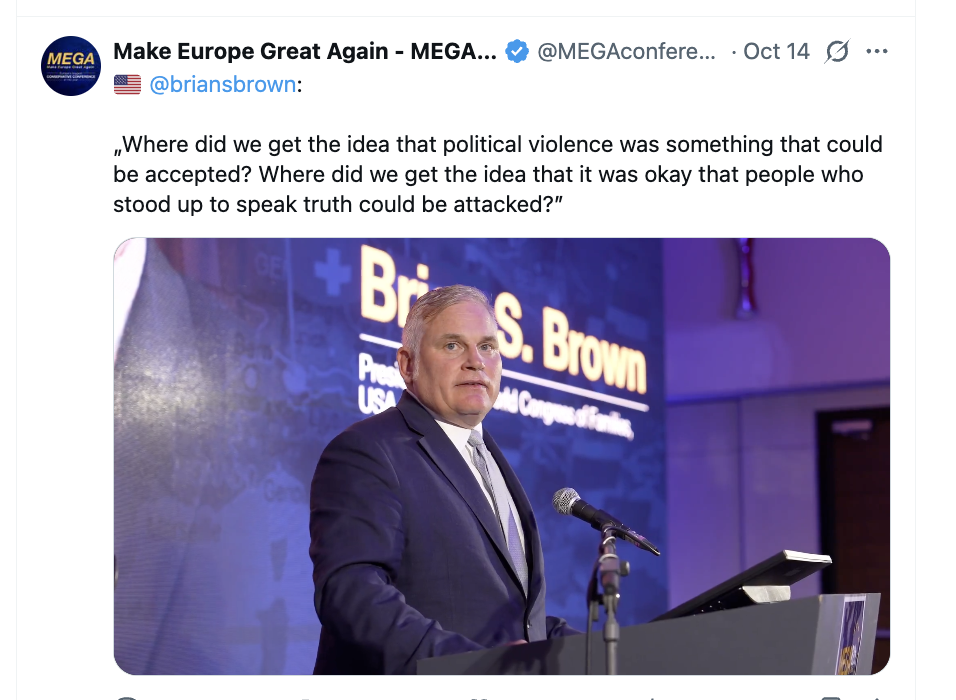
On TikTok, we found several accounts promoting the hashtag #MakeEuropeGreatAgain, which have published over 400 clips. One of the most important topics on the MEGA network was the murder of American right-wing activist Charlie Kirk.
The last MEGA rally in early October in Dubrovnik was a tribute to Kirk. Simion, Brown, and Czarnecki were all there, lauding Kirk’s legacy.
-

- Source: X
-
- Source: X
-
- Source: X
“Trumpists (…) are using three main techniques: an open willingness to interfere in European elections; a deliberate framing of EU-US relations as a values divide; and a new emphasis on free speech as a rallying point for Europe’s new right” – summarizes Paweł Zerka, a Senior Policy Fellow at the European Council of Foreign Relations, in a recently published report. As he emphasizes, “Trumpists accuse liberals in the US and Europe of silencing dissent, aided by “deep state” institutions—the media, the bureaucracy, the judiciary—that have allegedly turned against ordinary citizens; they also denounce any laws to counter hate speech and harmful content as censorship.”
New Force, Old Brothers
Simion aims to bring together not only conservatives from the ECR, but also two other groups in the European Parliament: Patriots for Europe and Europe of Sovereign Nations, which he calls “natural allies.”
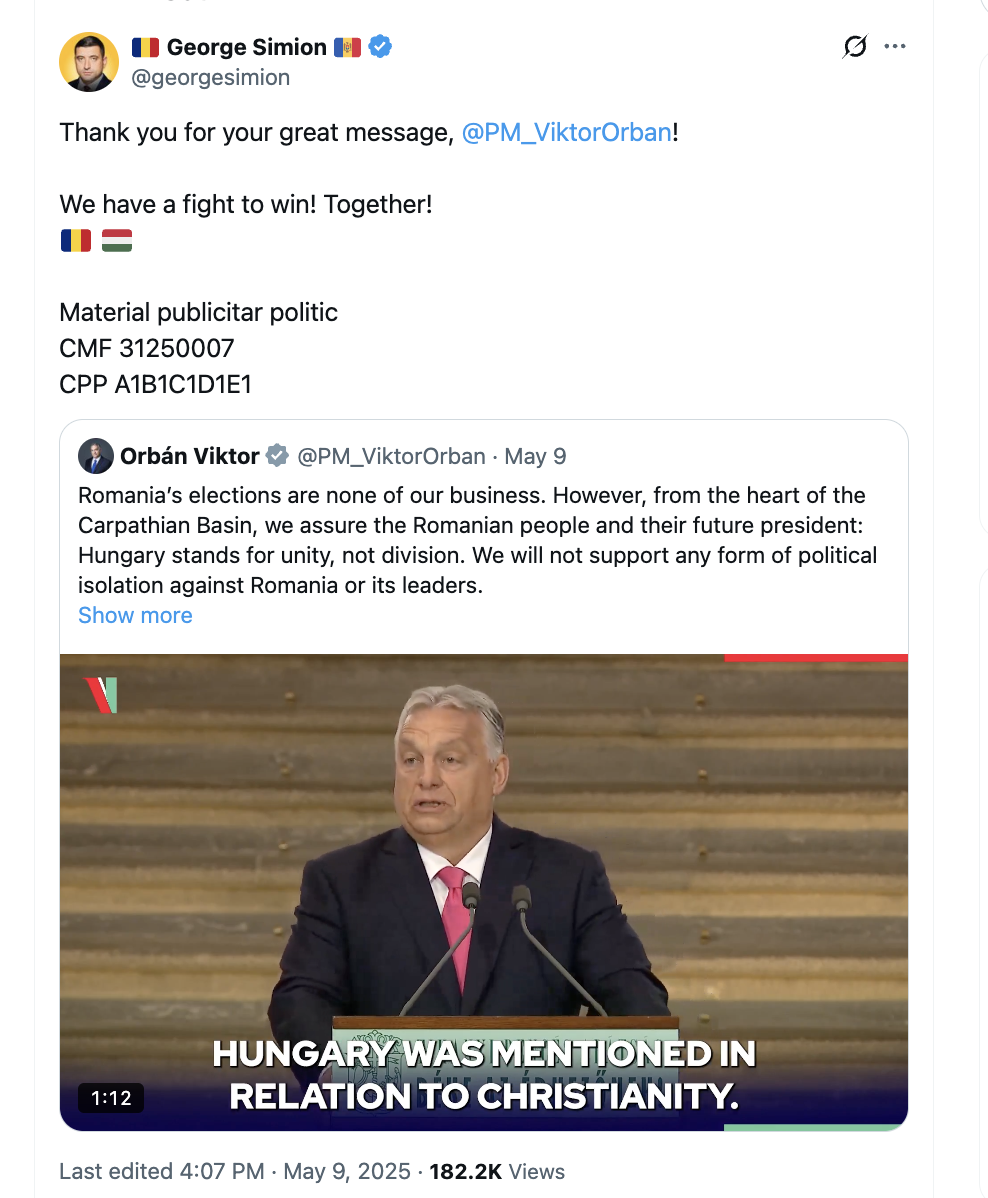
Particularly interesting are his relations with Hungarian Prime Minister Viktor Orbán, who has long seen himself as the leader of the Eurosceptic right (and was already promoting the MEGA slogan during the Hungarian presidency in 2024). After the Fidesz party was not accepted into the ECR, Orbán initiated the Patriots for Europe group. At that time, he sharply criticized the AUR as an “anti-Hungarian party.”
Unexpectedly, however, Orbán supported Simion in the final stages of his presidential campaign, when the AUR leader was fighting for the votes of the Hungarian minority. Orbán emphasized at the time that both politicians shared a “pro-Christian and anti-globalist” agenda. Simion’s campaign team even promoted Orbán’s speech with paid online ads targeting the Hungarian minority, as revealed by our Hungarian partner Átlátszó. According to Válasz Online, Orbán supported Simion partly as a result of “pressure from the US, among others.”
Source: X
Will Simion reciprocate the support and help his “conservative brother” in Budapest? According to recent polls, Orbán may lose power in April. There is no hope for help from Warsaw after the Hungarian leader’s recent meeting with Putin – Karol Nawrocki canceled his planned meeting with Orbán.
But as Orbán’s star seems to be fading, Simion is just getting started.
Alicja Pawłowska, Anastasiia Morozova, Tamara Kanuchova, Oana Manitiu , Andra-Lucia Martinescu and Marius Dima contributed to research.
This is the first story of the #MEGAverse project.
More to be published – follow us.
If you have some insights to share, let us know.

The Polish version of this investigation was published on FRONTSTORY.PL and the Romanian version on Context.ro.
Subscribe to Goulash, our original VSquare newsletter that delivers the best investigative journalism from Central Europe straight to your inbox!

A Warsaw-based investigative and data journalist at VSquare and Frontstory.pl, Anastasiia Morozova previously collaborated with leading media outlets in Ukraine (Radio Free Europe, Slidstvo.info). She was shortlisted for the Grand Press Award (2022) and was a recipient of the Novinarska Cena 2022.

Anna Gielewska is co-founder and editor-in-chief of VSquare and co-founder of Polish investigative outlet FRONTSTORY.PL. She is also vice-chairwoman of Fundacja Reporterów (Reporters Foundation). A journalist specializing in investigating organized disinformation and propaganda, Gielewska was the John S. Knight Fellow at Stanford University (2019/20) and has been shortlisted for the Grand Press Award (2015, 2021, 2022) and the Daphne Caruana Galizia Award (2021, 2023). She was the recipient of the Novinarska Cena in 2022.